


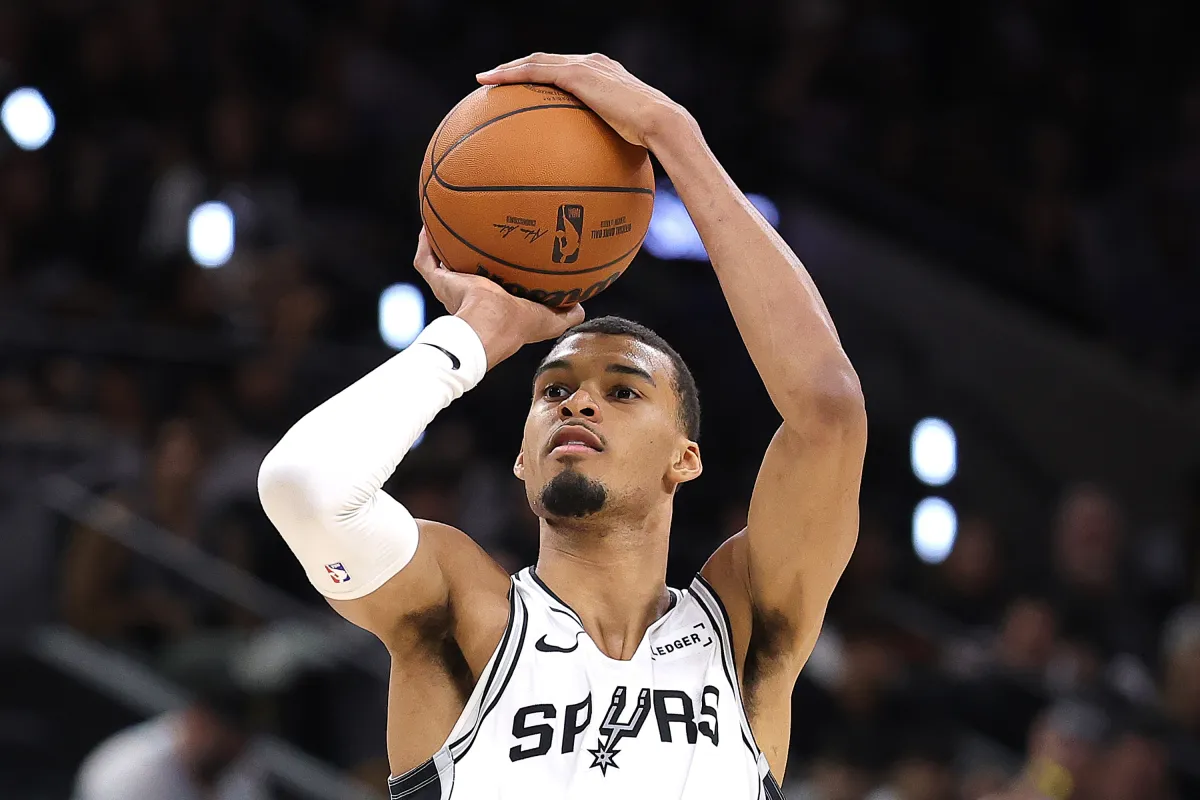
The pursuit of greatness in the National Basketball Association is rarely a quiet endeavor, but for San San Antonio Spurs sensation Victor Wembanyama, it has quickly morphed into a roaring, highly publicized crusade of self-actualization. When the league announced Oklahoma City Thunder guard Shai Gilgeous-Alexander as the regular season’s Most Valuable Player, the decision did more than just crown a new king of the league; it ignited a quiet, simmering fury inside the seven-foot-four French prodigy. Wembanyama, who has carried the impossible weight of being labeled a generational savior since before he even set foot on American soil, saw the MVP honors as a direct challenge, an unspoken reminder that despite his breathtaking rookie campaign, there were still heights left to conquer. He did not vocalize this frustration through media soundbites or passive-aggressive social media posts; instead, he chose to translate his competitive angst into a devastating physical showcase on the hardwood. In Game 1 of their highly anticipated playoff series, Wembanyama took the court with an almost palpable intensity, dismantling the Thunder’s defensive schemes with a spectacular, career-defining 41-point masterpiece that served as a loud warning shot to the rest of the league. It was a performance fueled by pure, unadulterated pride—a statement game designed to prove that while others might hold the silverware today, the future of basketball belonged to him. The basketball world watched in awe as this towering teenager, with the wingspan of a mythical creature and the coordination of an elite veteran guard, systematically broke down one of the best defensive teams in the Western Conference. Yet, as the young star would soon learn, the NBA playoffs are a cruel, unforgiving crucible where early success is quickly dissected, studied, and weaponized against you by elite coaching staffs, testing not just your physical limits, but your mental fortitude as a professional athlete.
Almost immediately, the narrative shifted from awe-inspiring dominance to a grueling lesson in postseason attrition as the series progressed into Games 2 and 3. The Thunder, spearheaded by their brilliant coaching staff and the defensive tenacity of their perimeter defenders, refused to let Wembanyama dictate the terms of engagement any longer. They crowded his landing spaces, sent physical double-teams before he could even dribble, and forced him into uncomfortable, contested looks far away from the basket, resulting in two frustrating losses for the young Frenchman and the Spurs. For a player who had spent the majority of his life making the game of basketball look effortlessly simple, these games represented a jarring, highly physical wake-up call. The sophomore slump or rookie wall that many expected him to hit during the regular season had finally manifested in the suffocating environment of the playoffs, where every single possession is analyzed under a microscope and every weakness is ruthlessly exploited. Offensively, Wembanyama looked human for perhaps the first time all year, struggling to establish deep post position and settling for difficult, off-balance jumpers that missed their mark. The frustration was visible in the slump of his shoulders and the exasperated looks directed toward the referee crew, raising questions about whether the young star was truly ready to carry the historic weight of the franchise on his slender frame. Critics who had spent months praising his astronomical ceiling suddenly began to question his durability and his mental fortitude under extreme pressure, wondering if the physical toll of his first full NBA season had finally caught up to him at the worst possible moment. This period of adversity was essential, however, as it forced Victor to confront the limitations of raw talent alone in a high-stakes playoff series.
Faced with the prospect of falling into a devastating 3-1 series deficit, Wembanyama stepped onto the court for Game 4 with a completely recalibrated mindset, shedding any lingering hesitation in favor of a raw, aggressive determination to dominate. “I feel like with who we are, we need to start games like this,” he would later reflect, his voice carrying the quiet confidence of a leader who had successfully weathered his first true professional storm. From the opening tip-off, it was clear that Wembanyama was no longer letting the Thunder dictate his rhythm; instead, he was hunting his own shots with an urgent, unapologetic focus, revealing afterward that his primary objective was simply to “shoot to score” without messing around. This clinical efficiency culminated in a breathtaking, game-high 33-point performance that breathed new life into the Spurs’ playoff hopes and thoroughly reestablished his dominance on both ends of the floor. The absolute highlight of this offensive masterclass came in the dying seconds of the first half, when Wembanyama launched an audacious, towering 40-foot buzzer-beater that seemed to hang in the air for an eternity before splashing perfectly through the net. This spectacular shot was not just a momentum-crushing blow for Oklahoma City; it also set a modern franchise record as the longest field goal made by a San Antonio Spurs player in postseason history since GeniusIQ began tracking such metrics in 2014. That single play, a combination of impossible height, distance, and casual grace, served as a vivid metaphor for his entire career so far—transcending the traditional limits of what a basketball player of his size should be able to achieve.
By securing victory in Game 4 and evening the series at two games apiece, Wembanyama did not just save his team’s season; he also etched his name into the very fabric of NBA history by shattering records that had stood for decades. With his 33-point display, he elevated his total points in his first-ever career postseason to an astounding 324, officially surpassing the previous San Antonio franchise record of 307 points set by the fiery Stephen Jackson during the Spurs’ memorable 2003 championship run. It is a testament to Wembanyama’s unique skill set that he was able to eclipse a scoring record held by a key veteran of a championship team, doing so in his debut playoff run while acting as the primary focus of every opposing defensive game plan. Furthermore, his sensational overall play allowed him to join the legendary Bill Walton as the only players in NBA history to amass at least 300 points, 150 rebounds, and 50 blocks in their debut postseason since 1974, when blocks were first officially recorded. To be mentioned in the same breath as Walton—one of the game’s greatest passing big men and a towering figure of 1970s basketball—illustrates the sheer versatility of Wembanyama’s nightly contributions to his team. He is not merely a scorer, nor is he simply a defensive anchor; he is a complete, multi-dimensional basketball force who impacts the game in every single statistical category, altering the geometry of the court on both ends of the floor. These historic milestones are a sobering reminder to the rest of the basketball world that we are witnessing the developmental phase of a player whose final, polished form could completely redefine the parameters of individual greatness in the sport’s history.
Behind the dizzying array of statistics and historical comparisons lies a deeply human story of a young man adapting to a foreign culture, an incredibly demanding profession, and the relentless scrutiny of global fame. Wembanyama’s transition from a highly touted European prospect to the undisputed focal point of a historic NBA franchise has been managed with an admirable level of maturity and emotional intelligence. Under the watchful, paternal guidance of legendary Spurs head coach Gregg Popovich, Victor has been sheltered from some of the more toxic elements of modern celebrity, allowed instead to focus on building a genuine, lasting connection with his teammates and the city of San Antonio. This team-first ethos was on full display throughout the ups and downs of this intense playoff series, as Wembanyama repeatedly redirected praise from his individual records back to the collective effort of his teammates, emphasizing that personal accolades mean very little without the validation of team victory. His teammates, a young and hungry group of players who have grown alongside him, have rallied around his lead, drawing confidence from his calm demeanor and his willingness to take accountability during their lowest moments. The bond they are forging in these high-stakes playoff battles is laying the foundation for what many believe will be the next great San Antonio dynasty, rooted in the same selflessness and work ethic that defined the Tim Duncan era. Wembanyama’s ability to compartmentalize the immense pressure on his shoulders, while still maintaining a playful curiosity and a genuine love for the game, is perhaps his most impressive attribute, endearing him to fans who see him not just as an unstoppable basketball machine, but as an authentic, thoughtful young athlete navigating his way to superstardom.
Now, as the series pivots back to the deafening confines of Oklahoma City’s Paycom Center for a pivotal Game 5, the stage is set for a truly epic conclusion to this modern-day basketball rivalry. With the series mathematically deadlocked at 2-2, the pressure on both teams has reached a boiling point, and the individual battle between Victor Wembanyama and Shai Gilgeous-Alexander will once again take center stage on Tuesday, May 26, at 8:30 p.m. Eastern Time. For the Thunder, playing on their home floor offers a golden opportunity to regain control of the series and push the young Spurs to the brink of elimination, utilizing their vocal crowd and cohesive team play to disrupt Wembanyama’s newfound offensive rhythm. For the Spurs, it represents the ultimate test of their growth and resilience—a chance to steal a crucial road win in a hostile environment and prove that their Game 4 resurgence was not a temporary flash in the pan but a permanent evolution. Regardless of which team ultimately emerges victorious from this grueling Western Conference clash, this series has already served its purpose as a spectacular showcase for the future of the NBA. We are watching the dawn of a new era, one where the traditional boundaries of player positions and physical limitations are being completely shattered by a new wave of exceptionally skilled, highly versatile superstars who challenge our very understanding of the game. As Victor Wembanyama prepares to step back onto the court in Oklahoma City, the fire that was lit when he watched another man claim the MVP trophy still burns brightly inside him, fueling a relentless pursuit of victory that promises to captivate sports fans for many years to come.