





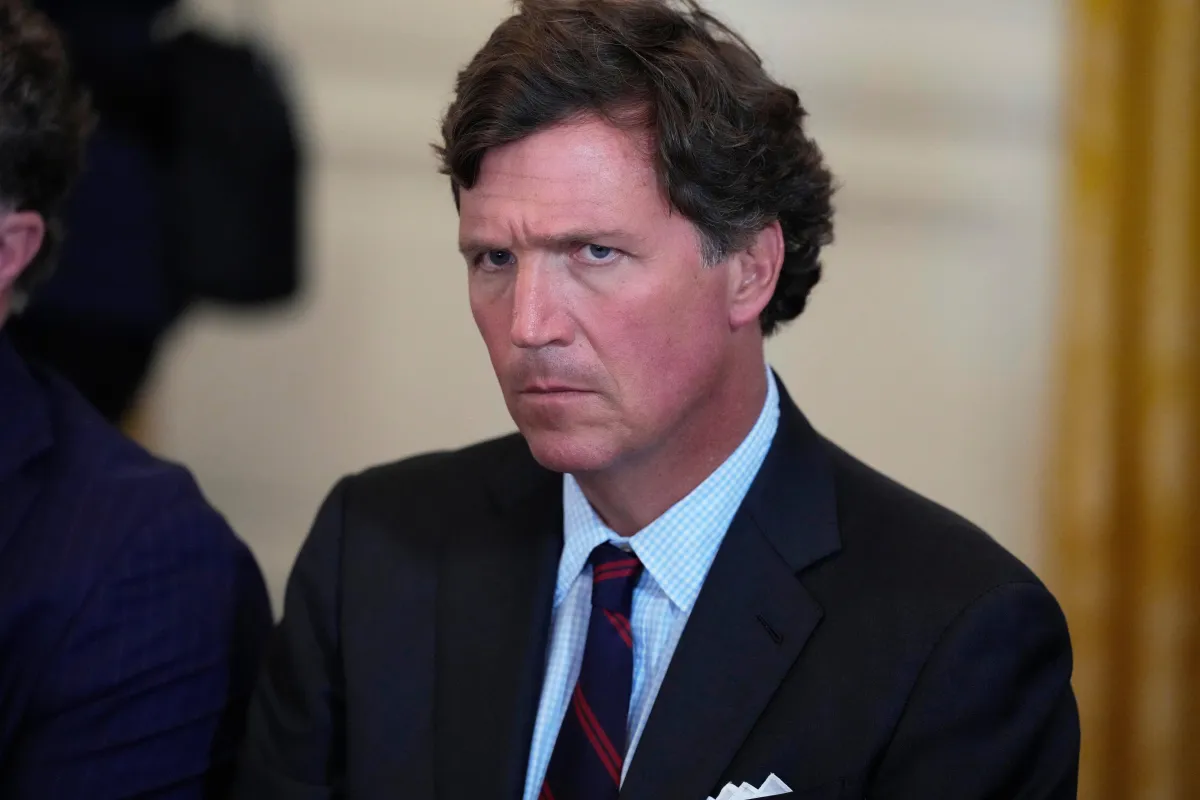
There was a time, not so long ago, when Tucker Carlson and Donald Trump seemed to be on the same team, almost inseparable in their political messaging. Carlson was one of the most influential conservative voices in America, and for years he stood firmly behind Trump, defending him against his critics and amplifying his grievances. But that relationship has unraveled in dramatic fashion, and Carlson has now made one of his most striking declarations yet: he believes the president should be removed from office immediately. The reason, Carlson says, is the possibility that the United States military could initiate the use of nuclear weapons in the ongoing conflict with Iran. Speaking on his podcast, Carlson made it clear that this is not a matter of policy disagreement or political strategy. For him, it is a fundamental moral and leadership failure. He acknowledged that he was strongly opposed to the two impeachment attempts against Trump, calling those efforts absurd, but he argued that the nuclear question is entirely different. In his view, any leader who even suggests the first use of nuclear weapons has crossed a line so serious that it forfeits their right to lead. Carlson’s words carry weight because they come from someone who was once a loyal ally, not from a lifelong opponent. His shift from defender to critic has been gradual, but on this issue, he is drawing a hard line in the sand.
Carlson’s reasoning is rooted in a simple but powerful standard: no leader should be allowed to contemplate an action that could destroy all of humanity. He posed the question directly, asking why there is no attempt to remove Trump from office immediately if he is considering a nuclear strike. For Carlson, the answer is obvious. He said that any leader of any country who suggests the first use of nuclear weapons has already forfeited their right to lead and must be removed right away. He called this a fair standard, and he seemed genuinely frustrated that more people were not treating the situation with the urgency it deserves. It is worth pausing to understand how significant this is. Carlson is not someone who has spent his career advocating for the removal of presidents. He opposed both impeachments, even when many on the left were calling for Trump’s ouster. He has often been skeptical of establishment institutions and has criticized the political system from the right. But the nuclear issue appears to be different for him. He is not talking about policy disagreements or political battles. He is talking about the survival of the human race. In his mind, there is no room for nuance or partisan loyalty when the stakes are that high. He seems to be saying that some lines are so fundamental that they transcend politics entirely, and the first use of nuclear weapons is one of them.
Carlson went further in his podcast remarks, claiming that discussions about the use of tactical nuclear weapons have taken place at the Pentagon. He accused Trump of repeatedly suggesting that nuclear weapons could be used against Iran. This is a serious allegation, and Carlson did not provide specific evidence to back it up, but he pointed to Trump’s own words as proof. In April, Trump warned that a whole civilization would die tonight if Iran failed to meet U.S. demands. Carlson characterized that statement as a nuclear threat, or at least as a threat that could reasonably be interpreted as one. He seemed to be saying that the president’s rhetoric has become so dangerous that it cannot be dismissed as mere bluster. The White House did not immediately respond to requests for comment, and it is unclear whether Carlson has access to information that the public does not. But his claims have added to a growing sense of unease about the direction of U.S. foreign policy. The war with Iran has already been a source of deep concern for many Americans, and the possibility of nuclear escalation takes that concern to an entirely different level. Carlson’s remarks suggest that he believes the president is not just using tough language but is actually considering options that most people would consider unthinkable. Whether or not his claims are accurate, they reflect a broader anxiety about the risks of the current moment.
This is not the first time Carlson has broken with Trump, and it is probably not the last. In June, he announced that he was breaking with the Republican Party altogether, saying that he would no longer support the GOP. He has also said that he plans to help build a third party, which would be a major shift in the American political landscape. Carlson’s split with Trump has been driven in large part by disagreements over foreign policy, especially the war with Iran. He has become increasingly critical of the administration’s approach, and he has warned that the United States is heading down a dangerous path. Earlier this month, he described nuclear war and artificial intelligence as the two biggest threats in all of history, saying that those in positions of authority were frozen in responding to them. That comment now seems even more relevant in light of his latest remarks. Carlson appears to see himself as a voice of warning, someone who is willing to say things that others are afraid to say. Whether you agree with him or not, there is no denying that he is using his platform to raise questions that many people would rather avoid. His call for Trump’s removal is not just about one president or one policy. It is about the broader question of what kind of leadership is acceptable in a world where the stakes are so high.
Trump’s own rhetoric toward Iran has drawn scrutiny as tensions have escalated. The president has repeatedly warned that Iran must not be allowed to obtain a nuclear weapon, and he has used increasingly forceful language when discussing the consequences of Tehran failing to comply with U.S. demands. In April, he warned that a whole civilization would die tonight if Iran did not reach a deal by a deadline he had imposed. Later that month, he explicitly ruled out using a nuclear weapon against Iran, saying that the United States did not need one and that nuclear weapons should not be used by anybody. But questions about the potential use of tactical nuclear weapons against Iran surfaced again in June, when Fox News reported, citing a White House official, that the Trump administration had not taken any options off the table as it considered possible military action against Iran’s underground Fordow nuclear facility. That report came after The Guardian reported that Trump was not considering using a tactical nuclear weapon against the site. The Pentagon declined to comment at the time, leaving the situation unclear. Trump has also drawn attention for his broader comments on nuclear weapons. Last year, he appeared to suggest that the United States could resume nuclear weapons testing for the first time in more than three decades, saying that he had instructed the Pentagon to begin testing on an equal basis with Russia and China. The United States has not detonated a nuclear weapon since 1992, and Trump offered few details about what type of testing he intended. He later said that he wanted to see denuclearization and de-escalation, but the mixed signals have left many observers confused and concerned.
In the end, Carlson’s remarks are a reminder of how fragile the norms of leadership can be. He was once one of Trump’s most powerful defenders, and his decision to call for the president’s removal is not something that should be taken lightly. It reflects a deep concern about the direction of the country and the world, and it raises questions that go beyond any single political figure. What does it mean when a prominent conservative voice says that a president has crossed a red line? What does it mean when the possibility of nuclear war becomes a topic of public debate? These are not easy questions to answer, but they are questions that demand attention. Carlson’s standard is clear: any leader who suggests the first use of nuclear weapons has forfeited their right to lead. Whether or not Trump has actually done that is a matter of interpretation, but the fact that Carlson believes it is enough to say something is significant. It shows that the issue of nuclear weapons is not just a partisan talking point. It is a matter of life and death, and it deserves to be treated with the seriousness it deserves. Carlson may be a controversial figure, and his motives may be questioned, but his words on this issue are a reminder that some things are bigger than politics. The future of humanity is at stake, and that is something that should concern everyone, regardless of where they stand on the political spectrum.