





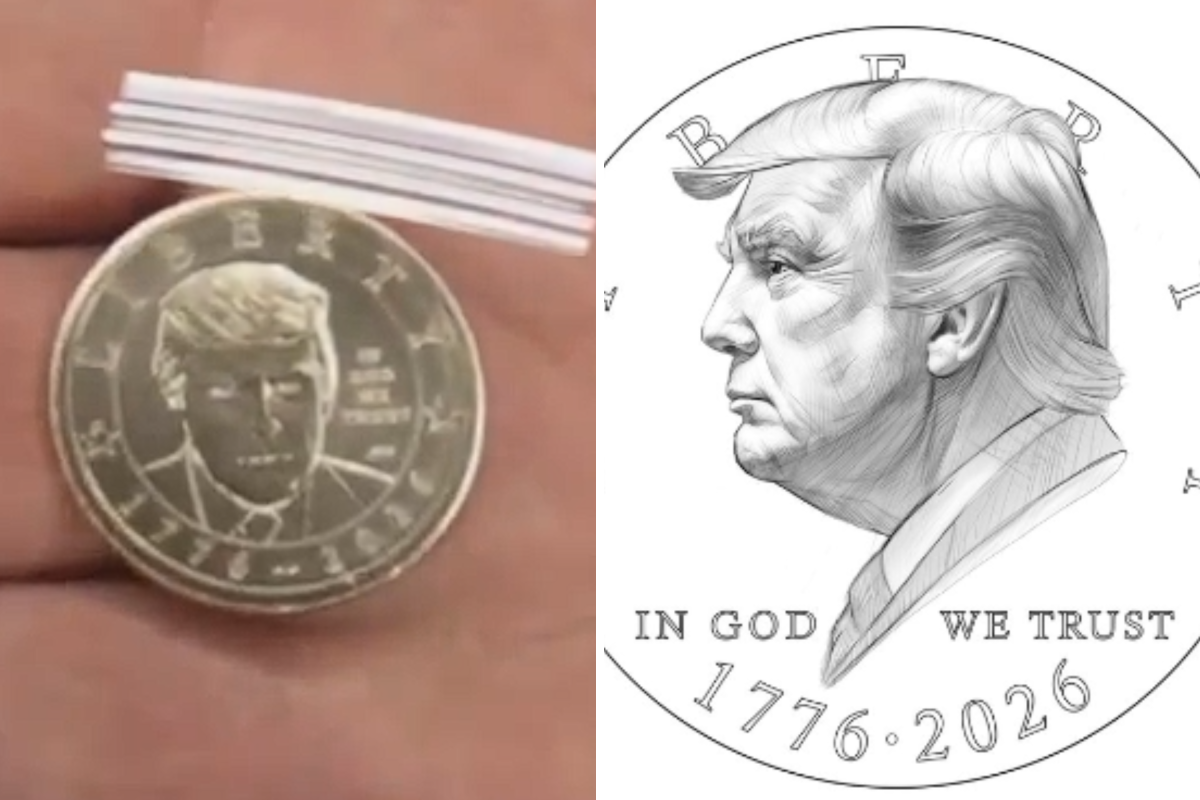
The United States is gear-shifting toward its monumental 250th anniversary in 2026, and the upcoming celebrations are already stirring up plenty of national conversation. In a recent television appearance that quickly caught the attention of both collectors and political watchdogs, Treasury Secretary Scott Bessent joined Fox News host Jesse Watters to offer the public its very first look at a brand-new, commemorative $1 coin designed to honor the nation’s semiquincentennial. At the very center of this highly anticipated coin is none other than the face of President Donald J. Trump. The freshly unveiled artwork presents a striking, front-facing portrait of the president, a noticeable departure from earlier drafts that had circulated online. Surrounding his likeness are deep-seated symbols of American heritage: the word “Liberty” spans proudly across the top, the timeless national motto “In God We Trust” is inscribed adjacent to his face, and the dual years “1776–2026” are anchored at the bottom to mark two and a half centuries of American independence.
This revealing television segment represents a major milestone in a design journey that has evolved significantly behind the scenes. When U.S. Treasurer Brandon Beach first confirmed the project on social media back in late 2025, early conceptual sketches showed President Trump in side profile. Other creative, highly dramatic concepts had even floated the idea of using the globally recognized image of Trump raising his fist in defiance following the July 2024 assassination attempt in Butler, Pennsylvania. Ultimately, the Treasury steered toward a more traditional, frontal portrait for the primary dollar coin. According to Beach, who has passionately championed the project, there is no face more fitting to represent the current state of the nation’s journey than the serving president. The design received its official blessing from the Commission of Fine Arts, an advisory body composed of members appointed during Trump’s presidency, paving the way for the U.S. Mint to move forward with production.
Yet, as with almost any initiative involving the 45th and 47th president, the coin’s creation has been enveloped in a storm of political debate and legal drama. Almost immediately after the currency plans became public, they faced fierce pushback from Democratic lawmakers, watchdogs, and traditional coin collectors. The heart of the controversy lies in a long-standing federal statute: 31 U.S.C. § 5114. This law explicitly dictates that United States currency and coinage cannot feature the image of any living person, nor can they depict a deceased former president within the first two years of their passing. To critics, placing a sitting, highly active political figure on spendable U.S. coins felt like a glaring violation of both established legal boundaries and historical norms designed to keep public currency entirely free from modern partisan politics.
This simmering public frustration quickly boiled over into a formal courtroom battle when James Rickher, a retired lawyer from Portland, Oregon, filed a federal lawsuit to halt the coin’s production. Rickher’s legal challenge focused heavily on a companion piece to the dollar coin: an ultra-exclusive, 24-karat gold commemorative coin made specifically for wealthy collectors. This high-end gold coin is an incredibly rare masterpiece; only 47 of them will ever be minted, with each one individually machined from roughly 19.7 ounces of pure gold, giving each piece an estimated raw material value of around $90,000. Rickher argued that these luxury items, alongside the standard dollar coins, directly bypassed the legal protections meant to prevent living leaders from being immortalized on American money. However, the legal effort hit a decisive roadblock in June when U.S. District Judge Karin J. Immergut—a Trump appointee from his first administration—dismissed the lawsuit. Rather than ruling on whether the coin actually violated the law, the judge threw the case out on a technicality, stating that Rickher lacked the legal standing to sue because he could not prove he would suffer any direct, personal harm from the coin’s existence.
To defend the validity of the project in the court of public opinion, Treasury Secretary Scott Bessent and the U.S. Mint have pointed to a handful of fascinating historical exceptions where living figures did, in fact, grace American coins. During his interview with Jesse Watters, Bessent specifically highlighted the 1926 Sesquicentennial half-dollar, which featured the profile of then-President Calvin Coolidge alongside George Washington to celebrate the country’s 150th birthday. Legal filings from the Treasury also cited the 1921 Alabama Centennial half-dollar, which bore the likeness of then-Governor Thomas Kilby, as well as a 1995 silver dollar commemorating the Special Olympics that featured its living founder, Eunice Kennedy Shriver. By highlighting these rare historical precedents, the Treasury has sought to reassure the public that honoring a living leader during a major national milestone is a deeply American, albeit rare, tradition.
As the United States rapidly approaches its 2026 semiquincentennial, this new $1 coin is destined to be far more than just a piece of pocket change or a simple collector’s item. It stands as a vivid, tangible symbol of the current political era—highly polarized, fiercely debated, and undeniably historic. While critics will continue to view the coin as an overreach that challenges traditional boundaries, supporters see it as a bold, patriotic tribute to a leader who has reshaped modern American history. No matter where one stands on the political spectrum, the arrival of the Trump dollar ensures that the nation’s 250th birthday will be remembered as a moment of intense passion, legal maneuvering, and unforgettable imagery.