







The geopolitical landscape of naval warfare has shifted dramatically with the United States military’s historic deployment of explosive sea drones in combat. In a high-stakes operation targeted directly at the heart of Iran’s maritime infrastructure, the U.S. Navy launched three state-of-the-art “Corsair” naval drones at a submarine repair facility in the southern Iranian port city of Bandar Abbas. Situated just north of the highly sensitive Strait of Hormuz, this coastal hub serves as the central nervous system for Iran’s naval operations. While remote-controlled, explosive boat technology has recently been championed by Ukraine to disrupt Russian control of the Black Sea, and weaponized on a smaller scale by Iran itself to harass commercial shipping, this operation marks the very first time a major Western superpower has utilized autonomous, one-way kamikaze surface vessels in an active wartime mission.
The technology behind this historic operation highlights a growing partnership between the Pentagon and cutting-edge defense tech firms. Manufactured by Texas-based autonomous vessel manufacturer Saronic, the Corsair is a sleek, 24-foot autonomous surface vessel engineered to traverse rough waters at speeds of up to 40 miles per hour, boasting an impressive operational range of over 1,150 miles. Originally purchased by the U.S. Navy under a substantial $392 million defense contract signed in December 2025, these highly agile drones have quickly proved their versatility; just last month, a Corsair drone successfully rescued two American soldiers following a helicopter crash near the Strait of Hormuz. In an official statement, Saronic expressed immense pride in seeing their advanced technology actively supporting critical national security missions on the global stage.
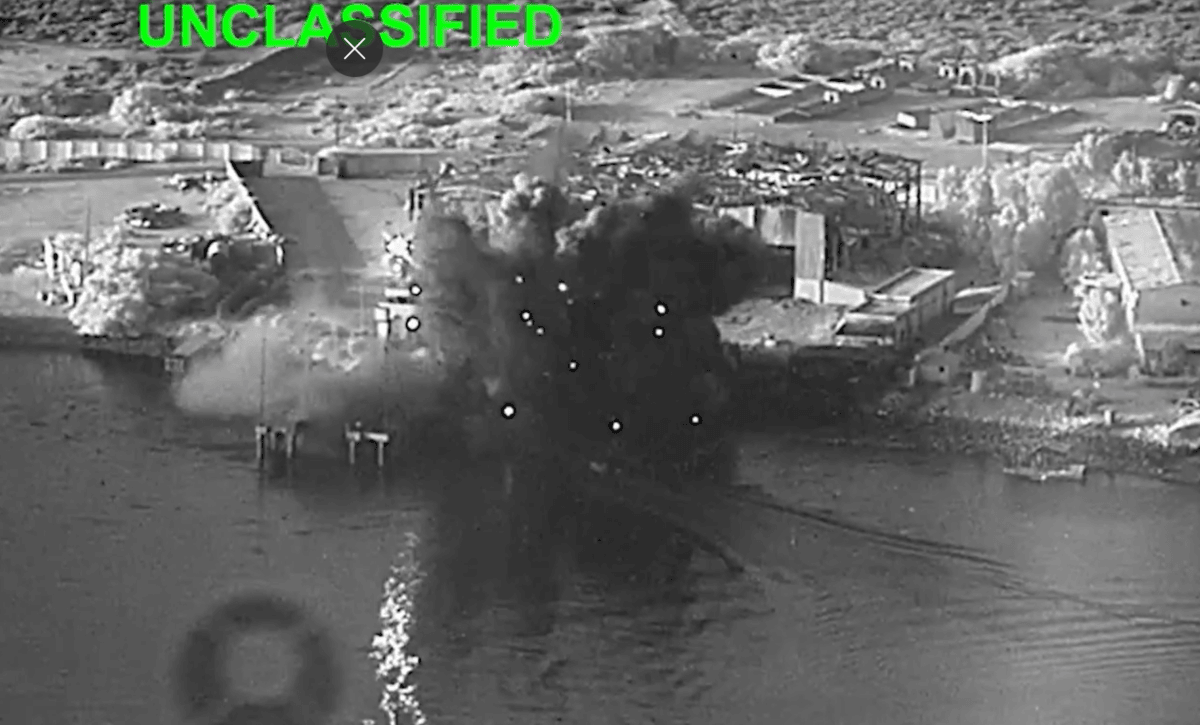
The strikes themselves were captured in dramatic, overhead military footage later shared on social media by U.S. Central Command (CENTCOM), which oversees all American military operations throughout the Middle East. The military broadcast featured a sequence of events showing the three robotic vessels veering purposefully toward the heavily fortified Iranian port. Just before the feed cut to a blinding flash of light, the camera switched to a first-person perspective from one of the approaching drones, showing it slamming directly into an active pier and triggering a massive, fiery explosion. While independent journalists have not yet been able to verify the authenticity of the video, state-controlled Iranian media confirmed that the attack resulted in the deaths of three individuals on-site. CENTCOM defended the operation as a highly calculated maneuver designed to degrade Iran’s capacity to continue launching hostile actions against commercial maritime traffic.
This high-tech naval strike marks a dangerous escalation in what has quickly evolved into an intense, multi-front conflict. Following the drone strikes, the U.S. launched a third consecutive night of intense bombings inside Iran, while Tehran’s forces retaliated fiercely by striking two commercial oil tankers belonging to the United Arab Emirates. According to Emirati officials, the Iranian missile strikes targeted the tankers while they were navigating within Omani territorial waters, igniting severe onboard fires, killing one crew member, and injuring eight others. Simultaneously, Iran claimed it launched targeting sweeps against American military installations located in Jordan and Bahrain, placing immense pressure on regional stability and casting a dark shadow over the fragile, temporary memorandum of understanding reached between Washington and Tehran just weeks earlier.
This rapid spiral into open warfare originated in late February, catalyzed by joint airstrikes launched against Iran by U.S. and Israeli forces. In response, Iran mobilized its network of regional allies to launch relentless drone and missile strikes at American entities, while aggressively targeting merchant vessels attempting to navigate through the Strait of Hormuz. Because nearly twenty percent of the world’s petroleum and natural gas supplies navigate through this narrow waterway daily, the ongoing instability has severely threatened the global economy. In response to the growing gridlock, President Donald Trump announced that the U.S. would reinstate its comprehensive naval blockade of all Iranian ports—which had been temporarily eased under last month’s foreign policy agreement—alongside an aggressive twenty percent tariff on all goods moving through the vital shipping lane.
As the conflict intensifies, both nations appear to be digging in for a prolonged confrontation rather than seeking a diplomatic off-ramp. In the wake of the latest U.S. drone strikes over Bandar Abbas, a senior Iranian lawmaker revealed that the parliament in Tehran is quickly drafting new legislation designed to tighten the country’s military grip over the Strait of Hormuz. With the initial June 17 peace negotiations now in tatters, the introduction of automated, weaponized sea drones has ushered in a highly unpredictable era of robotic naval combat. As both superpowers exchange devastating blows across the Gulf, international observers warn that the failure to secure these crucial waters could soon send devastating ripple effects throughout the global supply chain.