


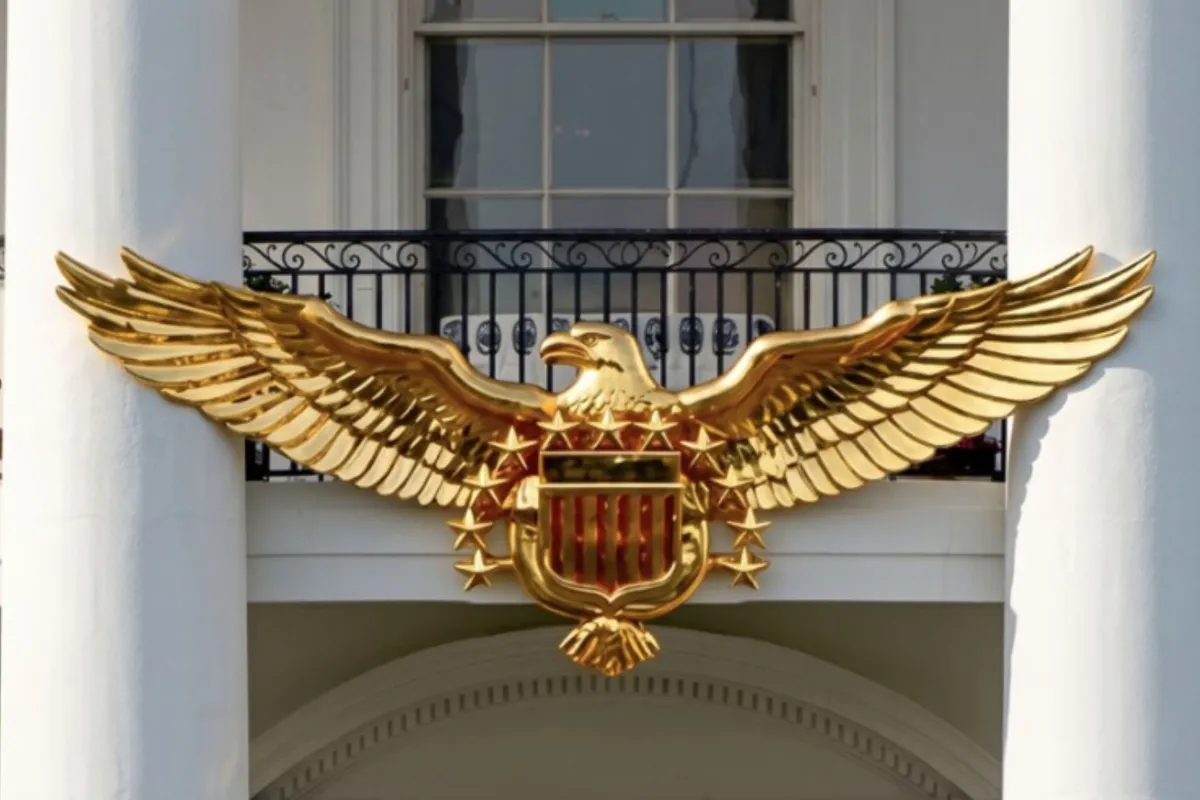
Imagine navigating the endless, rapid-fire deluge of a modern social media feed on a quiet afternoon, only to be stopped in your tracks by a glistening, larger-than-life golden beast perched proudly upon the historic columns of the White House. This was the surreal experience of millions of digital citizens when President Donald Trump posted a striking, highly saturated image on Truth Social, accompanied by the grand, exclamation-point-capped declaration: “A Golden Gift to the White House for its 250th Birthday Year!” In this theatrical image, a colossal, gilded bald eagle spreads its wings across the iconic columns of the Truman Balcony, its talons framing a classic patriotic shield adorned with the stars and stripes. The post immediately ignited a wildfire of public curiosity, digital investigation, and heartfelt debate across the internet. To many of his supporters, the image was seen as a stirring, majestic, and unapologetic tribute to American exceptionalism, projecting a sense of monumental strength and pride as the country marches toward its historic semiquincentennial anniversary. To critics and historians, however, it was viewed as a bizarre and kitschy piece of digital artifice that perfectly illustrates the modern intersection of high-stakes political branding and internet meme culture. This singular event serves as a fascinating lens through which we can observe how political communication has evolved; no longer bound by the dry constraints of formal press relations, modern leaders are increasingly utilizing highly emotional, visually stunning, and often fabricated imagery to speak directly to a fragmented public. In this brave new media landscape, the sheer psychological and aesthetic impact of an image has begun to completely supersede its literal truth, transforming a historic monument of global democracy into a fluid, digital playground for political myth-making.
Yet, beneath the initial, shimmering allure of this digital monument lay a series of glaring anomalies and historical discrepancies that quickly caught the attention of sharp-eyed internet sleuths and investigative journalists. Mainstream media outlets, led by forensic analyses from organizations like CNN, wasted no time diving into the digital DNA of the file, ultimately revealing that the image’s metadata bore the unmistakable electronic signature of Google’s generative artificial intelligence systems. Beyond the hidden lines of computer code, however, the physical evidence of the image’s computerized synthesis was written in plain sight across the image itself, embodying the classic “hallucinations” that current generative AI models exhibit when trying to recreate complex human history and real-world geography. For instance, the patriotic stars-and-stripes shield nestled beneath the eagle’s golden wings featured only eleven stars—a curious and historically inaccurate detail, given that the traditional American crest features thirteen stars to honor the original colonies that declared independence from the British Crown at the nation’s birth. Furthermore, architectural purists and seasoned White House commentators pointed out that the geometry and structural details of the balcony railings in the post deviated significantly from the actual, physical Truman Balcony that has graced the South Portico of the Executive Mansion since the mid-twentieth century. These design errors highlight a profound truth about our current technological epoch: while artificial intelligence is spectacularly adept at synthesizing billions of data points to generate hyper-realistic textures and dramatic lighting, it fundamentally lacks a human being’s deep, historical understanding of cultural subtext, national iconography, and physical craftsmanship. The algorithm does not comprehend the historical weight of the number thirteen, nor does it understand the architectural legacy of neoclassical design; it merely calculates which patterns of pixels are mathematically likely to look pleasing based on its training data, leaving human observers to navigate the confusing space between artificial fantasy and historical truth.
For those who have closely followed Donald Trump’s long, turbulent, and undeniably colorful journey through the digital landscape, this latest venture into the realm of AI-generated imagery represents far more than a simple social media mishap; it is a highly characteristic manifestation of a deeply entrenched, populist aesthetic strategy. Throughout his political career, Trump has demonstrated an intuitive grasp of the “attention economy,” recognizing that in a world saturated with information, a single, emotionally provocative, and visually arresting image can command more public attention, media coverage, and cultural conversation than a thousand pages of policy briefs or formal speeches. Over the years, his social media feeds have served as curated galleries for a fascinating array of edited, altered, and synthetically produced illustrations that gleefully blur the line between mundane reality and heroic fantasy. For instance, earlier this year, he sparked intense national debate and drew widespread criticism for sharing a striking image that depicted him as a comforting, savior-like figure performing a miraculous healing on the suffering—a piece of digital art that his most ardent, faith-based supporters found profoundly moving, while his critics denounced it as a worrisome display of self-aggrandizement. Similarly, another popular image shared of Trump showed him alongside several high-profile members of his Cabinet swimming triumphantly through the waters of the Lincoln Memorial Reflecting Pool, a physical impossibility rendered into vivid, digital life. These images do not function as tools of literal deception meant to trick the public into believing a physical event occurred; rather, they operate on the logic of folklore and dreamscapes. They are romanticized, highly mythologized tapestries designed to foster an intense emotional connection, a sense of shared humor, and a feeling of epic struggle among his base of supporters. By wrapping himself in these larger-than-life, almost comic-book-like narratives, Trump effectively elevates his political persona from that of a standard politician to a mythic folk hero, transforming the arduous, complex realities of federal governance into a thrilling, interactive cinematic drama where he is the ultimate champion of the common citizen.
This cultural slide toward synthetic presidential imagery highlights a much larger, more profound, and deeply human evolution in how our species communicates, processes information, and ultimately defines what is real. In past generations, political propaganda and state imagery were the secure domains of highly skilled human designers, photographers, and artisans who labored meticulously over hours, weeks, or months to craft pristine, believable messages of national unity or military strength. A presidential portrait was an exercise in solemn gravity, and a public monument was built with sweat, stone, and the physical passing of time. Today, however, the explosive democratization of generative artificial intelligence has fundamentally shattered those barriers, allowing anyone with a simple internet connection to materialize complex visual narratives out of thin air in a matter of seconds. While this sudden creative liberation possesses an undeniable, democratic charm, it simultaneously introduces a dizzying level of cognitive instability to our shared public square, quietly eroding the foundational concept of a shared, objective truth. When influential public figures regularly disseminate synthetic media directly to millions of followers, they contribute to a broader psychological shift where the fake and the real are granted equal standing in the court of public opinion. Regular people are left to navigate a fractured online ecosystem where they must constantly apply a layer of profound skepticism to every photograph and video they encounter, asking themselves if they are observing an actual historical moment or merely a set of algorithmic calculations. This constant, exhausting state of digital vigilance slowly breeds a deep-seated cynicism in the human heart, leading many to abandon the tiring pursuit of factual verification altogether. When people can no longer trust the evidence of their eyes, they naturally retreat into the safety of their pre-existing political identities, choosing to believe whatever synthetic fantasy aligns with their psychological needs, thereby transforming public debate from a rational discussion of shared facts into a spiritual struggle between competing, digitally fabricated illusions.
To truly appreciate the deep, historical irony of this digital golden eagle, one must look closely at the rich, highly dramatic, and deeply human biography of the physical Truman Balcony itself—a structure whose very existence was forged in the fire of genuine political conflict and intense aesthetic debate. When President Harry S. Truman first proposed the addition of a balcony to the South Portico of the White House in the late 1940s, he faced a fierce and unrelenting wall of opposition from the federal Commission of Fine Arts, historically minded architects, and a skeptical public, many of whom argued that the addition would forever ruin the clean, neoclassical symmetry of the beloved Executive Mansion. Undeterred by the national outcry, Truman maintained a deeply human, practical defense of the project, writing letters and giving energetic press conferences wherein he argued that his family desperately needed a private outdoor sanctuary to escape the stifling mid-Atlantic summer heat, while also pointing out that a balcony would actually improve the architectural proportions of the south side of the mansion. Truman’s historic battle was fought not with pixels, but with physical sandstone, structural steel, architectural blue-lines, and grueling negotiations over federal budgets, eventually resulting in the elegant white porch that has since served as a backdrop for historic treaty signings, majestic state arrivals, and quiet, lonely nights of presidential reflection. Superimposing an artificial, golden-gilded digital eagle onto this specific, hard-won physical space represents a stark and fascinating clash of historical epochs. It juxtaposes Truman’s laborious, high-stakes struggle over concrete preservation, physical materials, and public taste with our modern, frictionless era of instantaneous digital edit files. Where Truman had to spend months of intense political capital and enduring national television criticism to alter the physical face of the White House by a few feet, a modern user can effortlessly transform that very same structure into a mythological avian playground with a brief text prompt, perfectly illustrating how our collective connection to sacred civic spaces has drifted away from a deep respect for physical craftsmanship and toward an appetite for transient, screen-based spectaculars.
As the United States rapidly approaches its highly anticipated semiquincentennial, this strange, digital episode of the golden eagle serves as a poetic and timely warning of the complex cultural and philosophical crossroads at which our society now stands. The classic symbol of the bald eagle, especially when rendered in majestic gold and dramatically perched over the heart of American democracy, speaks to a deeply rooted, universally human desire for collective strength, national pride, and a soaring sense of shared destiny. Yet, as this brief digital uproar reveals, there exists an irreplaceable, fundamental difference between a symbol whose meaning is hard-won through collective sacrifice, human physical labor, and the slow unfolding of shared history, and one that is effortlessly generated by a cold mathematical algorithm running in a distant server farm. True national strength, civic unity, and democratic resilience cannot be simulated by a software developer’s code, nor can they be truly validated by the fleeting, dopamine-fueled currency of social media engagement; instead, they must be continuously built, repaired, and protected through the difficult, offline work of community building, historical preservation, and a stubborn, unwavering devotion to objective truth. As we venture further into this bewildering future of synthetic media, where the boundary between what is real and what is artificially compiled will only continue to dissolve, our greatest challenge will be to foster a new kind of human awareness and digital literacy. We must develop the intellectual capacity to enjoy the creative possibilities of artificial intelligence without allowing it to replace our respect for real-world facts, authentic human experiences, and physical craftsmanship. By honoring our genuine monuments, remembering the complex human struggles that actually built them, and refusing to settle for easy, computerized illusions, we can ensure that as we celebrate our nation’s historic birthday, we are standing on the solid, unyielding rock of a true democratic legacy rather than wandering lost through a glittering, golden hall of digital mirrors.