


The Shocking Incident at the White House Correspondents’ Dinner
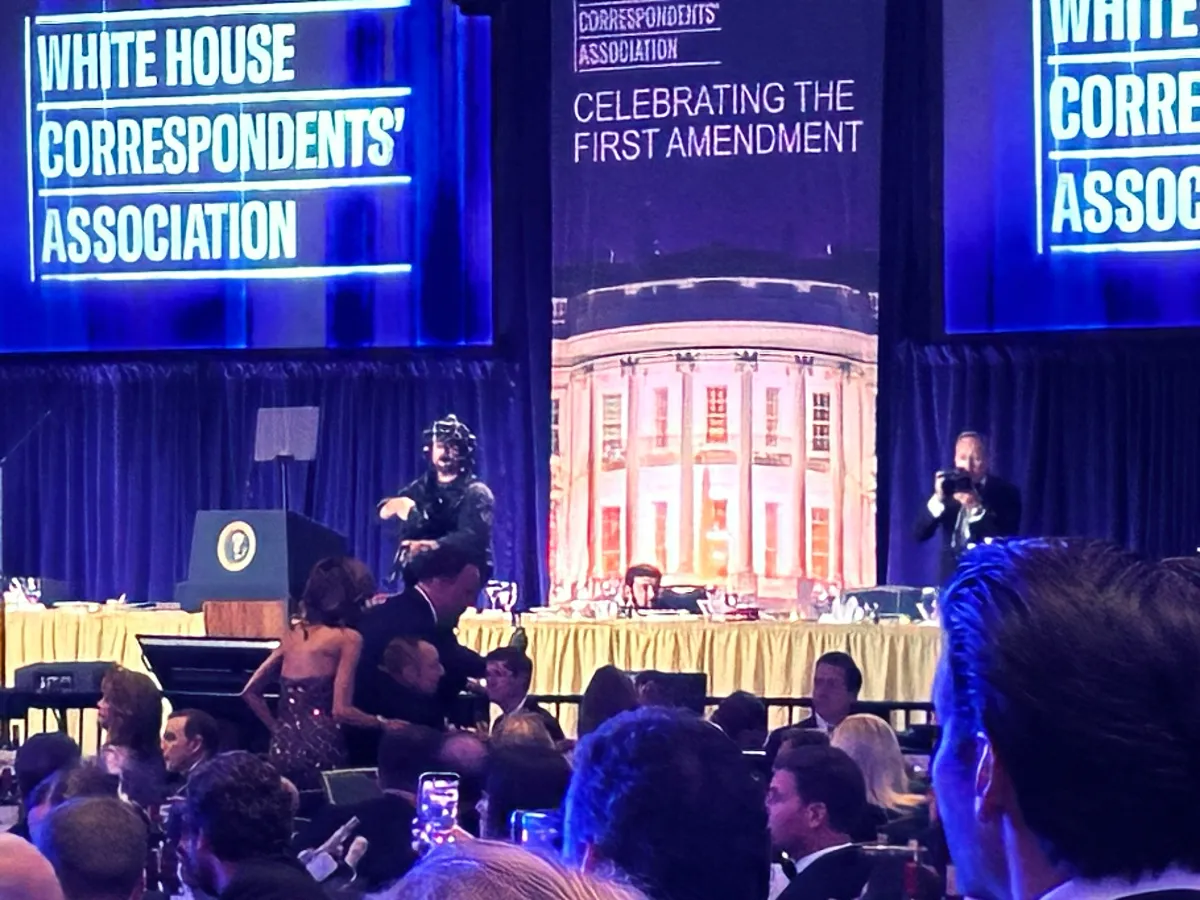
It was just after 8:30 p.m. on a Saturday evening when the atmosphere at the White House Correspondents’ Dinner turned from celebratory to chaotic. This annual gala, a glittering affair where journalists and politicians mingle over roasts and toasts, was suddenly shattered by the crack of gunfire. President Donald Trump, surrounded by his Cabinet and members of the media elite, found himself in the crosshairs of a determined gunman. Video footage from Trump’s own Truth Social platform captured the harrowing moment: the suspect, later identified as Cole Tomas Allen, a 31-year-old from Torrance, California, sprinting past security barricades like a shadow in the night. Secret Service agents scrambled, their instincts kicking in as they pursued him through the crowd. One brave officer took a hit to his bullet-resistant vest— a painful reminder of the razor-thin line between a would-be assassin’s bullet and disaster. The agents tackled Allen to the ground, apprehending him swiftly, but not before the President and his entourage were evacuated in a rush of adrenaline and confusion. It was an attempt that echoed through history, reminding America of its fragile democracy. Federal officials wasted no time in labeling it an assassination plot, part of a dark pattern that has stalked U.S. presidents for generations. As news spread, families watching from home clutched their phones, imagining the terror of their leaders in such peril. This wasn’t just a security lapse; it was a stark jolt to a nation already divided, forcing us to confront how vulnerable our leaders are in a world awash with accessible weapons and unchecked rage. Trump’s later words praised the Secret Service’s “fantastic job,” but the incident left an indelible mark, sparking debates on gun control and the price of political polarization. For many, it felt personal—imagine being at a fun event one minute and dodging bullets the next, analyzing how a lone individual’s actions could rip apart the fabric of American society, exposing vulnerabilities that affect us all, from everyday citizens to the most powerful office in the land.
Echoes of Past Tragedies: Assassinations That Shaped a Nation
Delving into America’s painful past reveals a string of presidential assassinations that feel almost like chapters in a grim thriller, each more tragic than the last. Abraham Lincoln, the Great Emancipator, was gunned down in 1865 by John Wilkes Booth at Ford’s Theatre in Washington, D.C., just days after the Confederacy’s surrender. Picture the scene: a crowded theater laughing at a comedy, then the deafening bang from Booth’s derringer piercing the air. Lincoln slumped, his wife Mary weeping beside him as his life ebbed away— a symbol of hope assassinated at the cusp of healing a fractured nation. It wasn’t the first, nor would it be the last. In 1881, President James A. Garfield succumbed to wounds inflicted by Charles J. Guiteau, a delusional man who shot him at a train station, believing it was his divine mission. Garfield lingered for weeks, his doctors’ fumbling attempts to extract the bullet only worsening his agony, before he died— a poignant reminder of 19th-century medicine’s limitations and the personal toll of political madness. William McKinley followed in 1901, felled by anarchist Leon Czolgosz at the Pan-American Exposition in Buffalo, where the President was shaking hands with well-wishers. Czolgosz fired twice at close range, the second bullet ending McKinley’s life after he had rallied for days. These stories aren’t just history; they’re human dramas of ambition turned lethal, where ordinary citizens became killers driven by ideology, resentment, or mental turmoil. And then there’s John F. Kennedy, the charismatic leader whose tragic end in 1963 became the most televised tragedy of its era. In Dallas, Lee Harvey Oswald’s shots rang out during a motorcade, striking Kennedy and Governor John Connally. The Zapruder film immortalized the horror: the President slumping forward, Jackie Kennedy clambering onto the trunk for help. These assassinations weren’t isolated; they’re chilling reminders of how fragile power can be, affecting families, nations, and the global stage. Each one prompted reforms, but also endless speculation— who benefited? What could have been prevented? For everyday Americans, these are cautionary tales, urging vigilance against the “lone wolves” who emerge from society’s fringes, their motives a mix of personal grievances and broader disillusionment. The recent attempt on Trump feels like a continuation, a stark warning that despite cameras and barricades, history’s ghosts still loom large.
Failed Attempts and Near-Misses: The Haunting “What Ifs”
Beyond the successful assassinations, a shadow gallery of thwarted plots lingers, each a narrative of near-catastrophe that underscores the unpredictability of human malice. President Andrew Jackson, in 1835, faced an assassination bid from Richard Lawrence, a deranged painter who fired pistols at him at point-blank range—but both misfired, and Jackson, the feisty “Old Hickory,” famously attacked his assailant with his cane before celebrating as if nothing had happened. Imagine the President’s relief and rage, the crowd’s shock turning to cheers for their indomitable leader. Theodore Roosevelt endured a bullet to the chest in 1912 during his Bull Moose campaign, the projectile slowed by a folded speech and eyeglasses case in his pocket; he delivered his 90-minute address nonetheless, bleeding from the wound but defiant. It’s a story of resilience, yet it highlights how public exposure leaves leaders vulnerable. Harry S. Truman survived two attempts: one in 1947 by Ossian Sweet, a Puerto Rican nationalist who jumped the White House fence and fired wildly into Blair House, where Truman lived during renovations; and another in 1950 involving two Puerto Rican nationalists who opened fire at the White House itself. Gerald Ford faced two assailants in 1975—one in Sacramento, one in San Francisco—while Ronald Reagan was gravely wounded in 1981 by John Hinckley Jr., who waited in a crowd outside the Washington Hilton, his .22-caliber bullets grazing the President’s lung and wounding others. These near-misses aren’t mere footnotes; they’re intimate glimpses into the adrenaline-pumped lives of protectors and the psychological toll on the protected. Families and nations held their breath, wondering how a single moment’s insanity could alter history. For the Secret Service, these incidents were learning curves—for instance, the 1981 attack spurred reforms in motorcade logistics and threat assessment. On a human level, they evoke empathy: the fear of the first family hearing sirens in the night, the dedication of agents who risk everything. The pattern reveals a troubling trend—most threats from disaffected individuals, fueled by politics, grievances, or delusions—making America’s leaders seem perpetually at risk in an open society where guns are easily obtainable.
The Evolution of Presidential Protection: From Haphazard to High-Tech Safeguards
The journey to secure America’s presidents has been a slow, reactive ballet of adaptation, transforming intermittent safeguards into a fortress of vigilance. Prior to 1901, protection was patchwork and inadequate, relying on local cops or temporary details—think Lincoln’s few guards or Garfield’s minimal entourage, vulnerability summed up in exposed carriages and unguarded events. After McKinley’s shocking death, the Secret Service stepped up, assuming full-time presidential protection in 1902, funded properly by Congress in 1906, and made permanent in 1913. It was a pivotal shift, driven by public outrage and the need for professionalism; agents became the invisible shields, expanding to include families in 1917 amid wartime paranoia. By 1951, protection extended to vice presidents and presidents-elect, evolving into today’s comprehensive network. Kennedy’s 1963 assassination accelerated reforms—threats became federal crimes in 1965, venue security hardened, routes shrouded in secrecy, and intelligence expanded to probe motives preemptively. In the modern era, technology plays a star role: ballistic vests, armored limouseds like “The Beast,” drone surveillance, and AI-driven threat analysis. Yet, it’s not all gadgets; it’s the human element—agents trained like elite athletes, psychologically prepared for the unthinkable. For presidents and their loved ones, this means restricted lives: curtailed freedoms, constant scripts, the emotional weight of isolation. Families miss simple joys—impromptu walks or unguarded smiles—trading them for safety. The Secret Service’s culture fosters loyalty, with agents sharing stories of long shifts and dodged bullets, their own families waiting anxiously. This evolution isn’t just policy; it’s a testament to human ingenuity against chaos, ensuring leaders like Trump can navigate events like the Correspondents’ Dinner with layers of invisible defense. But incidents like the recent breach remind us: perfection is elusive, and every gradation of risk carries the humanity of real people’s lives hanging in the balance.
Analyzing the Patterns: Motives, Lone Wolves, and Societal Vulnerabilities
Peeling back the layers of these attempts reveals a tapestry of motives that feel deeply personal, often rooted in ideology, disillusionment, or mental strife—motives that make America’s past feel hauntingly relevant today. Lone actors dominate, from John Wilkes Booth’s Confederate sympathies to Lee Harvey Oswald’s anti-establishment rage, defined by their isolation. Some, like Richard Lawrence, were clearly delusional, hearing voices or driven by bizarre fixations; others, such as the Puerto Rican nationalists targeting Truman, fueled by grievances over colonialism. Political volatility amplifies these threats, especially during elections or crises, when rhetoric escalates and global tensions simmer. Security lapses frequently occur at public forums—motorcades, crowds, dinners—where exposure is maximized, highlighting America’s unique openness compared to walled-off leaders like Xi or Putin. Mark Shanahan, an expert from the University of Surrey, points to U.S. presidents’ public visibility as a double-edged sword: their constant campaigning and governing in plain sight make them approachable, but combined with the Second Amendment’s loose gun interpretation, it creates a perfect storm. This access to firearms, unparalleled globally, turns personal vendettas into deadly possibilities—imagine a resentful neighbor or extremist radicalized online, turning ideology into action. Reforms have addressed these, but patterns persist: threats from the fringes, exacerbated by social media’s echo chambers where conspiracy theories fester. Humanizing this, think of the perpetrators often as troubled souls—Cole Allen, like so many, a 31-year-old with a digital footprint hinting at plans stewed in solitude—versus the broader societal failings like inadequate mental health support or unchecked proliferation of weapons. For everyday people, this breeds fear: attending rallies, debating politics, all tinged with what-if anxiety. The analysis isn’t coldly academic; it’s a call to empathy, urging communities to spot warning signs, foster dialogue, and perhaps rethink gun norms that disproportionately endanger leaders and citizens alike. In Trump’s case, investigators delve into Allen’s background, seeking clues that might prevent future echoes of this chilling history.
What Happens Next: Reactions, Reforms, and Reflections on a Nation’s Resilience
In the aftermath of the attempted assassination, reactions poured in like a flood, mixing relief with resolve. President Trump called the Secret Service’s response “fantastic,” a compliment that humanizes the often-anonymous heroes—agents who are spouses, parents, and guardians themselves, their quick actions saving lives despite the breach. The incident sparked calls for investigations: federal agencies combing through Cole Allen’s life for motivators—his writings, online trails, suggesting premeditated malice. Was it political fervor, personal grudge, or something darker? This scrutiny aims to connect dots, perhaps uncovering how long he planned, echoing past plots. Meanwhile, the Secret Service braces for internal reviews, scrutinizing protocols for outdoor events like the Correspondents’ Dinner, far from the White House’s bastion. Experts predict enhancements: heightened vetting, more personnel, maybe tech upgrades to detect anomalies in crowds. On a societal level, the outrage fuels debates on gun control—the nation’s “almost unique” interpretation of the Second Amendment under fire, with calls for restrictions that balance rights with safety. Politicians, pundits, and ordinary citizens grapple with polarization’s role, wondering how divided discourse breeds violence. Families affected by past tragedies, like the Kennedys or Reagans, might share stories of resilience, inspiring hope. For many, it’s a moment of unity: red and blue alike condemning threats to democracy’s core. Long-term, reforms could include broader threat intelligence, public awareness campaigns against extremism, and support for mental health to nip lone-actor impulses in the bud. Amid all, there’s a poignancy—the human cost, the what-ifs that haunt. Yet, America’s history teaches adaptation: from Lincoln’s era to ours, each crisis births strength. As investigations unfold, the nation reflects on its fragility and fortitude, reminding us that even in peril, the indomitable spirit endures, safeguarding not just presidents but the ideals they represent. This latest chapter is a stark reminder, but it’s also a chance for collective healing and forward motion.