


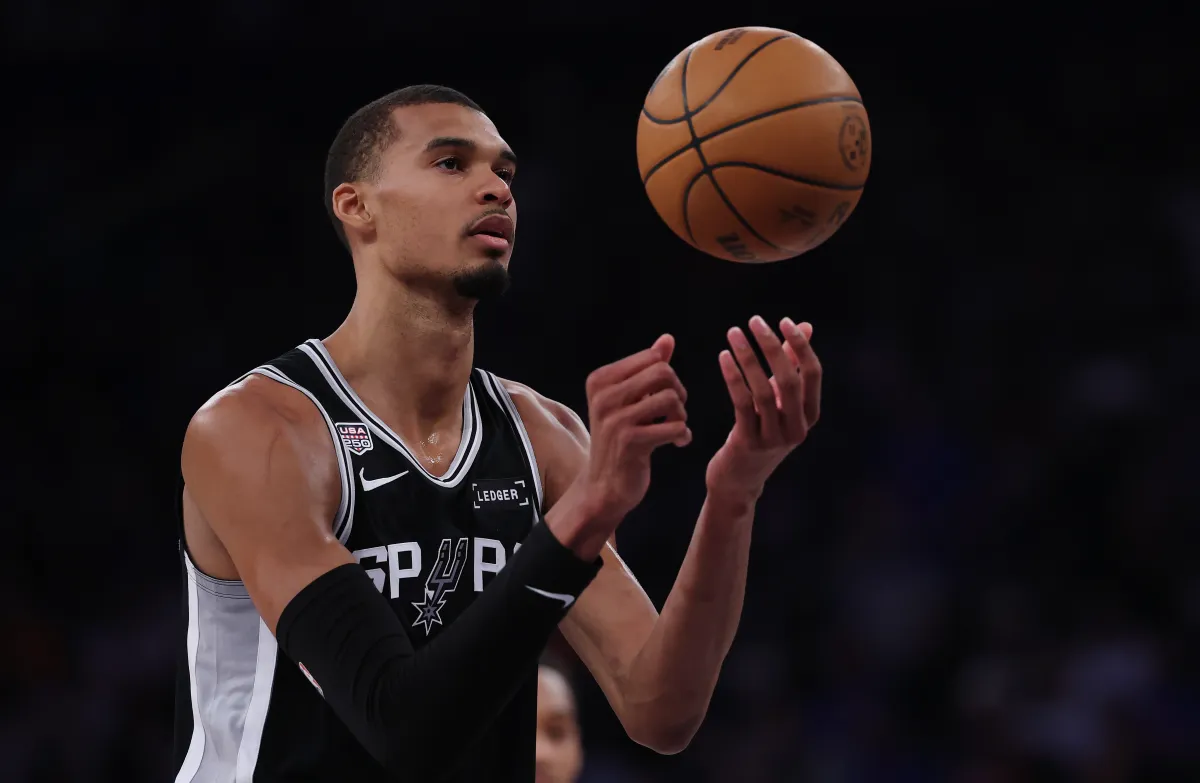
The basketball world is notoriously unforgiving, but Madison Square Garden is downright tribal, representing a stage where legends are either crowned or systematically dismantled. On a sweltering Wednesday night in June, the legendary arena was supposed to be the backdrop for a crowning achievement, a showcase of the inevitable future of the sport as the San Antonio Spurs faced off against the New York Knicks in Game 4 of the 2026 NBA Finals. At just twenty-two years old, Victor Wembanyama carried not just the hope of his franchise on his slender shoulders, but the grand expectations of a global league desperate for its next singular, era-defining icon. For the first twenty-four minutes of play, Wembanyama looked every bit the celestial world-killer he had been advertised to be, moving with a fluid grace that defied his towering frame. The Spurs, playing with a frantic, beautiful desperation, carved through the Knicks’ defense like a hot knife through butter, leaping out to a commanding nineteen-point first-quarter lead that left the Broadway crowd in stunned silence. Every possession felt like an exhibition of the future; Wembanyama was blocking shots at the rim and running transition breaks like a guard, culminating in a jaw-dropping sequence where he lured New York’s rugged center Mitchell Robinson into a flagrant foul. Standing tall amidst the deafening boos of the New York faithful, Victor leaned down, his eyes ablaze with the arrogant fire of youth, and uttered four words that would echo across the sports landscape: “I’m in your head.” At that moment, with San Antonio’s lead expanding to a gargantuan twenty-nine points, it seemed impossible to imagine any other outcome than a series-tying victory. The young Frenchman had conquered the world’s most famous arena, asserting his psychological and physical dominance over a blue-collar Knicks squad that suddenly looked hopelessly outmatched, exhausted, and broken.
What followed in the second half of Game 4 will be studied by sports psychologists and basketball analysts for decades, serving as a sobering reminder of how quickly competitive momentum can turn into a suffocating avalanche. As the third quarter commenced, the Knicks did not merely adjust their strategy; they transformed the basketball court into an absolute alley fight, testing the limits of physical officiating and chipping away at the Spurs’ seemingly insurmountable twenty-seven-point halftime advantage. Suddenly, the effortless fluidity that had characterized Wembanyama’s early game vanished, replaced by a hurried, erratic rhythm that saw him miss shot after shot, finishing a dismal four-for-eighteen from the field following his high-profile confrontation with Robinson. The psychological gravity of the moment began to press down hard on the young superstar, as every missed jumper and sloppy turnover fueled a roaring Madison Square Garden crowd that sensed blood in the water. Step by grueling step, the Knicks clawed their way back, turning a blowout into a heart-stopping, possession-by-possession war of attrition in the game’s final minutes. With the Spurs clinging desperately to a 104-103 lead and less than two minutes remaining on the clock, the moment of ultimate reckoning arrived as Wembanyama was fouled and sent to the charity stripe. For a player destined to inherit the league, these are the moments where legacy is cemented, but instead, the heavy air of the Garden proved too stifling, and both game-sealing free throws clanked unkindly off the rim. The Knicks seized upon this devastating psychological blow, executing flawlessly down the stretch to pull off a stunning 107-106 victory—the largest comeback in NBA Finals history—to snatch a commanding three-games-to-one series lead and leave the young Spurs shell-shocked on the hardwood floor.
To understand the sheer magnitude of the mountain Victor Wembanyama and the San Antonio Spurs must now climb, one must look at the merciless ledgers of basketball history, where a three-to-one deficit in the NBA Finals has historically served as an absolute death sentence. Out of the dozens of teams that have found themselves backed into this precise corner over the seven-decade history of the league, only a single roster has ever successfully orchestrated a resurrection: the iconic 2016 Cleveland Cavaliers, led by a peak LeBron James, who pulled off the impossible against a record-setting seventy-three-win Golden State Warriors team. For a twenty-two-year-old rising star, being placed in direct comparison to LeBron’s magnum opus is a terrifying, almost unfair burden, casting a long shadow over what has otherwise been an incredibly historical individual campaign. The legendary ghosts of San Antonio’s past—specifically the stoic, clutch legacies of Tim Duncan and David Robinson—hover quietly over the locker room, demanding a level of poise and maturity that few young men of Wembanyama’s age have ever had to summon. The media machine, which is always quick to crown a new king, is just as swift to assemble the guillotine when that chosen sovereign falters under the bright lights, and the national discourse surrounding Victor has already shifted from awe of his unprecedented physical gifts to skepticism about his late-game emotional mettle. The realization that his dream season could end in a humiliating collapse on the sport’s biggest stage is a heavy dynamic to carry, threatening to define his early career narratives in ways that can take years of championship pursuit to shake off. Yet, this is the exact crucible where true basketball immortality is forged; a superstar is not constructed during the comfortable blowouts or the effortless stretches of regular-season dominance, but in how they manage their sanity when their backs are pinned firmly against the wall and the entire basketball universe is waiting for them to break.
In the immediate aftermath of that historic disaster, as the echoes of the ecstatic New York crowd still vibrated through the concrete walls of Madison Square Garden, the sports world watched closely to see how the young Frenchman would carry himself in front of the microphones. What they witnessed was not a broken kid or a defensive athlete hiding behind rehearsed clichés, but a remarkably grounded young man processing an unprecedented level of emotional pain with rare maturity and vulnerability. Victor candidly admitted that the sting of Game 4 was “harder to shake off” than any other loss he had ever experienced in his basketball life—by far—humanizing himself to a fan base that often views him as an indestructible, alien-like entity. Yet, underneath that raw honesty lay an unshakeable, bordering-on-defiant confidence that refused to allow the looming shadow of elimination to paralyze his spirit, declaring boldly that “everybody thinks — everybody knows we’re gonna do it.” This level of psychological conviction is infectious, serving as a vital lifeline for a young, emotionally battered San Antonio locker room that desperately needed a lighthouse in the middle of a raging storm. He insisted that the team was already over the heartbreak, emphasizing that the fast-paced, unforgiving nature of the playoff cycle leaves absolutely no time to indulge in lingering regrets or hypotheticals. Instead of looking at the daunting task of winning three straight games against a relentless opponent, Wembanyama spoke of a disciplined, highly meditative approach focused entirely on isolating Saturday night’s contest, warning that wasting mental energy on future games would be an amateur mistake. It is this psychological compartmentalization—the ability to shrink a monumental, season-defining task down to a single forty-eight-minute block of execution—that separates the good players from the truly transcendent ones, signaling that while the Spurs’ bodies may have been beaten in Game 4, their leader’s spirit remained entirely intact, armored by a profound belief in their collective destiny.
For the coaching staff led by the legendary Gregg Popovich, the days leading up to Game 5 are less about grueling physical conditioning and far more about detailed tactical restructuring and collective mental rehabilitation. The Knicks, coached by the notoriously defensive-minded Tom Thibodeau, successfully unearthed a blueprint in the second half of Game 4, leveraging their immense physicality, subtle off-ball holding, and hyper-aggressive double-teams to disrupt Wembanyama’s high center of gravity and isolate him from his teammates. To counter this suffocating pressure, the Spurs must find creative ways to feed Victor the ball in dynamic, high-speed situations rather than static, predictable post-ups, utilizing his unique passing vision to punish the Knicks’ aggressive over-commitments. There is also the critical matter of supporting cast execution, as players like Devin Vassell and Jeremy Sochan must step boldly into the scoring vacuum to relieve the immense defensive attention concentrated on their young center. If San Antonio’s perimeter threats can consistently knock down open three-pointers, it will force New York’s defenders to play honest, reopening the lane for Victor to recapture his dominant paint presence. The physical and tactical chess match will be incredibly fierce, but the ultimate deciding factor in Game 5 will not be a slick play drawn on a whiteboard; it will be the sheer, unadulterated human will to survive. San Antonio must find a way to match the Knicks’ blue-collar, playground-style intensity from the opening tip-off, proving that they are entirely willing to bruise their bodies, dive for loose balls, and master the gritty, unglamorous aspects of playoff survival. By shifting the burden of playmaking and ensuring that Wembanyama is not forced to carry the entire offensive load in isolation, Popovich can restore the beautiful, fluid ball movement that made San Antonio a powerhouse in the first place, setting the stage for a spectacular counter-punch.
On Saturday night, the battleground shifts from the noisy, media-saturated streets of Manhattan to the passionate, sun-drenched heart of Texas, where the Frost Bank Center will be transformed into an absolute cauldron of deafening noise and raw emotion. San Antonio fans, who have nourished a deep, generation-spanning love for championship basketball, understand welfare that they are about to bear witness to a defining moment in their franchise’s modern era. The arena will be a swirling sea of silver and black, with thousands of voices ready to carry their young savior through every single difficult possession. For Victor Wembanyama, this home game is far more than just a desperate opportunity to extend a playoff series; it represents a profound, inescapable rite of passage, a chance to prove to the world that his spectacular, gravity-defying talent is anchored by an equally spectacular reservoir of competitive character. True legends of the game are never defined solely by the trophies they easily hoist or the individual accolades they collect during comfortable, dominant runs; they are forged in the hot fires of adversity, judged by the grace, fire, and resilience they exhibit when their season is on the absolute edge of elimination. Whether Wembanyama begins a historic, earth-shattering comeback that will be talked about for generations, or falls heroically on his sword in front of his home crowd, Saturday night will serve as a massive, unforgettable milestone in his journey toward basketball immortality. He has stated quite clearly to the world that he and his team are simply not ready to go out quietly, and as the clock ticks down toward tip-off in Southern Texas, the sporting world holds its collective breath, waiting to see if this young giant can transform his immense promise into a legendary reality.