


We live in an era of sports media where nuance is frequently discarded in favor of radical, polarizing hot takes, yet the reality of Shai Gilgeous-Alexander demands that we embrace two diametrically opposed ideas at the exact same time. On one side of the coin, the Oklahoma City Thunder starting guard is a certified physical phenomenon, a breathtakingly smooth operator who confidently commands the hardwood with a level of mid-range poise and spatial awareness that we have rarely seen since the prime years of legendary guards. His spectacular ability to score from any square inch of the wood, combined with a vastly underrated gift for scanning defenses and delivering pinpoint assists, makes him the absolute, undisputed heartbeat of a young, hungry roster that looks capable of establishing the NBA’s next great multi-year dynasty. He is a back-to-back Most Valuable Player who has earned his place among the basketball elite through sheer kinetic mastery and a work ethic that has turned a former mid-first-round pick into a globally recognized international icon. However, the other side of this very same coin is painfully ugly to look at: Gilgeous-Alexander is rapidly cementing his status as one of the most profoundly exhausting, hard-to-watch players in the long and storied history of professional basketball. The very same player who can orchestrate a beautiful offensive possession with a series of sublime crossovers and delicate finger-rolls will, just moments later, reduce the game to an unwatchable, heavily litigated sequence of free-throw hunting and theatrical head-snapping. This constant tension between aesthetic majesty and cynical game-manipulation creates a deep sense of frustration among basketball fans who desperately want to love Shai’s game for its purity, but find themselves repeatedly alienated by the cheap, rule-bending tactics that define his approach to the modern game, making him both a spectacular savior and a frustrating villain of the modern sport.
Nothing highlighted this maddening dichotomy quite like the high-stakes drama of Sunday night’s primetime matchup, where the Thunder had a golden opportunity to seize control of the Western Conference Finals against the sensational Victor Wembanyama and the resurrection-era San Antonio Spurs. Going up 3-1 in a highly competitive playoff series heading back to the roaring, blue-shirted crowds of Oklahoma City is the kind of legacy-defining, modern chokehold that all-time greats live for, yet when the bright lights turned on, Shai’s performance was shockingly pedestrian. For much of this postseason run, he has existed in an odd, lukewarm space—he is rarely a complete disaster or a detriment to his team’s structural success, but he consistently lacks the transcendent, game-bending energy that is supposed to define a back-to-back MVP. In fact, if a person had slipped into a decade-long coma in the mid-2010s, woke up on Sunday evening, and watched this crucial matchup without any prior context, they would have been hard-pressed to identify Oklahoma City’s superstar as the league’s premier player. Watching the game unfold, that confused observer would have likely named five or six other players on the floor who appeared more engaged, more physically dominant, and more central to the flow of the game than the Thunder’s cornerstone guard. Instead of a triumphant celebration of SGA’s greatness, the night quickly devolved into a brutal, one-sided obliteration spearheaded by San Antonio’s French phenom, whose unique, alien-like coverage of the court and sheer competitive joy turned a potential Western Conference coronation into an absolute rout. The resulting blowout completely shifted the momentum of the entire postseason, turning what should have been a straightforward OKC victory march into a nerve-wrecking, best-of-three series that leaves the Thunder’s championship credentials suddenly looking incredibly fragile.
This “coma test” is not just a hyperbolic thought experiment; it gets directly to the absolute core of the growing disillusionment surrounding the way Shai Gilgeous-Alexander accesses his greatness on the hardwood. When we think of legendary, historical back-to-back MVPs—men like Michael Jordan, LeBron James, Shaquille O’Neal, or even Stephen Curry—there was an undeniable, visceral sense of physical and structural domination every single time they stepped onto the court, regardless of whether their shots were falling. You felt their gravity, their fierce competitive fire, and their willingness to impose their sheer athletic will onto the opposition to wrench a victory from the jaws of defeat. With Shai, however, that dominant aura is frequently replaced by a cold, calculating, and ultimately sterile style of basketball that prioritizes foul-baiting and defensive manipulation over raw athletic execution. When the whistles fall silent in the intensely physical, high-intensity atmosphere of the NBA playoffs, his offensive scoring output often feels much more like a slow, halting grind of difficult mid-range pull-ups and carefully orchestrated collisions rather than an explosive display of unstoppable basketball wizardry. This reliance on referee intervention strips his performances of their heroic quality, transforming what should be a breathtaking display of playoff heroism into a monotonous, legalistic exercise in whistle-baiting. Consequently, when his team desperately needs him to rise above the chaos of a physical playoff defense and carry them home with sheer force of personality, he instead retreats into a style that feels intensely passive, safe, and reliant on officiating charity. This leaves fans with a persistent sense of emptiness, wondering how a player gifted with such immensely astronomical natural talent can choose to play a brand of basketball that feels so small and mechanical when the stakes are at their highest.
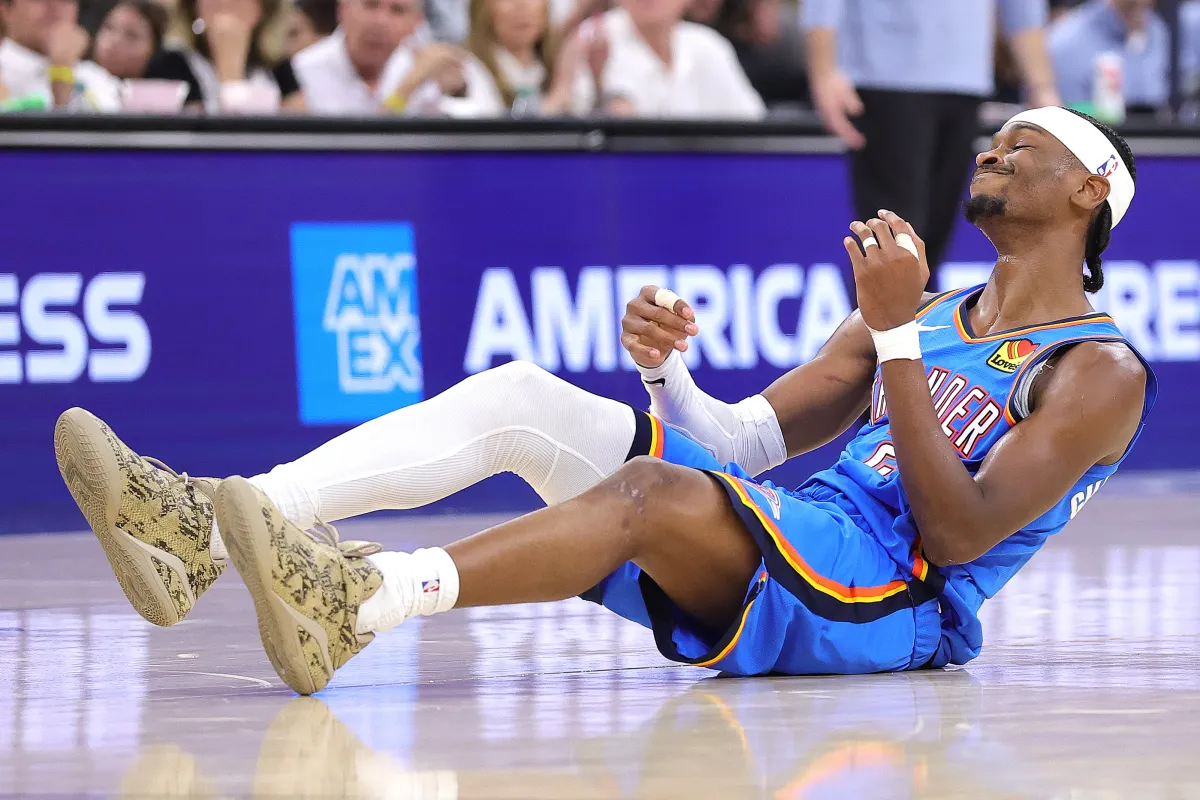
The primary catalyst for the widespread online outrage and media criticism following Sunday night’s game was not simply that the Thunder lost, but rather how Shai behaved in his desperate attempts to rescue their failing offensive possessions. Once again on Sunday, national television cameras captured the reigning MVP executing a series of embarrassing, exaggerated flops that have become all too familiar to frustrated NBA viewers around the world. In one particularly egregious and widely mocked instance that quickly went viral across major social media platforms, Gilgeous-Alexander launched a shot attempt and suddenly reacted with the violent, dramatic jerk of a man who had just been struck by a military-grade bazooka, despite the replay showcasing that not a single San Antonio defender had made even nominal contact with his body or jersey. In a vacuum, one could argue that a player has a right to avoid landing on a defender’s feet—such as De’Aaron Fox’s famously planted feet in previous highly contested matchups—or to protect their physical health in a league that often fails to safeguard its stars. But the uncomfortable truth is that Shai has officially exhausted any lingering benefit of the doubt from fans, analysts, and the officiating crew alike due to an incredibly extensive, multi-year history of manufactured contact and artificial flailing. This constant manipulation of the rulebook turns what is meant to be a beautiful, flowing sport into a cynical game of micro-grifting, where the goal is no longer to score through defense, but to trick a hardworking group of middle-aged referees into blowing their whistles. The sight of a physical masterpiece of an athlete voluntarily throwing himself to the hardwood like a ragdoll at the slightest hint of a phantom breeze is a deeply undignified look for one of the faces of the league, and it casts a long, dark shadow over his actual basketball accomplishments.
To lay the blame solely at the feet of Shai Gilgeous-Alexander, however, would be to ignore the larger, systemic basketball philosophy that has been carefully cultivated within the entire Oklahoma City Thunder franchise under the highly strategic leadership of head coach Mark Daigneault. The objective truth is that this frustratingly maddening style of play is not an isolated individual habit, but rather a deeply ingrained piece of the young team’s collective cultural identity. Across the league, prominent opposing head coaches have started raising their voices in press conferences to call out this specific brand of basketball, while fanbases around the country have rallied together in collective disgust at the way the Thunder approach the game. Oklahoma City has masterfully designed a system that walks a highly controversial, hyper-aggressive tightrope on a nightly basis: on one end of the floor, their young and intensely athletic defenders play a suffocating, ultra-physical brand of defense that pushes the boundaries of what referees will allow, frequently initiating heavy body contact that goes uncalled by the officials. Yet, the moment they transition to the offensive end of the court, those very same players run headfirst into incoming defenders, flailing their arms and snapping their heads back at the first sign of contact to secure a trip to the free-throw line. It is a wildly hypocritical, yet undeniably brilliant mathematical strategy that weaponizes the complex, modern NBA rulebook to its absolute limit, maximizing efficiency and minimizing empty possessions. While it is incredibly difficult to fault a young, ambitious team for utilizing every single legal exploit at their disposal to win games at the highest level, it does not change the fact that this calculated approach to the game is deeply antithetical to the spirit of competitive basketball, turning what should be a showcase of athletic excellence into a frustrating exercise in rulebook manipulation.
When all is said and done, there is an incredibly high probability that this Oklahoma City Thunder squad will achieve everything they have set out to accomplish, potentially building the most dominant, long-lasting dynasty the league has witnessed since Kevin Durant packed his bags for the Bay Area to join the historic Golden State Warriors. They possess an embarrassment of draft assets, a brilliant front office, a visionary coaching staff, and a deeply unified roster overflowing with young, incredibly versatile talent that will only continue to mature and improve over the next decade. Yet, as we look ahead to a future that will likely be filled with Thunder championship parades and endless media coronation segments, a vital human truth remains: winning games does not automatically entitle a team to the adoration of the basketball-watching public, nor does it ever obligatorily force us to enjoy the product they put on the screen. There is a profound difference between respecting a team’s mathematical efficiency and actually finding joy in their arduous journey, and right now, the Thunder are failing the aesthetic test of sportsmanship. Basketball at its absolute best is a sacred art form, a beautiful, improvised dance of speed, raw strength, and creative ingenuity that inspires awe because of its purity and competitive honor. When a team chooses to swap that natural beauty for a cold, cynical strategy of flopping, whistle-hunting, and referee manipulation, they may secure the Larry O’Brien trophies they desire, but they will never capture the hearts of the passionate global basketball community. If SGA and the Thunder ultimately ascend to the absolute peak of the NBA mountain by systematically grifting their way through the whistle, we will begrudgingly write their names in the history books as champions, but we will never look back on their era with the nostalgic warmth and reverence that is reserved for the true artists of the game, choosing instead to remember them as the most talented, yet deeply unlikable rulers the sport has ever known.