






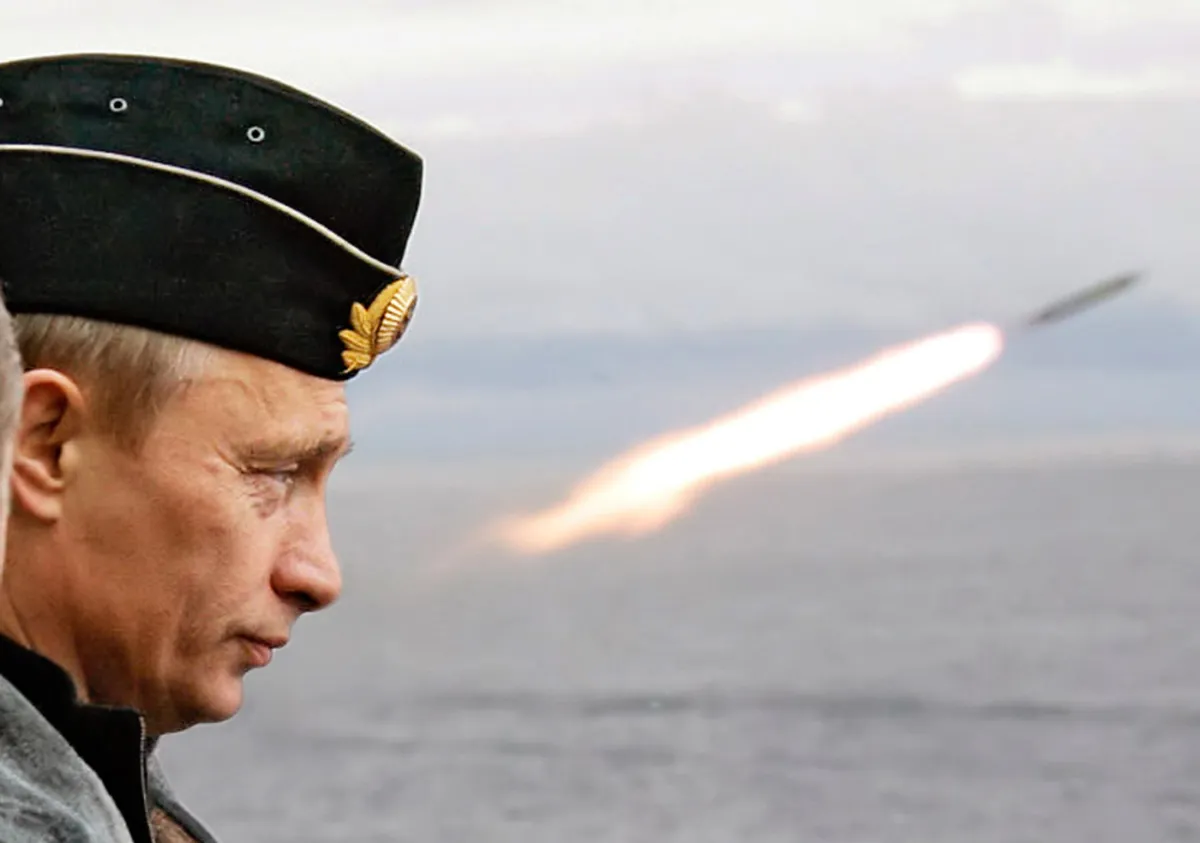
Another week, another round of nuclear saber-rattling from Moscow, and the timing was, as always, anything but accidental. Bloomberg reported that a growing number of Russian officials have quietly concluded Vladimir Putin might ultimately use tactical nuclear weapons in Ukraine as a last resort. That story landed the same week CIA Director John Ratcliffe made an unannounced visit to Moscow, and it gave the usual chorus of Russian hawks another chance to play their favorite game. Igor Korotchenko, a military analyst and editor of Russia’s National Defense magazine, declared that Russia’s General Staff should devise a plan to cut Ukraine off from European weapons supplies using nukes. Ultra-hardline oligarch Konstantin Malofeyev went even further, openly advocating for a “20–25 kiloton strike” to end the war within a month. On paper, and in headlines, this is terrifying. But here is the thing the Kremlin understands better than almost anyone: Russia’s most useful nuclear weapon is the one it never fires. Its real yield is not measured in kilotons but in hesitation. Every time a Russian official floats the possibility of a tactical strike, Western politicians pause, debate, and wonder whether this time the red line is real. That hesitation is exactly what Moscow wants. The nuclear threat has become a diplomatic weapon, a psychological lever, a way to make Ukraine’s allies second-guess every new shipment of arms. The more we panic at the noise, the more power we give to a threat that, so far at least, has always been more bluff than reality. We have been here before, many times, and we will be here again. The boy who cried nuke is still crying, and the trick is learning to tell the difference between a cry and an actual wolf.
The most detailed evidence that Russian tactical nuclear threats are overblown comes from a massive study published in December 2025 by researchers at the German Institute for International and Security Affairs (SWP) and the Peace Research Center Prague. They catalogued more than 400 nuclear-related statements and actions from the run-up to the full-scale invasion through January 2025. Of the 282 Russian signals they analyzed, by far the largest category was what they called “nuclear escalation risk signaling”—rhetoric deliberately designed to dramatize the danger of uncontrolled escalation, manipulate Western threat perceptions, and discourage the United States and Europe from giving Ukraine more support. In other words, most of the scary talk was not a plan. It was performance. The researchers said they even had to rewrite their methodology to refine their classification of threats because Russian nuclear rhetoric had become so commonplace and normalized that simply calling everything escalatory stopped being analytically useful. When everything is a red line, nothing is a red line. Some of the top experts on the Russia-Ukraine war have reached similar conclusions. In June, Orysia Lutsevych, deputy director of the Russia and Eurasia Programme at Chatham House, told the British Parliament’s House of Commons Defence Committee that “we are very far away from the risk of nuclear weapons.” Retired Lieutenant General Ben Hodges, former commanding general of United States Army Europe, went even further. He told Parliament’s Joint Committee on the National Security Strategy there is “almost zero chance” Russia would use nuclear weapons in and around Ukraine because there is no benefit for Moscow. The benefit, he argued, is in the threat itself and in watching the West “frankly, overreact to it.” Darya Dolzikova, a senior research fellow in RUSI’s Proliferation and Nuclear Policy program, echoed that view. She said Russian nuclear threats are regularly floated in expert and media commentary as an apparent effort to coerce Ukraine’s partners, and she does not currently see the conditions under which the prospect of Russian nuclear use would become credible. Stop us if you have heard this before.
But if we are being honest, how can we be sure? Saber-rattling from Russian officials, retired military types, and television propagandists is clearly not a reliable indicator of real nuclear intent. So what would a genuine threat actually look like? Earlier this year, nuclear expert George Perkovich of the Carnegie Endowment for International Peace proposed a useful test. In a report titled How to Assess Nuclear ‘Threats’ in the Twenty-First Century, he argued that analysts should strip away the scary language and ask simple, specific questions. Who made the threat? Does that person actually have nuclear authority? Is there a clear demand attached to the threat? Is the situation existentially threatening for the adversary? And, crucially, is the rhetoric being accompanied by unusual physical preparations—actual movements of warheads, loading of delivery systems, heightened readiness of nuclear forces—that look like more than just putting on a show? When Perkovich applied his framework to Russian nuclear hysteria since 2022, he found that, in almost every instance, Western governments detected no corresponding preparations to actually use the weapons. Except one. In September and October 2022, Russian forces were being routed around Kharkiv and Kherson. Putin warned that he would use “all weapon systems available” and insisted, “This is not a bluff.” Intercepted military communications added real substance to the threat. Journalist Bob Woodward reported in his 2024 book War that intelligence agencies informed President Joe Biden there could be up to a 50 percent chance of nuclear use if Russian lines collapsed and Moscow’s control of Crimea came into doubt. Assessing the rhetoric and physical signals together, Perkovich concluded that there was, however briefly, an urgent threat. That is the point where “radioactive baloney” stops being funny. And it is worth remembering why: a tactical nuclear weapon is not some cute little diet nuke. The term generally describes shorter-range weapons intended for battlefield use, often with lower yields than strategic warheads. But “lower” is doing some heroic work there. A five-kiloton weapon still releases roughly one-third the explosive energy of the Hiroshima bomb. Some tactical weapons are more powerful than Hiroshima. Once somebody uses one, nobody gets to control neatly what happens next.
This is why a healthy dose of skepticism matters. As Perkovich reminds us, we cannot allow our very rational fear of nuclear consequences to make us treat every reference to nuclear weapons as a genuine threat. Doing so can weaken national or alliance resolve to defend against aggression, and it can cause us to lose sensitivity to the moments when the situation calls for genuine concern. When threats are inflated, and the feared actions do not transpire, people may become inured and stop preparing adequately to respond when the moment is truly dire. A good example came in November 2024, when Russia officially updated its nuclear doctrine. Putin broadened the circumstances in which Moscow could consider nuclear use, including a conventional attack posing a “critical threat” to Russian sovereignty or territorial integrity, and stated that an attack by a non-nuclear state backed by a nuclear power could be treated as a “joint attack.” To Western nations steadily ramping up their provision of more advanced weaponry to Ukraine, this sounded alarming. But SWP noted that nuclear experts largely saw the changes as simply codifying behavior Russia was already displaying, rather than unveiling some radically lower threshold. Russian Foreign Minister Sergei Lavrov himself said the update “does not add anything that the West does not know.” What’s more, every supposed red line that prompted nuclear warnings from Russia turned out to be chalk marks that were crossed, rubbed out, and simply redrawn further back. In 2023, Lavrov warned that providing Ukraine with F-16 fighter jets would be viewed as a nuclear threat because the jets can carry nuclear weapons. The F-16s came anyway. That same summer, Security Council Deputy Chairman Dmitry Medvedev said Russia would have “no other way out” but to use nuclear weapons if a NATO-backed Ukrainian offensive seized Russian territory. A year later, Ukrainian troops marched into Kursk. Then Putin warned that allowing Ukraine to fire Western long-range weapons into Russia would mean NATO countries were “at war with Russia.” Ukraine subsequently fired U.S.-supplied ATACMS, British Storm Shadow, and French SCALP missiles into Russia. Moscow responded by launching its “Oreshnik” ballistic missile—but with a conventional warhead. In June 2025, Ukraine’s Operation Spiderweb went even further, attacking strategic Russian airbases and nuclear-capable bombers in a series of country-wide drone strikes. The security think tank CSIS noted that the strikes arguably satisfied one of the conditions laid out in Russia’s revised doctrine for possible nuclear use. And still, there was no nuclear response.
Why does Moscow keep stopping short? Mark Temnycky, an Atlantic Council fellow, told Newsweek that most assessments conclude a tactical weapon would be unlikely to reverse Ukraine’s military position in any lasting way. Ukrainian forces are dispersed rather than concentrated, which limits the payoff of a single strike. There is also the inconvenient fact that Russia wants the land it is threatening to irradiate. A tactical strike would contaminate that same land for years, poisoning the very territory Moscow claims it is trying to liberate and absorb. The value of such a weapon to Russia, Temnycky said, would be primarily psychological and coercive rather than tactical. In other words, a nuclear bomb is not a useful battlefield tool when the goal is conquest. It is only a useful tool when the goal is fear. And that is the human reality we need to keep in mind. Nuclear threats from Moscow are more theater than strategy. The people making the loudest threats are often television personalities, oligarchs with no formal power, and retired officers whose influence is measured by how many clicks they generate. They are not the ones holding the launch codes. Putin may occasionally encourage their rhetoric because it serves his purpose, but he has shown time and again that he understands the difference between brandishing a weapon and using it. The West’s panic, on the other hand, is free propaganda for the Kremlin. Every front-page story about an imminent nuclear strike, every parliamentary debate about whether supporting Ukraine is worth the risk, every agonized pause before sending another shipment of weapons—these are the victories Moscow is actually seeking. The nuclear threat is designed to make us hesitate, and the worst thing we can do is hand the Kremlin the strategic victory of panicking on command.
So what should we take away from all this? Not that Russia’s nuclear arsenal can be treated as if it does not exist. That would be dangerously naive. The weapons are real, the rhetoric is calculated, and there have been moments when the risk was genuinely elevated. If Russian forces suffer a catastrophic collapse in Ukraine, if intelligence agencies start detecting unusual movements of warheads, if Putin issues a specific ultimatum rather than vague warnings to “all weapon systems,” then we should all be deeply concerned. But until those things happen, the rational response to Russian nuclear bluster is to recognize it for what it is: an attempt to manipulate our emotions and our policies. The Kremlin wants us to believe that every escalation in Western support risks nuclear annihilation. That belief, if we accept it, does more damage to Ukraine’s cause than any Russian missile. We do not have to be reckless, and we do not have to dismiss the danger entirely. But we do need to calibrate our responses based on evidence, not on scary headlines and dramatic quotes. The most humane and effective response to the boy who cried nuke is not to assume the wolf is always coming. It is to watch the treeline, keep the defenses ready, support the people under threat, and refuse to be paralyzed by fear. Moscow’s most powerful weapon is not a warhead. It is our own willingness to believe that a warhead might be coming. The best way to disarm that weapon is to stop treating every threat as a promise, and to keep our eyes fixed on what actually matters: a free Ukraine, a stable Europe, and a world where nuclear intimidation does not decide the fate of nations. That is not naivety. That is resilience.