





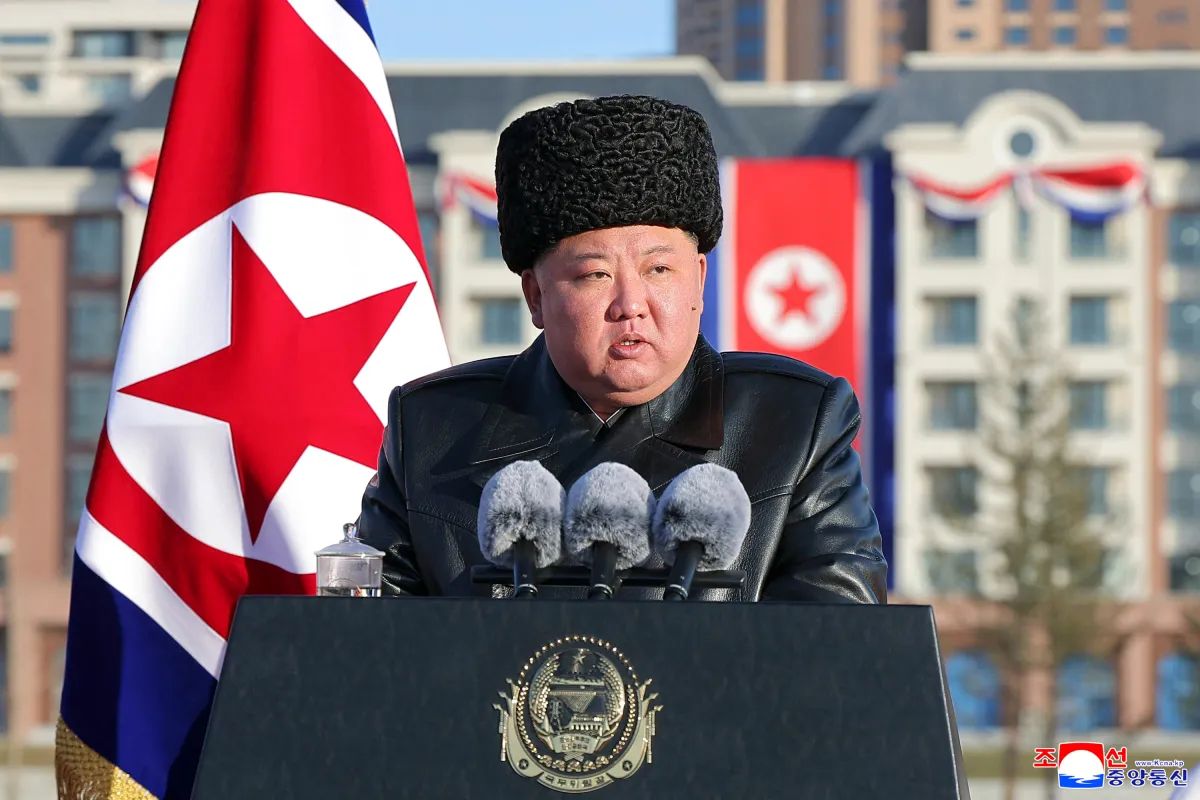
It’s hard to keep whiplash to a minimum when the man setting the pace keeps changing lanes without signaling. President Donald Trump has once again given critics of his Indo-Pacific strategy plenty of fuel to declare the long-promised U.S. pivot to Asia dead on arrival. This time, the shock came hours before joint military drills with South Korea were set to begin. In a late-night post on his Truth Social platform, Trump called the annual war games with a key ally “inappropriate and hostile” to North Korea and its leader, Kim Jong Un. He praised Kim as “unthreatening and respectful” during his presidency, then took a swipe at South Korean leadership for declining to join his military adventure in Iran. The timing was striking, to say the least. North Korea had just violated multiple U.N. Security Council resolutions by test-firing more ballistic missiles, and instead of condemning the provocation, the American president effectively rewarded the behavior by offering a concession before negotiations even started. For adversaries watching closely, the message was clear: rhetorical threats against the United States have real utility, and even a modest nuclear arsenal like Pyongyang’s can buy serious leverage. For allies and longtime Asia watchers, the message was less reassuring. After more than a decade of Washington promising to rebalance toward the world’s most consequential region, the gap between rhetoric and reality has never looked wider.
North Korea certainly welcomed the last-minute intervention, especially since it had just spent days railing against the exercises, describing them in state media as “a rehearsal for an aggressive war” that threatened the regime’s very existence. Foreign policy professionals, meanwhile, were left shaking their heads at what looked like yet another concession made at the expense of an ally, and so soon after Trump had publicly expressed his “great respect” for Chinese leader Xi Jinping in Beijing. But for those who have followed Trump’s diplomatic style for years, this move was not entirely surprising. He has long favored a carrot-and-stick approach, and he pulled the exact same lever in 2018 and 2019, canceling major exercises with South Korea to facilitate three rounds of ultimately fruitless summits with Kim. Could another meeting between the two leaders be on the horizon? Perhaps. But the United States is not negotiating from the same position it held eight years ago. Robert Kelly, the political scientist sometimes known as “BBC Dad” and based at South Korea’s Pusan National University, noted that Pyongyang now has a second patron in Moscow, one that is paying handsomely—and in U.S. dollars—for the soldiers and weapons North Korea has sent to Russia for its invasion of Ukraine. Kelly also pointed out that Trump himself seems even more erratic and disengaged than during his first term, adding that he will likely be even more inclined to “just give stuff away” in pursuit of the Nobel Prize he so desperately wants. Kim’s allies in Tehran understand all too well that Trump’s mood can flip overnight if talks go south. And for Kim, that is a comforting thought: North Korea today is far more resilient than it was during Trump 1.0.
The treatment of South Korea, in particular, reveals a troubling pattern. In January, Pentagon policy chief Elbridge Colby described South Korea as a “model ally.” But in a short Trump post on Sunday, that model ally was suddenly cast as a free rider benefiting from expensive military exercises paid for by American taxpayers. The whiplash is consistent, analysts note. Around a year after Defense Secretary Pete Hegseth called Poland a “model ally,” the Pentagon abandoned plans to deploy 4,000 U.S. troops to the country on NATO’s eastern flank. Last week, in Manila, Colby used the exact same phrase to describe the Philippines. What all this means for America’s oldest alliance in Asia is unclear, but any setback would first benefit China, which has spent years clashing with the Philippines over contested flashpoints in the South China Sea. The symbolism grows stranger the closer you look. Colby has now given a speech in Seoul that never mentioned North Korea, a second in Brussels that never referenced Russia, and a third in Manila that never named China. This is not normal. It is also not what allies expect from the world’s most powerful military, especially when they are being asked to trust that American security guarantees remain ironclad. The administration’s decision in June to rename the U.S. Indo-Pacific Command back to Pacific Command—a title Trump himself had ordered changed in 2018—was framed as a nostalgic nod to America’s war-winning past. But the symbolic gesture, aimed at domestic audiences, may have missed the subtle signal it sent to phrase-sensitive partners like India, which appeared to be dropped from the strategic concept overnight. Colby insisted last week that the U.S.-India partnership remains “vital,” but the broader uncertainty is taking a toll in international opinion. A Pew Research report released in July found China more popular than the United States in most surveyed nations. Confidence in Trump to do the right thing in world affairs was lower than confidence in Xi and lower than confidence in Joe Biden at the same point in his presidency. As Adrian Ang, a researcher at Singapore’s S. Rajaratnam School of International Studies, put it, the administration adds new data points almost daily to the ongoing debate about whether American credibility still matters.
Yet not everything about Trump’s latest overture to Kim is without merit, at least in the eyes of some analysts. South Korean President Lee Jae Myung over the weekend proposed peace talks to end the country’s official at-war status with the North, suggesting that a formal treaty to end the Korean War might help curb Kim’s appetite for more nuclear weapons. Pyongyang insists its buildup is irreversible, but the idea is not without supporters. Jennifer Kavanagh, a military analyst at Defense Priorities, argued that joint exercises with South Korea have failed to achieve their stated aims on the Korean Peninsula and represent a particularly poor use of the Pentagon’s shrinking pool of resources. In her view, the U.S. military should not be preparing to fight alongside South Korea in a war with its northern neighbor at all. Instead, Washington should hand responsibility for South Korea’s security over to Seoul entirely. Evan Sankey of the Cato Institute said Trump’s decision to reduce potential points of tension with North Korea could restart talks at a time when U.S. policy remains “at a dead end.” He acknowledged there is little prospect of convincing Kim to give up his nuclear weapons, but argued that negotiations could lead to caps on missile arsenals and fissile material stockpiles. And Isaac Stone Fish of the Strategy Risks consultancy raised a tantalizing possibility: what if Trump really could pull North Korea out of the orbit of China and Russia? The question, he said, is what that would cost in terms of U.S. global prestige, and whether weakening American support for troops in South Korea would embolden China even further. These are hard trade-offs, and reasonable people can disagree about the best path forward. But the manner in which decisions are being made—impulsive, personal, and late at night—makes serious strategic calculation almost impossible.
The broader picture is even more concerning for those who believe the Indo-Pacific matters most to America’s future. Washington’s Asia hands fear the Trump administration is too focused on the Western Hemisphere, given its involvement in Venezuela and possible interventions in Cuba and Greenland. Others insist the pivot to Asia—originally envisioned by former State Department Pacific policy chief Kurt Campbell—is still alive, just in a different form. It now lives in smaller, targeted initiatives and “minilateral” groupings like the Quad and the AUKUS pact with Australia and Britain. But even in the first island chain, where Colby says a favorable balance of power will define the 21st century, Trump is proving that nothing is nonnegotiable. He appears to be reconsidering a $14 billion arms sale that would bolster the defenses of Taiwan, which Beijing claims as its own, apparently to avoid upsetting Xi before his first state visit to the United States since 2015. When the USS George Washington, the Navy’s only aircraft carrier based in the Western Pacific, left the region last week to relieve the USS Abraham Lincoln in the Middle East, it sent an unmistakable signal about where this administration’s priorities lie. For decades, American presidents of both parties have been accused of neglecting the Pacific, of failing to demonstrate resolve and sustained presence where it matters most. Trump is hardly the first to face that charge. But the speed and shamelessness of the current retreat are nonetheless remarkable.
So is the pivot to Asia dead? Maybe the question itself is the problem. The pivot was never really alive in the way its architects imagined. It was always more of a slogan than a strategy, a promise that never quite survived contact with reality. Every administration has paid lip service to the Indo-Pacific while getting dragged into crises elsewhere. Trump, however, has stripped away the pretense. He is openly transactional, openly dismissive of allies, and openly willing to trade long-term strategic position for short-term personal glory. North Korea, Russia, and China are all watching, taking notes, and adjusting their behavior accordingly. The United States still has enormous military and economic strength, but influence is not automatic. It has to be exercised, consistently and credibly, or it fades. And right now, in the region that will define the coming century, the world’s most powerful nation seems less interested in leading than in withdrawing, less interested in reassuring allies than in rewarding authoritarians. Whether this is a temporary bout of Trumpian turbulence or a permanent shift in America’s global posture is the question of our time. But for South Korea, Japan, Taiwan, the Philippines, and the rest of the Indo-Pacific, the answer cannot come soon enough. They are left waiting, once again, to see whether Washington even knows what it wants—and whether the pivot was ever a destination or just a nice way to describe a ship that never left port.