





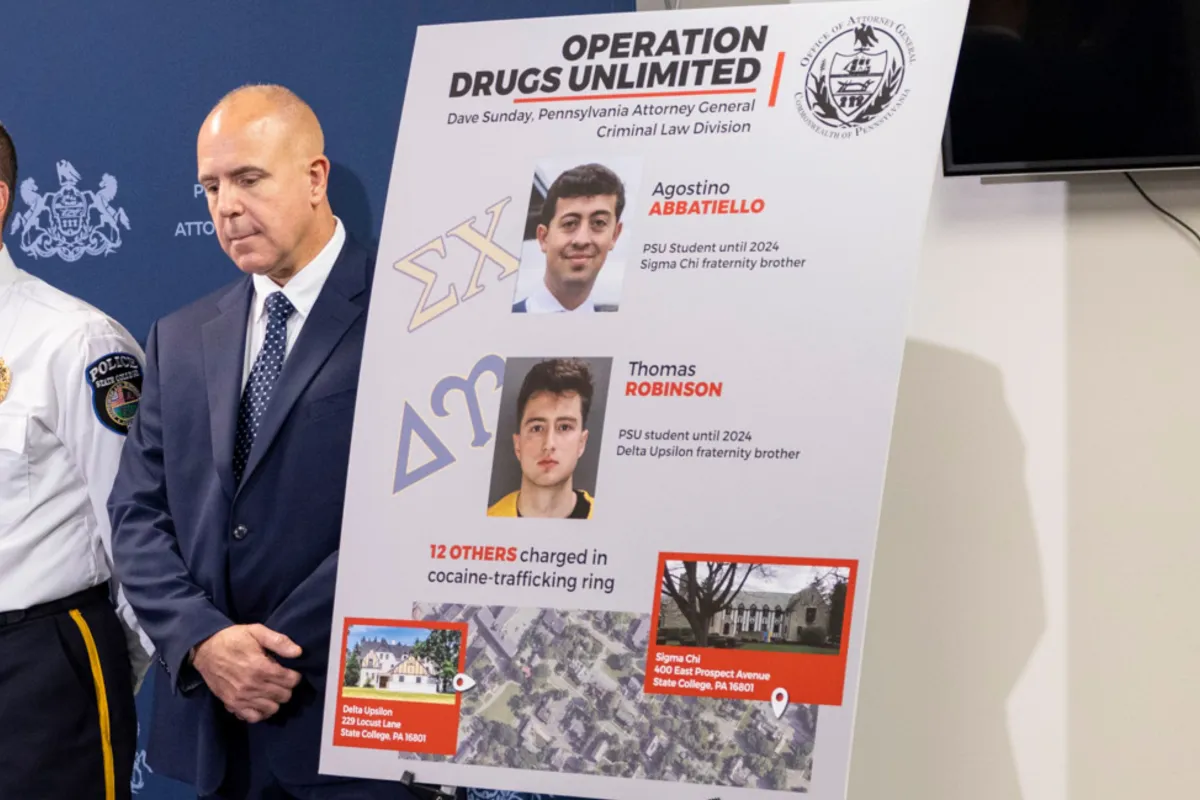
In the idyllic landscape of central Pennsylvania, where rolling hills meet the storied brick of Penn State University’s sprawling campus, the air is typically filled with the roar of Beaver Stadium on autumn Saturdays and the hopeful chatter of students chasing degrees and futures. Yet beneath this veneer of collegiate normalcy, a dark and corrosive enterprise was allegedly festering within the hallowed walls of Greek life. On Monday, Pennsylvania Attorney General Dave Sunday made a chilling announcement that shattered the facade of fraternal camaraderie: fourteen individuals, including thirteen current or former Penn State students and one father, have been charged in connection with a sophisticated, multi-year drug-trafficking operation. The most disturbing revelation, however, was the alleged method of recruitment—the ritualistic “indoctrination” of fraternity pledges, who were reportedly compelled to cut and package cocaine as a twisted rite of passage into their brotherhood. This wasn’t just a simple case of social drug use among college kids; it was a coordinated, profit-driven criminal syndicate operating in plain sight, leveraging the vulnerabilities of youth and the enigmatic allure of exclusive societies. The enormity of the charges, ranging across felony drug offenses, carries with it the weight of obliterated futures, betrayed trust, and a sobering indictment of a culture that has long been romanticized in American college life. The very notion that a pledge might stand in a kitchen, plastic gloves on, scaling out lines of cocaine while a senior member nods approvingly, is a grotesque distortion of the sacred promises of loyalty and mutual uplift that fraternities claim to represent. It evokes a chilling parallel to the recruiting tactics of street gangs, but dressed in the crisp khakis and polo shirts of university dons. As the news rippled across the campus Monday, students walked through the HUB-Robeson Center in hushed tones, the cheerful dining halls feeling suddenly foreign. This development has not only shocked the microcosm of State College but has caught the attention of national media, serving as a stark reminder that the “college experience” can sometimes harbor the darkest of secrets.
According to the detailed evidence unveiled by the Attorney General’s office, this was no petty street-level dealing; it was a large-scale, inter-state logistical operation. Prosecutors have identified Agostino Abbatiello and Thomas Robinson as the enterprise’s principal suppliers, the kingpins who orchestrated the flow of narcotics. The duo is accused of making regular, calculated pilgrimages to the drug markets of New York City and Philadelphia, returning to State College with substantial quantities of raw cocaine. The pattern was meticulously planned; they would leave at odd hours, take varying routes, and often use rental vehicles to avoid detection. Once acquired, the drugs were allegedly transported to the fraternity houses of Sigma Chi and Delta Upsilon, where the bulk of the processing occurred. In these opulent common rooms, decorated with university banners and decades-old photographs of esteemed alumni, authorities allege that a dark alchemy took place. The cocaine was meticulously “cut” with cutting agents like levamisole or mannitol to maximize profit, then weighed on precision scales and repackaged into smaller, street-ready quantities, often stamped with identifiable markers. The target audience was chillingly specific: the broader Penn State student body. The network was streamlined and efficient, operating on the notion that college campuses are captive markets with high disposable incomes and often careless attitudes toward risk. While the specifics of the father’s role remain murky, the involvement of the 14th defendant adds a layer of tragic complexity. It raises disturbing questions about generational complicity—how a parent, perhaps seeking to bond with a child or entangled in the operation’s finances, could have allowed his name to be tethered to such a sordid venture. Is it possible he drove them to their pickups? Did he offer a garage for storage? The emotional agony of a parent watching a child descend into criminality must have been palpable, yet the legal system now treats him as an active participant. The sheer scale of the distribution network implies hundreds of transactions, thousands of grams moved, and a staggering amount of drug money flowing through bank accounts, student loans, and cryptocurrency wallets, leaving a veritable paper trail for investigators to meticulously unravel.
To truly understand the gravity of this situation, one must delve into the arcane, often hazardous world of American fraternity initiation. Greek life is built upon centuries-old traditions of brotherhood, loyalty, and shared experience, but in recent decades, these bonds have frequently been forged through the fires of hazing—physical, psychological, and now, evidently, criminal. The alleged requirement that pledges participate in the cutting and packaging of cocaine as a form of “indoctrination” represents a terrifying perversion of that bonding process. For a freshman desperate to belong, intimidated by older members, and seduced by the promise of status and lifelong connections, the directive to handle a bag of white powder may have felt less like a crime and more like a test of commitment—an artificial demonstration of their readiness to sacrifice. The psychological manipulation is insidious; it strips away the notion of personal agency, convincing these young men that secrecy and complicity are the highest forms of loyalty. In this perverse ecosystem, the fraternity house became a utilitarian hub of criminality, where the loud music, laughter, and drunken partying served as the perfect acoustic camouflage for the sound of baggies being sealed. The tragedy is that virtually every student involved walked into these houses seeking community, belonging, and perhaps a network of future business partners; instead, they walked into a trap that threatens to destroy their academic records, their reputations, and their liberty. The image of a young man, still wearing the faint smile of a hopeful initiate, standing over a mirror with a razor blade, is chilling. He is not cutting a line for personal use at a party—he is manufacturing a product for sale to his peers, a transaction that could lead to fatal overdoses, debilitating addictions, and the fracturing of families across the state. The fraternity’s high walls and secretive rituals, once designed to protect centuries-old secrets, are now being weaponized as shields for felony activity. A prospective student and their parents, researching Penn State, will now stumble upon this news, forever altering the perception of these historic houses on Fraternity Row.
The legal thunderclap delivered by Attorney General Dave Sunday signals a robust, aggressive crackdown on what authorities believe to be a deeply entrenched drug distribution network. In his statement, Sunday described the crew as “coordinated and highly profitable,” asserting that the evidence paints a vivid picture of a criminal enterprise that operated with a brazen disregard for the law and the safety of the student community. The charging documents likely lay out a trail of surveillance footage, controlled buys, financial records, and witness testimony that pieced together months of illegal activity occurring between 2023 and 2024. For the thirteen students facing charges, the immediate stakes are cataclysmic. Aside from the potential for lengthy prison sentences if convicted on serious felony counts, their academic futures are effectively shattered—expulsion proceedings are imminent, scholarships will be revoked, and the stigma of a drug trafficking arrest will follow them into any professional landscape. They will face the anger and disappointment of their families, the whispers of their hometowns, and the crushing realization that what once seemed like fast cash and fraternal bragging rights has now cost them everything they worked for. The ripple effects extend far beyond the defendants themselves. The students they sold to, friends and fellow classmates, have been swept into a narrative of potential addiction, financial loss, and academic decline. It forces the entire Penn State community to confront an uncomfortable truth: that the pervasive accessibility of narcotics on campus is not a random accident but often the result of sophisticated, localized supply chains run by the very peers they sit next to in lecture halls. Law enforcement agencies, from the local police to the DEA, will likely dig deeper into this ring, examining whether these fraternities had outside connections to larger cartels or downstate distributors. The collaborative effort between the Attorney General’s Bureau of Narcotics Investigation and campus authorities highlights a growing initiative to target college-town drug networks, which have historically been viewed as low-hanging fruit for dealers given the dense population of young, affluent, and often reckless consumers.
Penn State University’s immediate response to the arrests has been definitive, yet it lays bare the complex jurisdictional gaps that exist in the Greek system. The university has placed Delta Upsilon on interim suspension, freezing its operations and curtailing its activities as the investigation unfolds. This is a standard measure designed to ensure the safety of the campus and to signal that the institution does not condone such behavior. However, the case of Sigma Chi presents a unique challenge; Penn State clarified that the chapter is not currently recognized by the university and therefore operates independently, outside the university’s direct oversight. This distinction highlights a persistent loophole in collegiate Greek life, where national organizations can exist as off-campus entities, evading university scrutiny even as they draw their membership from the student body. The university’s press release was carefully worded, expressing shock and providing reassurances of cooperation, but also emphasizing the legal limits of their reach. While the university cannot police every off-campus residence, this incident will undoubtedly spur conversations about tightening regulations, requiring all chapters to register with the school, or implementing mandatory oversight of fraternity finances and activities. Alumni from both chapters have likely expressed outrage, demanding answers from national headquarters, which themselves are struggling to distance their historic brands from this scandal. The national Sigma Chi organization will likely issue a statement revoking charters and cooperating with authorities, but the damage is done. But for now, the institution is left to pick up the pieces, issuing promises of cooperation with law enforcement while grappling with a public relations nightmare that tarnishes the university’s branding. The development remains fluid, with prosecutors promising further indictments and the ongoing investigation casting a long shadow over the campus as students return from break, their WhatsApp groups buzzing with anxiety over who might be named next. The college’s prevention programs will be scrutinized, and questions will be asked about why hazing reports hadn’t surfaced earlier, or if the fraternity’s reputation for raucous parties had somehow insulated them from scrutiny.
Ultimately, this story is a glaring, cautionary tale about the confluence of privilege, peer pressure, and greed. It is heartbreaking to imagine the homecoming dinners where proud parents asked their sons about their fraternity experiences, unaware that their “brothers” were mentoring them in the art of narcotics distribution. The fourteen individuals charged—bright students with potential, a father who perhaps acted out of misguided loyalty—are now inexorably linked in a criminal case that will define their lives. The allure of “easy money” that draws many into the drug trade offers a stark contrast to the reality of prison bars, shattered dreams, and the lifelong label of felon. For every hundred dollars of cocaine sold, there is a risk of a narcotic overdose in a dorm room; for every successful packaging run, there is a human being whose life is being fed into a grinder. This incident forces a national reckoning with the unglamorous reality of modern fraternity culture. If the bonds of brotherhood can be so twisted that they involve criminal conscription, then perhaps the very foundation of these organizations needs to be reevaluated. As the legal machinery grinds forward, the community of State College mourns the loss of innocence, not just for the accused, but for the systemic failure that allowed this to happen. One can only hope that these arrests serve as a wake-up call, prompting educational institutions nationwide to foster cultures of genuine mentorship and accountability, rather than the destructive, hierarchical hazing that too often turns vulnerable youth into pawns in a dangerous game. The true price of “brotherhood” has never been so brutally clear. As court dates approach and the evidence will be presented, both the defendants and the university will have to answer for their roles, but the real lesson for generations of students to come is that the pursuit of social status can never justify sacrificing your moral compass or your freedom. The gilded letters of Sigma Chi and Delta Upsilon, once symbols of elite belonging, may now stand as ironic monuments to the cost of unbridled hubris.