


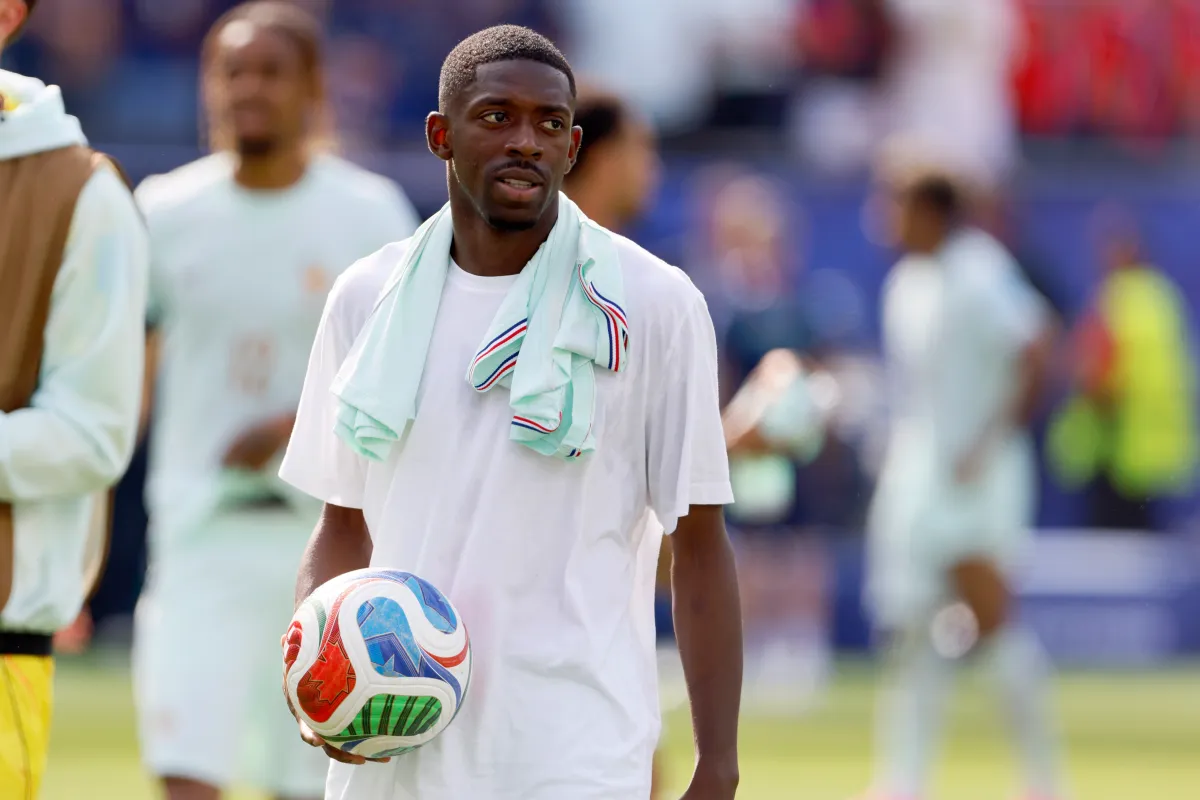
Few sights in modern football are as captivating as a world-class winger playing in a state of absolute, unburdened flow, and that is precisely what the global audience witnessed as Ousmane Dembélé put on a masterclass of clinical finishing and breathtaking movement during France’s emphatic 4-1 victory over Norway. It was a crisp, high-stakes evening of World Cup action, and Dembélé transformed the pitch into his personal canvas, painting a masterpiece within the opening half-hour of the match. His historic performance began with a lightning-fast strike in just the seventh minute, a goal that immediately destabilized the Norwegian defense and set a relentless tone for the rest of the match. Before the opposition could catch their breath or adjust their defensive block, the elusive Frenchman struck again in the 20th minute, showcasing a blend of electric pace and composed decision-making that left spectators in awe. The crowning moment of this first-half blitz arrived in the 32nd minute when Dembélé completed his historic hat-trick with a superb finish, etching his name into the annals of the tournament’s history. Not since the 1994 World Cup in the United States, when Russia’s clinical forward Oleg Salenko dismantled Cameroon with a historic first-half display, had a player managed to secure a hat-trick before the halftime whistle in a World Cup match. Dembélé’s explosive exhibition of raw talent and precision not only secured France’s dominance on the night but also served as a stark warning to the rest of the competing nations that Les Bleus possess an attacking arsenal capable of dismantling even the most organized defensive units on the planet.
Yet, what occurred in the media mixed zone after the final whistle was perhaps even more fascinating than the glittering display on the pitch, offering a rare and humanizing window into the complex psychology of an elite athlete who refuses to be blinded by individual statistics. Rather than basking in the adulation of a historic milestone or indulging in the self-congratulatory narratives that dominate modern sports media, Dembélé delivered a remarkably candid and grounded assessment of his own performance. Translated from his native French, the superstar confessed that while he was deeply happy and recognized the moment as incredibly unique and personally important, he surprisingly preferred his previous tournament outings against Senegal and Ireland. Dembélé explained that in those matches, despite not scoring a hat-trick, he felt far more connected to the team’s tactical structure and believed his overall play was significantly more influential to the collective effort. This level of self-criticism in the wake of a historic achievement is exceedingly rare in the modern game, where goal tallies often eclipse all other metrics of performance. It reveals a highly mature and introspective player who measures his success not by personal glory or social media highlight reels, but by his tactical utility, his defensive work rate, and his ability to dictate the rhythm of the game for his teammates. Dembélé’s insistence that the team must quickly pivot from this victory, banish complacency, and maintain absolute focus for the monumentally important challenges ahead speaks volumes about the leadership culture brewing within the French camp.
This collective pursuit of excellence and refusal to rest on their laurels has been the defining characteristic of France’s campaign as they successfully navigated their way through the challenges of Group I. The journey began with a commanding 3-1 triumph over a resilient Senegal side, a match that was largely illuminated by the terrifying brilliance of Kylian Mbappé, who netted a vital brace to guide his country to victory. France then followed up that opening statement with a highly professional 3-0 demolition of Iraq, a match where Mbappé once again demonstrated his status as a global icon by scoring another two goals, while Dembélé chipped in with a well-deserved third to put the game completely out of reach. These consecutive, high-octane victories ensured that Didier Deschamps’ men had already secured safe passage into the highly anticipated Knockout Stage before they even stepped onto the pitch to face Norway. The tactical synergy between Mbappé and Dembélé on the flanks has emerged as the crown jewel of this French squad, creating an almost unsolvable dilemma for opposing managers who must decide whether to double-team the explosive pace of Mbappé on the left or stretch their defensive lines to account for the unpredictable, two-footed wizardry of Dembélé on the right. By securing nine points from a possible nine and winning their group in emphatic fashion, France has established themselves as the undisputed team to beat, marrying individual brilliance with a fiercely disciplined tactical structure.
To fully understand the context of Friday’s 4-1 victory, however, one must also analyze the strategic chess match taking place behind the scenes, particularly from the perspective of a pragmatic Norwegian side. Norway entered the match against the heavyweight French squad with their primary objective of the group stage already achieved, having successfully qualified for the coveted Round of 32 in their own right. Recognizing the grueling physical demands of a modern international tournament, Norway’s coaching staff made the calculated and highly deliberated decision to shield their talismanic superstar, Erling Haaland, leaving the powerhouse striker to watch the entire ninety minutes from the safety of the substitute bench. For Norway, the match was less about fighting tooth and nail for the top spot in Group I and more about managing squad fatigue, preventing devastating injuries to key personnel, and preservation of energy for the life-or-death knockout rounds ahead. Consequently, while France remained heavily aggressive and intensely focused on maintaining their momentum, Norway was largely content to accept a respectable second-place finish in the group. This tactical imbalance certainly contributed to the space Dembélé enjoyed in the final third, a reality that the sophisticated French winger undoubtedly recognized and which likely fueled his introspective post-match comments regarding the true competitive nature of his historic hat-trick.
The contrast between the external celebration of Dembélé’s milestone and his own internal standard of performance highlights a fascinating dynamic in the world of elite sports: the tension between individual statistics and genuine team impact. In an era where players are constantly scrutinized through the narrow lens of fantasy sports points, goal contributions, and viral moments, Dembélé’s desire to focus on his holistic “influence” on the pitch is incredibly refreshing. It serves as a reminder that the most beautiful aspects of football—the off-the-ball runs that drag defenders out of position, the subtle defensive tracking back that protects a vulnerable fullback, and the patient recycling of possession that tires out an opponent—are often invisible on a basic score sheet. Dembélé’s standard of excellence is not dictated by the number of times he finds the back of the net, but by how effectively he executes the complex tactical instructions laid out by his coaching staff. By publicly prioritizing his more rounded and disciplined performances against Senegal and Ireland over a flashy, three-goal display against a rotated Norwegian side, Dembélé has set a powerful precedent for his teammates, demonstrating that personal accolades must always remain secondary to the pursuit of collective, tournament-winning cohesion.
Now, as the grand theater of the World Cup transitions into the unforgiving, single-elimination phase of the tournament, France must translate this highly grounded philosophy into tangible results on the pitch. Standing in their way in the upcoming Round of 32 is a disciplined, physically imposing Sweden squad, with the high-stakes encounter scheduled to take place on Tuesday, June 30. Sweden will undoubtedly present a far more rigorous defensive challenge than a relaxed Norwegian side, relying on their signature compact defensive shape, aerial superiority, and lethal efficiency on counterattacks to orchestrate a monumental upset against the reigning world titans. The path to World Cup glory is notoriously littered with highly talented teams that fell victim to complacency after cruising through the group stages, a fate that Dembélé and his teammates are desperately determined to avoid. As Les Bleus prepare to take the pitch in this make-or-break clash, the footballing world will watch with bated breath to see if France can maintain their dazzling momentum. Under the watchful eye of Didier Deschamps, and armed with the explosive talent of Mbappé and the newfound, mature leadership of a humble Ousmane Dembélé, France appears to possess not just the physical tools, but the psychological fortitude required to navigate the treacherous pressure cooker of the knockout rounds and march steadily toward ultimate footballing immortality.