


The college football world is no stranger to intrigue, but the initial SEC availability report released on Wednesday night landed with the force of a perfectly executed blitz. LSU, in a move that stunned fans and analysts alike, listed its starting quarterback, Sam Leavitt, as “doubtful” for the highly anticipated Saturday clash against Ole Miss. The timing was perplexing, to say the least. Just two days earlier, head coach Lane Kiffin addressed the media with his customary bravado, fielding questions about the Rebels without so much as a whisper regarding his signal-caller’s health. This silence, juxtaposed with the harsh reality of the “doubtful” designation, created an immediate vacuum of trust and spawned a wildfire of speculation. Across message boards and social media platforms, the narrative shifted rapidly from concern for Leavitt’s well-being to accusations of deliberate deception. Was this the ultimate mind game from a coach known for his unorthodox tactics? Was LSU attempting to force Ole Miss defensive coordinator Pete Golding to split his preparation between two completely different offensive schemes? The theory of a smokescreen felt entirely plausible, given the high stakes of a game that could define the trajectory of both teams’ seasons. However, as Thursday morning broke, the narrative began to evolve, transforming from a tale of calculated espionage into something far more relatable and, in a way, more human: the story of a gritty quarterback fighting through a painful, nagging injury to be ready for the biggest game of his young career.
The fog of uncertainty began to lift when veteran LSU insider Matt Moscona dropped a crucial update on social media, offering a direct contradiction to the bleakest interpretations of the previous night. According to Moscona, citing team sources, Leavitt actively participated in the Tigers’ practice session on Thursday morning. The reason for his absence on Wednesday, and subsequently his placement on the availability report, was not a catastrophic structural injury, but rather a sudden bout of back spasms. Back spasms are a cruel, unpredictable affliction for any athlete, capable of seizing the body with intense, involuntary muscle contractions that can make even the simplest movement agonizing. For a quarterback, whose entire craft is built on rotational torque, hip mobility, and a fluid throwing motion, a back spasm is a terrifying enemy. The fact that Leavitt was able to return to the practice field just 24 hours after being listed as “doubtful” speaks volumes about his resilience and the effectiveness of the LSU medical staff. It also highlights a crucial nuance often lost in the immediate hysteria of injury reporting: the initial report is a snapshot in time, reflecting a player’s status at that exact moment. By Thursday morning, the spasm had likely subsided enough to allow movement, though the lingering soreness would surely be monitored closely. The atmosphere within the LSU facility shifted from one of panic to cautious optimism, as the sight of their starting quarterback moving around in practice provided a massive morale boost to a team that knows its College Football Playoff aspirations hinge on this very game.
Adding further clarity to the situation, Pete Nakos of On3 provided a comprehensive report detailing the specific nature of Leavitt’s ailments. According to Nakos, the quarterback was dealing with not just back tightness, but also a sore shoulder that had limited his workload throughout the week. He notably did not throw a single pass during Wednesday’s practice, which perfectly explains why the team felt compelled to list him as “doubtful” on the SEC’s mandatory report. However, the most telling detail in Nakos’s report was the expectation echoed by multiple sources within the program: they fully expect Leavitt to play against Ole Miss on Saturday night. This assessment suggests that the injuries, while painful and restrictive, are not considered severe enough to keep him out of a contest of this magnitude. The combination of back tightness and a sore shoulder paints a picture of a quarterback who has taken a beating over the first two weeks of the season, absorbing hits from aggressive defenses while also contributing significantly to the running game. Yet, the human spirit of a competitor cannot be underestimated. The difference between being able to practice on Wednesday and being able to play on Saturday is immense. With 72 hours of aggressive treatment—ice baths, massages, anti-inflammatory medication, and targeted stretching—a back spasm can often be managed enough to allow a player to function. The team’s confidence in his availability suggests that the medical staff views this as a manageable pain tolerance issue rather than a structural threat. Leavitt is likely doing everything in his power to prove he can go, and the coaching staff, understanding the gravity of the matchup, is giving him every opportunity to do so.
To fully appreciate the drama surrounding this report, one must understand the stringent regulations governing the SEC’s availability policy. The league mandates that teams submit reports three days prior to game day, and the designations carry specific definitions. A “doubtful” tag is reserved for a player who is “unlikely to play due to significant concerns,” a label far more severe than “questionable,” which denotes uncertainty, or “probable,” which implies likely participation. The stakes for misreporting are not trivial; the SEC can levy fines ranging from $25,000 to $100,000 for inaccurate or late submissions. This framework is designed to ensure transparency, particularly for sportsbooks and opposing coaches, but it also creates an interesting gray area for injury management. A player’s status is fluid—a back spasm that warrants a “doubtful” label on Wednesday night could be completely resolved by Saturday afternoon. Conversely, a player who appears perfectly healthy could suffer a setback during warmups. In this specific case, the discrepancy between Leavitt’s “doubtful” status and his expected availability highlights the delicate balance between medical caution and competitive necessity. If Leavitt does indeed play, LSU will likely face questions about the accuracy of their report, though they could easily defend it by citing the severity of Wednesday’s spasm. However, if they had listed him as “questionable” or “probable,” they would have risked underreporting the severity of his initial condition. The system inherently incentivizes teams to err on the side of caution on the initial report, which often leads to dramatic upgrades in status as the week progresses. This is precisely what appears to be happening in Baton Rouge.
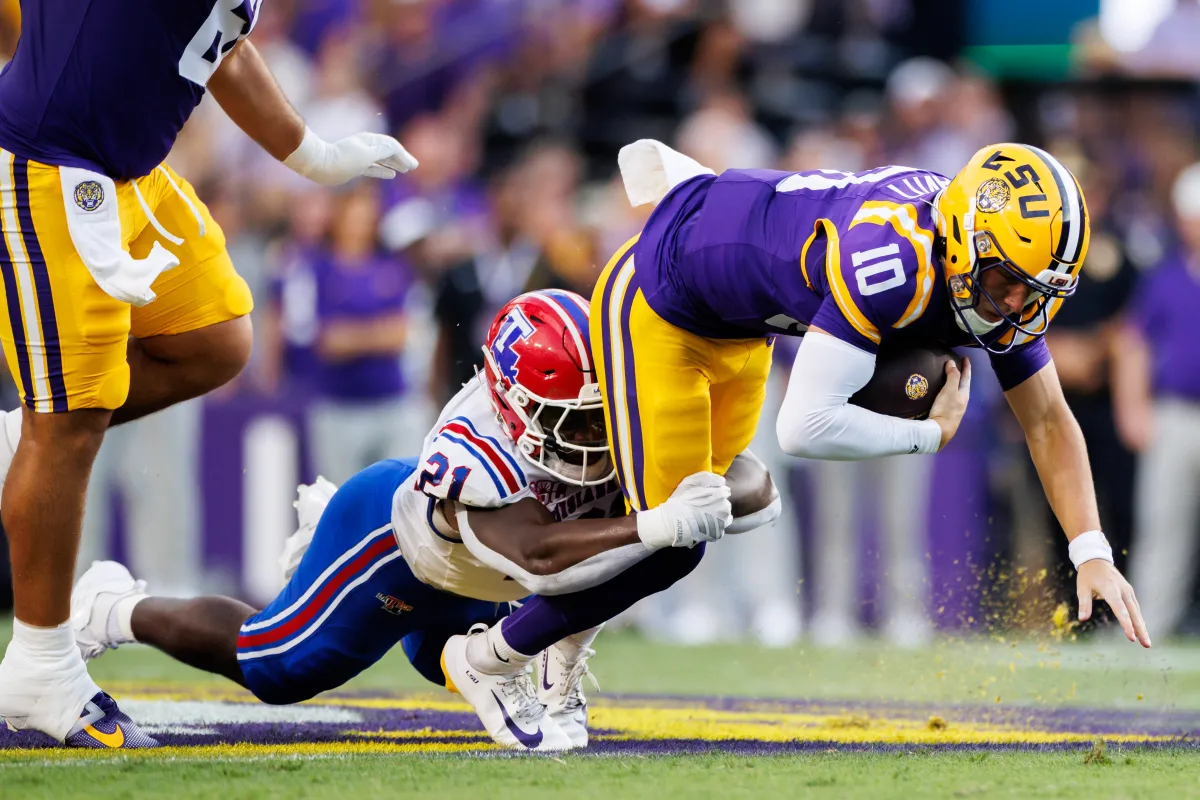
Beyond the medical drama lies the simple, undeniable fact of Leavitt’s importance to the LSU offense. In the season opener against Clemson, he was nothing short of spectacular, throwing for 230 yards and a touchdown while adding a breathtaking 133 rushing yards and two more scores on the ground. That performance showcased a dual-threat quarterback capable of eviscerating a defense with his arm and his legs. However, his second outing against Louisiana Tech painted a more erratic picture. While he accumulated 344 passing yards, he also threw three interceptions, reminding everyone that he is still a developing player prone to forcing throws under pressure. The inconsistency is a concern, but the threat he poses is undeniable. Against an Ole Miss defense that will undoubtedly dial up pressure and blitz packages, Leavitt’s mobility is arguably his most valuable asset. The ability to escape the pocket, extend plays, and scramble for crucial first downs is what separates him from a standard pocket passer. His sore shoulder and back tightness, however, could compromise that mobility. If he is limited in his ability to throw with full velocity or scramble with his trademark elusiveness, the Ole Miss defense can be far more aggressive, knowing they have less to fear. The coaching staff will have to tailor the game plan accordingly, perhaps relying more on quick, short passes to get the ball out of his hands quickly and protect him from further punishment. The chess match between LSU’s offensive adjustments and Ole Miss’s defensive aggression will hinge entirely on Leavitt’s effectiveness, making his health the single most important variable in the game.
Ultimately, this entire saga boils down to a familiar theme in college football: the warrior mentality of a young man willing to sacrifice his body for the sake of his team. Lane Kiffin, despite his reputation as a provocateur, remained silent on the injury, which might simply be a reflection of a coach trusting his medical staff and waiting for more information rather than a deliberate attempt at deception. The rivalry between LSU and Ole Miss is notoriously fierce, and a victory on Saturday carries significant weight in the SEC West standings and the national championship picture. For Leavitt, sitting out this game would be a devastating blow, not just to his team’s chances, but to his personal pride. All signs point to him taking the field on Saturday night, but with the caveat that he will be playing through significant pain. The medical staff will likely make a final determination after a pregame warm-up, testing his range of motion and throwing velocity one last time. The skepticism that dominated Wednesday night has given way to a sense of resigned acceptance: this is a young quarterback who got banged up in practice, was listed as doubtful out of an abundance of caution, and is now fighting tooth and nail to be under center when the lights come on. The “smokescreen” theory has faded, replaced by a more human story of grit, pain management, and the immense pressure of a marquee SEC showdown. For fans, it will be a tense few days, but the anticipation of seeing Leavitt lead his team onto the field, albeit hobbled, is a compelling narrative that adds another layer to an already electric matchup.