


The landscape of American politics often resembles an endless horizon where one grueling campaign cycle bleeds seamlessly into the next, leaving little time for the public or the party establishments to catch their breath. Even as the nation grapples with the lingering national hangover of the 2024 presidential election, the invisible machinery of the 2028 race is already humming with quiet intensity. For the Democratic Party, still searching for an anchor and a coherent identity in a highly polarized era, the future remains an open and highly anxious question. We find ourselves in a period of intense reflection and preliminary jockeying where no candidate has formally declared their intentions, yet the court of public opinion is already in session. This persistent uncertainty is reflected in various hypothetical matchups polling since 2025, which paint a picture of a restless electorate testing the waters and assessing whether old standard-bearers or fresh voices are best suited to lead them out of the political wilderness. At the very center of this brewing storm is former Vice President Kamala Harris, a figure who evokes both fierce loyalty and profound skepticism as the party attempts to map out its trajectory for the coming years.
The current state of play is vividly captured in the latest data from The Center Square Voters’ Voice Poll, conducted by Noble Predictive Insights between June 1 and June 4, which surveyed 1,013 Democrats with a margin of error of 1.93 percent. This dynamic poll reveals that Harris remains the clear frontrunner in the hearts and minds of prospective primary voters, commanding 27 percent of the hypothetical vote—nearly double her closest rival, California Governor Gavin Newsom, who sits at 14 percent. Following behind them are former Transportation Secretary Pete Buttigieg at 11 percent and New York Congresswoman Alexandria Ocasio-Cortez at 8 percent, while Midwestern governors JB Pritzker of Illinois and Andy Beshear of Kentucky both linger at a modest 2 percent. Yet, perhaps the most telling statistic in this survey is the 17 percent of voters who remain entirely unsure, signaling a quiet hesitation to fully commit to the established paths. This internal negotiation is further highlighted by a separate simulation conducted by Lake Research Partners from May 6 to May 11 among 800 Democratic primary voters, carrying a 3.5 percent margin of error. In their initial ranked-choice round, Harris led with 26 percent, followed by Newsom at 17 percent, Buttigieg at 16 percent, and Ocasio-Cortez at 10 percent; however, when the field was narrowed to a final head-to-head match, Harris’s seemingly dominant lead became far more competitive, ending in a narrow 52 percent to 48 percent split against Newsom.
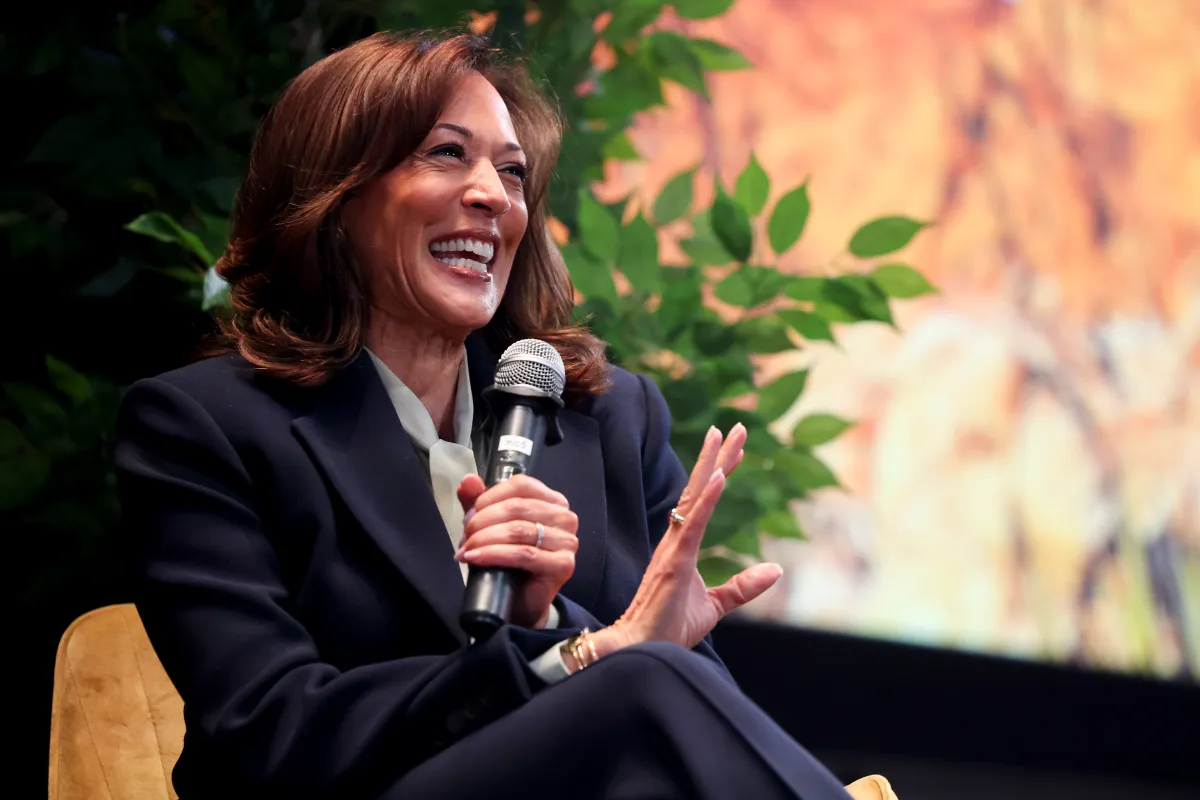
These numbers present a complex paradox: while Harris possesses undeniable strength as a known quantity, her commanding presence in the polls may reveal more about the power of familiarity than a deep-seated mandate from the base. Grant Davis Reeher, a professor of political science at Syracuse University, suggests that Harris’s current leads are largely driven by name recognition, brand familiarity, and the natural political inheritance of a former vice-presidential nominee. Reeher argues that when voters are presented with early, hypothetical surveys, they tend to reach for the names they know best, though this support can easily dissolve once the crucible of a real campaign begins. In a sobering assessment of Harris’s viability, Reeher expressed deep reservations about her potential to lead a successful national ticket, pointing to her previous general election loss to Donald Trump in 2024 as a major obstacle. He highlighted her perceived “California baggage,” her history of unforced campaign errors—most notably her tendency to sidestep direct answers to basic policy questions—and her historic struggle to build organic momentum, a pattern that first emerged during her unsuccessful 2020 primary run. Despite these critiques, and the quiet wishes of some party strategists who believe she should step aside to make room for a new generation of leadership, Harris has kept her options open, telling the Reverend Al Sharpton earlier this year that she is actively “thinking about it.”
In stark contrast to the traditional, calculated ambitions of seasoned insiders, Alexandria Ocasio-Cortez offers a fundamentally different philosophy on political power and public service, one that rejects the constant calculus of looking for the next promotion. When recently asked by veteran political strategist David Axelrod about her thoughts on a potential 2028 presidential bid, the New York representative delivered a candid, reflective response that cut through the typical script of Washington ambition. She explained that she consciously avoids making legislative decisions with her eye on a future Senate or White House run, noting that such long-term planning can act as a creative and moral straightjacket. For Ocasio-Cortez, true liberation comes from not being attached to a lifelong dream of holding a specific office, allowing her instead to focus her energy on building movements and advocating for lasting, transformative reforms. She emphasized that while individual politicians, senators, and presidents are merely transient figures who come and go, systemic achievements like a living wage, robust workers’ rights, and single-payer healthcare are enduring legacies that outlast any single administration. By prioritizing systemic change over personal status, her approach challenges the conventional rules of political planning, demonstrating how a leader can command significant influence simply by refusing to play the traditional political game.
Despite the intense skepticism surrounding the current crop of Democratic heavyweights, the broader national landscape suggests that the party still possesses a robust and resilient defensive line when matched against prospective Republican opponents. When looking past internal primary dynamics to the general electorate, the Public Sentiment Institute’s survey of 893 likely voters from May 21—with a 3.8 percent margin of error—reveals some remarkably consistent patterns. In hypothetical head-to-head matchups against Vice President JD Vance, Kamala Harris leads 47 percent to 38.9 percent, while maintaining similar advantages against other top-tier Republicans: she bests Secretary of State Marco Rubio by 46.9 percent to 38.9 percent, Florida Governor Ron DeSantis by 47.2 percent to 38.8 percent, and Texas Senator Ted Cruz by 46.1 percent to 38.5 percent. This pattern of comfortable leads is not unique to Harris; Pete Buttigieg similarly outperforms the Republican field, leading Vance by 45.7 to 39.8 percent, Rubio by 44.3 to 39 percent, DeSantis by 45.2 to 37.3 percent, and Cruz by 45.5 to 37.5 percent. Gavin Newsom also shows strong general election viability, consistently leading his Republican counterparts by comfortable margins, including a 45.1 to 38.6 percent lead over Vance, a 45.9 to 39.1 percent lead over Rubio, and a 44.4 to 39.4 percent lead over Cruz. These numbers demonstrate that while primary voters may express doubts about their field in isolation, the prospect of a Republican administration immediately coordinates and solidifies the Democratic coalition.
Ultimately, these early polls and philosophical debates are about much more than mere numbers, margin errors, and statistical models; they reflect a deeper, more human struggle within a nation trying to define its direction. The transition toward 2028 will force the Democratic Party to make a fundamental, agonizing choice between the institutional security of the status quo and the risky, inspiring promise of bold, systemic change. Voters are being asked to decide whether they want a leader who has navigated the halls of power and carries the scars of previous campaigns, or one who is willing to challenge the system itself from the ground up. As Harris mulls over her political future, as Newsom and Buttigieg carefully position themselves on the national stage, and as Ocasio-Cortez champions a more liberated form of public service, the American electorate watches, waits, and prepares to write the next chapter of its democratic journey. This serves as a powerful reminder that leadership is never truly won in sterile laboratories of data or national polls, but is earned in the quiet commitment to building a more equitable and authentic society.