

Imagine a classroom full of teenagers studying American history. The teacher asks them to close their eyes and picture where they were on September 11, 2001. Most cannot—because they weren’t born yet. That distance is exactly why educators across the country say the 25th anniversary of the attacks is such a critical teaching moment. According to Associated Press research, at least 40 states now expect or encourage public schools to address 9/11 in some form. Twenty-five states have laws or educational standards that specifically require or expect instruction about the attacks, while another 13 include optional references in their guidance. Several more mandate or recommend observances like moments of silence. Together, these policies mean the anniversary is no longer left to individual teachers’ discretion in most of the nation. But the numbers also reveal something deeper: the way America teaches 9/11 is changing. Roughly one-third of Americans were born after al-Qaida hijackers crashed four commercial airliners into the World Trade Center, the Pentagon, and a field in Pennsylvania, killing nearly 3,000 people. Today’s students are far removed from the shock and grief of that day. They have grown up in a world shaped by the attacks, but the raw immediacy is gone. Jeremy Stoddard, an education professor at the University of Wisconsin who studies how schools teach 9/11, told Newsweek that teachers increasingly see the attacks as a historical event, not a lived experience. Many now emphasize how the policies and wars that followed 9/11 continue to shape students’ lives. The challenge, Stoddard says, is to make an event that feels ancient feel urgent and real, without losing the human stories at its center. For teachers, this is no small task; it means finding a way to speak about an event they may still feel deeply, to students who cannot feel it at all. It means deciding how much truth is appropriate, how much sorrow is necessary, and how much hope can be offered. In many schools, the question is no longer whether to teach 9/11, but how.
Stoddard has spent years listening to teachers describe the strange new reality of teaching 9/11. “They just do not have the same emotional connection, the collective memory experience,” he said. In the years after the attacks, teachers could rely on shared grief; students remembered televisions playing the same footage, parents coming home early, the eerie silence of grounded planes. Now, for a student born in 2005, 9/11 is as distant as Pearl Harbor was to their grandparents. It is a date they memorize, not a wound they carry. The collective trauma of September 11 has become something else: an inheritance without inherited memory. Teachers often try to bridge the gap by sharing their own stories—where they were, whom they called, what they saw. But Stoddard acknowledges that storytelling can only go so far. “They will never have that same connection,” he said. The risk, as Gordon Felt put it, is silence. Felt’s brother Edward died aboard United Airlines Flight 93, which crashed near Shanksville, Pennsylvania, and he has spent years talking to educators. “Even worse than getting started wrong or using inappropriate language is the total omission of telling the story,” he told teachers during a seminar at the Flight 93 National Memorial. “That’s our biggest fear.” Felt’s words captured a central concern among educators and survivors: as living memory fades, the story could slip out of classrooms entirely. That fear has helped drive the push for state policies, curriculum standards, and memorial observances. It has also prompted schools to rethink how to present the day to children who never knew it. Some teachers assign interviews with parents or grandparents, asking students to become historians of their own families. Others ask students to look at photographs of the victims, not as statistics but as people with birthdays, favorite songs, and unfinished conversations. The September 11 Memorial & Museum has built an education program around this challenge, offering workshops, virtual field trips, and primary-source resources for teachers. Yet no resource can replace the power of a teacher willing to pause, look at students, and say: this is part of who we are. The goal is not to make students feel guilty or sad, but to make sure they understand that history is made of flesh and blood.
This summer, educators gathered at the Flight 93 National Memorial to wrestle with those questions. What details are appropriate for young children? How should victims be remembered? What broader lessons should students take away? The answers have shifted over time. When Stoddard surveyed teachers around the 20th anniversary, many reported focusing on the anniversary itself—showing news footage, sharing recollections, and emphasizing the heroism of first responders and the feeling of national unity. That approach still exists, but he now sees a “generational split.” Younger teachers, and even some veteran teachers, have started treating 9/11 as history rather than memory. They are more likely to ask students to analyze how the government’s response—from the creation of Homeland Security to the Patriot Act—still affects their everyday lives, from airport security to surveillance and debates over civil liberties. “We do see a generational split of sorts where they view it more as history and want students to understand how the response to 9/11 in particular, such as the Patriot Act, still impacts them today in ways that they do not know,” Stoddard said. This broader frame makes the subject feel less like a memorial and more like a lesson in civic life. It also makes room for complexity: the wars in Afghanistan and Iraq, the treatment of Muslims and Arab Americans, the balance between security and freedom. Some teachers use oral histories, primary documents, and virtual tours of the memorial museum. Others ask students to explore difficult questions about national security and civil liberties. Students may wonder why airport security is the way it is, or why American citizens of Muslim faith sometimes face suspicion. Those questions do not have easy answers, but they are exactly the kind of questions that make history feel alive. States, too, have become more willing to include 9/11 in their curriculum standards as the events recede into the past. A decade after the attacks, roughly 60 percent of states did not mention 9/11 at all in their education standards. Since then, the map has changed dramatically. Stoddard said that “for those states that include it, it seems to be going in much more depth than it was in the past.”
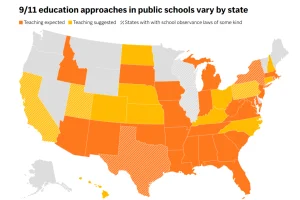
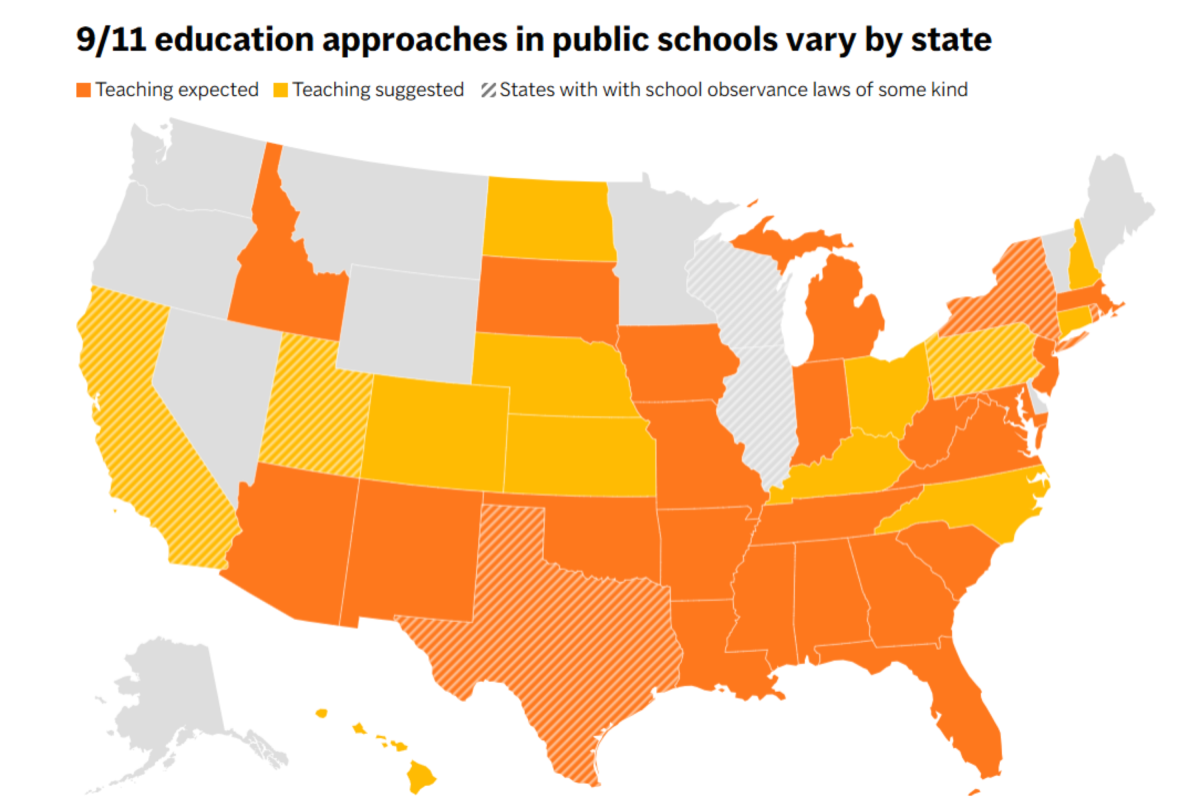
The national picture is not a simple divide between states that teach 9/11 and those that don’t. It is a patchwork. The strongest requirements fall into three broad categories. Some states, like Arizona and Florida, explicitly direct schools to provide instruction about the attacks. Other states—including Alabama, Arkansas, Georgia, Idaho, Iowa, Louisiana, Maryland, Massachusetts, Michigan, Mississippi, Missouri, New Jersey, New Mexico, New York, Oklahoma, South Dakota, Tennessee, Virginia, and West Virginia—embed the topic in required or expected social studies standards. A third group, made up of California, New York, Pennsylvania, Rhode Island, Texas, and Wisconsin, has statewide laws or provisions calling for moments of silence or other school observances, though the details differ. Beyond the strongest mandates, a broader set of states provides guidance without a hard mandate. Alaska, Colorado, Connecticut, Delaware, Hawaii, Illinois, Kansas, Kentucky, Maine, Nebraska, Nevada, New Hampshire, North Carolina, North Dakota, Ohio, Oregon, and Utah offer teachers suggested content, examples, or instructional support but stop short of requiring a specific statewide lesson. And a small number of states—Minnesota, Montana, Vermont, Washington, and Wyoming—had no specific 9/11 policy identified in the AP review. The categories are not always neat. A state might require instruction and also call for a moment of silence, while another might simply list 9/11 as one suggested topic among many. In places without a statewide mandate, local districts often make their own decisions; a vibrant memorial program can exist in one school and be completely absent in another just a few miles away. This inconsistency has consequences. It means that a student’s education about 9/11 can depend on the zip code in which they live. These differences can be confusing. Stoddard noted that reviews of state standards have produced different totals because researchers use different methods. A 2026 University of Wisconsin analysis he co-authored identified fewer states with explicit teaching or commemoration requirements because it focused only on official standards and legislation. The patchwork means that a student in one state may spend weeks studying the causes and consequences of 9/11, while a student in another may only hear about it if a teacher takes it upon herself to bring it up.
Among the states with explicit requirements, the level of depth varies. Alabama’s standards, for example, require students to study the U.S. military involvement that followed the attacks and to evaluate the effectiveness of America’s response, including the creation of Homeland Security and the passage of the Patriot Act. That is a far cry from simply watching a video of the towers falling. It asks students to think critically about cause and effect, about costs and consequences. Arizona lawmakers initially passed a statewide requirement for “age-appropriate education” on or around each 9/11 anniversary, though the requirement was later narrowed to grades seven through twelve. In other states, the topic appears in curriculum frameworks as a recommended example rather than a mandated lesson. Teachers can choose to cover it through a history unit on terrorism, a civics discussion about national security, or an English class reading a first-person account of the day. Some schools organize assemblies, invite guest speakers, or host moments of silence. Others weave the subject into broader lessons about American foreign policy or the changing nature of warfare. The AP research counted at least 25 states with laws or standards that specifically require or expect instruction, and another 13 with optional references. Add the states with observances, and the total reaches at least 40. Newsweek has also published a guide to help teachers navigate these decisions, offering suggestions for age-appropriate lessons, primary documents, and ways to address the trauma of the day. Some teachers use the anniversary to demonstrate what historians do: compare eyewitness accounts, evaluate sources, weigh evidence. Others use it to talk about civics, showing how a single day can transform laws and institutions. Indeed, one of the most powerful changes in recent years has been the move toward student-centered inquiry: students ask the questions, and teachers guide them to sources. But Stoddard cautions against reading too much into any single tally. “Different reviews have different methodologies,” he said. What matters, he argues, is not just whether 9/11 appears in a document, but whether students actually encounter it in a meaningful way.
As the 25th anniversary approaches, the question is not simply whether students learn the date or can list the facts. It is whether they can understand the human weight of that morning and the long shadow it has cast. For the young people who now fill America’s schools, 9/11 is not a memory. It is a doorway into understanding how grief, fear, and resilience shaped the world they inherited. The teachers gathered at the Flight 93 National Memorial this summer knew this. They listened to Gordon Felt, to survivors and family members, and to one another. They debated the right words, the right images, the right lessons. Their goal was not to make students feel guilty or scared, but to make them care. That is the heart of the challenge. A state law cannot force empathy; a curriculum standard cannot capture the sound of a fire alarm or the look on a parent’s face. But classrooms can do something no policy can: they can tell the story. They can make a distant event feel present by connecting it to the world students live in—to the way we board airplanes, to the debates about privacy and security, to the meaning of service and sacrifice. The worst outcome, as Felt warned, is omission. The second worst is a lesson that reduces nearly 3,000 deaths to a dry list of dates and policy responses. The best, many educators say, is a lesson that respects the past while speaking honestly to the present. On the 25th anniversary, Americans will pause again. The towers will be remembered in Manhattan, the Pentagon will remember its own, and a field in Pennsylvania will echo with names. In classrooms across the country, a generation that never knew that morning will be asked to understand it. The policies may be a patchwork, the standards uneven, the arguments ongoing. But the story, if told well, will endure. It will be told by teachers who may not have been alive themselves in 2001, but who have chosen to study, listen, and pass it on. And it will be heard by students who may not know what they are inheriting until they learn the names and the stories behind them.