





It was supposed to be a public health success story—a disease once declared eliminated in the United States, kept at bay by one of the most effective vaccines ever developed. Instead, the latest federal data paints a troubling picture of backsliding. During the 2025-26 school year, measles, mumps and rubella (MMR) vaccination coverage among American kindergarteners fell to 92.4 percent, while vaccine exemptions climbed to a record 4.2 percent. Those numbers may sound small, but in the world of infectious disease, they represent a meaningful crack in the wall of community protection. The consequences are already visible. The United States has recorded 2,566 measles cases so far in 2026, surpassing the 2,289 cases reported during all of 2025. The overwhelming majority of those infections have occurred in people who were unvaccinated or whose vaccination status was unknown. For experts like Professor Helen Bedford, who has spent decades studying childhood immunization at University College London, the trend is deeply worrying. “Any fall in uptake of MMR is a cause for concern, particularly with respect to controlling measles disease,” she told Newsweek. “Measles is among the most highly infectious diseases which means to stop it spreading very high rates of vaccine uptake need to be sustained.” Her warning captures the fundamental challenge: measles is so contagious that even a modest drop in vaccination can create the conditions for explosive outbreaks.
The new data from the Centers for Disease Control and Prevention is sobering on multiple levels. MMR coverage among kindergarteners fell to 92.4 percent during the 2025-26 school year, down from the previous year and now well below the 95 percent threshold that public health officials generally consider necessary to prevent sustained community transmission of measles. But the decline was not limited to the measles vaccine. The CDC found that vaccination coverage decreased for every routinely reported childhood vaccine, while exemptions from one or more vaccines rose from 3.6 percent to 4.2 percent nationally. That may not seem like a dramatic jump, but in a country with millions of schoolchildren, it translates into roughly 155,000 kindergarteners who entered school without at least one recommended vaccine. The increases were widespread: exemptions rose in 41 states and Washington, D.C., and 24 states reported exemption rates above 5 percent. Equally concerning, the CDC estimated that about 280,000 kindergarteners were attending school without documentation showing they had completed the recommended MMR vaccine series. That means the problem is not just vaccine refusal—it is also gaps in access, record-keeping, and follow-through. Together, these numbers suggest a system of childhood immunization that is slowly losing ground, not because of any single dramatic event, but through a steady accumulation of missed doses, philosophical exemptions, and wavering confidence in vaccines that were once considered routine.
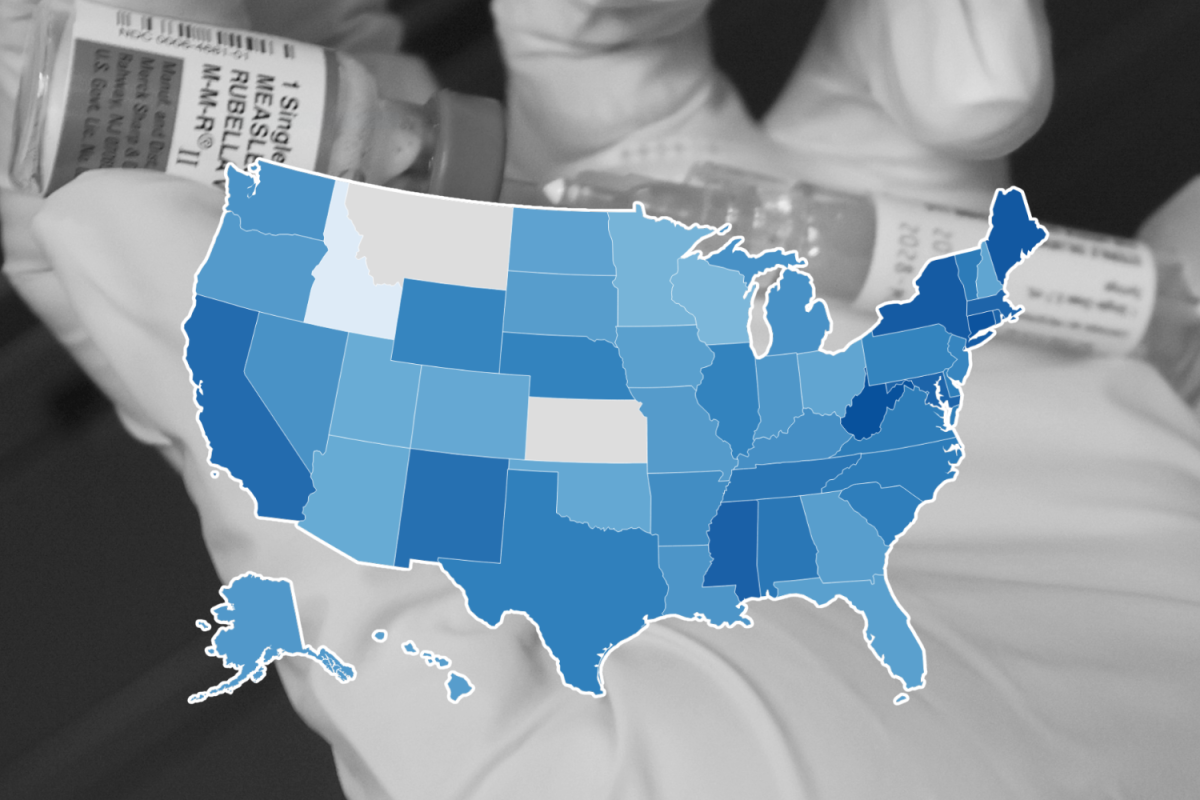
The national averages, however, hide stark geographic divides. State-level data released by the CDC reveal a patchwork of immunity across the country, with some states performing well above the national average and others falling far below the 95 percent target. In certain communities, measles vaccination coverage has dipped to levels that leave neighborhoods, schools, and families dangerously exposed. This is not an abstract concern. When measles enters a community with low vaccination rates, it spreads quickly, especially among children who are too young to be vaccinated or who cannot receive vaccines for medical reasons. “We now have a stark reminder of the consequences of lower vaccine uptake with the largest numbers of cases of measles this year since the early 1990s,” Bedford said. “This is a huge backward step for disease prevention, leaving children at risk of a potentially very serious disease.” Her words carry added weight because measles is not a harmless childhood illness. It can cause pneumonia, brain swelling, and long-term complications, and it can be fatal, especially for young children. For every 1,000 children who get measles, one or two may die from it. The disease is so contagious that a person infected with measles can spread it to up to 9 out of 10 susceptible people around them. That is why the differences between states matter so much—a child in one county may be well-protected while a child in another county down the road is at significant risk.
The declining numbers arrive at a moment of intense debate over childhood vaccination in the United States. Earlier this month, the Trump administration announced plans to review the federal childhood immunization schedule, including the vaccines recommended for infants and children. On August 10, the president signed an executive order pushing to reduce the total number of recommended shots and to split combined vaccines into separate visits. Public health experts have reacted with alarm, arguing that combination vaccines like the MMR shot are safe, effective, and scientifically justified. Patsy Stinchfield, executive director of the Measles Collaborative, told Newsweek that the combined MMR shot has been safely used since 1971 and that “more than 99 percent of people who receive two doses after their first birthday develop protective antibodies.” She called the administration’s plan to divide the shot “not an evidence-based recommendation.” Indeed, splitting the MMR vaccine into separate injections would mean more visits, more pain for children, more logistical hurdles for parents, and more opportunities for doses to be missed—all without any scientific benefit. In a surprising turn, even Robert F. Kennedy Jr., one of the country’s most prominent vaccine skeptics, urged the public to get the MMR vaccine in early August. “Parents should get their children vaccinated for measles. A measles vaccine is effective. It stops measles in about 97 percent of the cases. People should get vaccinated,” Kennedy said during an interview on August 2. His comments underscored how serious the situation has become, though they did little to ease the concerns of experts who worry that the broader political climate is undermining trust in immunization.
The scale of the current outbreak is difficult to overstate. The CDC has recorded 2,566 measles cases so far in 2026, already exceeding the total for all of 2025. Nearly half of this year’s cases have occurred among children and teenagers aged 5 to 19, while children younger than 5 account for about one in five infections. This pattern is typical of measles outbreaks in undervaccinated communities, where the virus finds its way into schools and daycares, jumping easily from one unvaccinated child to another. The CDC data also reinforces the crucial importance of vaccination: 93 percent of reported cases involved people who were either unvaccinated or whose vaccination status was unknown. Only 3 percent of cases occurred among people who had received one dose of the MMR vaccine, and another 3 percent among those who had received the recommended two doses. In other words, the vaccine works remarkably well. The outbreaks are not happening because the vaccine fails—they are happening because too many people are skipping it altogether. The fact that the United States is seeing thousands of cases of a disease it once eliminated is not a sign that measles is inevitable. It is a sign that the social contract around vaccination has weakened, and that the consequences are now showing up in pediatric hospitals and isolation wards.
Public health officials have long pointed to the 95 percent vaccination threshold as a critical benchmark for maintaining herd immunity. No vaccine is perfect, and measles is so contagious that even small gaps in coverage can allow outbreaks to take hold. “95 percent uptake is the target set for most vaccines to achieve herd immunity, [but] in practice you don’t need this for all vaccines but certainly for measles,” Bedford explained. “An overall uptake of 92.4 percent is not too bad—but of course this figure masks the variation in uptake—in some areas it’s very low indeed.” The good news is that the situation is reversible. Unlike many public health problems that require years of investment and structural change, measles can be controlled with a simple, proven tool: better vaccination coverage. “This situation can be reversed, quite simply by improving vaccine uptake,” Bedford said. “This requires a concerted effort by all concerned agencies and for some restoring confidence in the safety and effectiveness of MMR vaccine. We have fifty years of evidence showing the safety of this highly effective vaccine.” That evidence is overwhelming. The MMR vaccine was introduced in the United States in 1963 and combined into the MMR shot in 1971. Decades of studies involving millions of children have shown it to be safe and highly effective. Yet the current moment is a reminder that scientific truth is not enough on its own. Public health requires trust, and trust must be earned, communicated, and protected. The question now is whether Americans will heed the warning signs, reverse the trend, and restore the protective shield that once made measles a distant memory. Every child who walks into a classroom unprotected is a reminder that the fight against preventable disease is never really over—it only pauses when enough people choose to do the right thing.