






Imagine waking up to the news that, a few hundred miles from where millions of Europeans live and work, hidden military sites are being quietly expanded with one clear purpose in mind. That is the unsettling picture painted by a new report, which alleges that Russia has built at least ten secret locations capable of launching long-range drones deep into NATO territory. According to The Telegraph, satellite imagery analyzed by the intelligence firm DroneSec shows that Moscow has installed dozens of new “launch rails” at bases along its border with Belarus and Ukraine. These are not just any rails; at least twenty of them are reportedly capable of firing some of Russia’s most sophisticated fixed-wing attack drones, the kind that have been used to devastate cities in Ukraine. The findings land alongside a stark warning from NATO officials: Moscow could launch a limited attack on alliance soil as early as this fall. That phrase—“limited attack”—is deliberately vague, but it is enough to send a chill through NATO’s eastern members, especially Poland and the Baltic states, who have long feared they are in Russia’s crosshairs. The Russian government has dismissed such claims as nonsense and repeatedly denied any plans to attack NATO territory, but the construction of these sites, described as tucked into remote countryside or embedded within existing military bases and airports, speaks for itself in the minds of many analysts. The timing is hardly accidental. Recent weeks have seen drones launched from these very sites at the Ukrainian capital, Kyiv, according to the report, suggesting that Russia is not merely preparing for contingencies but actively testing the machinery and tactics it would need in a broader confrontation. For ordinary people, the distinction between a drone used against Ukraine and a drone aimed at NATO can feel like a technicality, and the report makes that distinction feel even thinner.
The war in Ukraine has rewritten the rules of aerial combat in ways that would have seemed almost unthinkable a decade ago. What started as a conflict over territory has also become a desperate race for technological supremacy, with Kyiv and Moscow pouring enormous resources into drones. Russia has become notorious for its use of Iranian-designed Shahed drones, including the domestic version known as the Geran-2. These relatively cheap, slow-moving loitering munitions have become a symbol of the war, buzzing over Ukrainian cities at night, often in swarms designed to overwhelm air defenses. But Ukrainian military intelligence says Russia is now rushing to produce jet-powered variants capable of striking targets much farther away. The upgraded Geran-4 and Geran-5 attack drones are being manufactured at a staggering pace: Russian industry is reportedly able to turn out roughly three thousand of them every month. Most of this production is concentrated in a massive facility in Yelabuga, in Russia’s Tatarstan region, where Moscow has built a dedicated drone hub. Both Russian and Ukrainian sources say the Geran-5 can travel about a thousand kilometers, or just over six hundred miles. That range changes the strategic picture entirely. From launch sites near the border with Ukraine or Belarus, these drones could plausibly reach NATO soil hundreds of miles beyond the alliance’s eastern frontier. In other words, the distance that once felt like a buffer between Russia and NATO has been quietly erased by cheap, expendable machines. The sheer numbers are also part of the threat. Even if many drones are intercepted, a swarm of thousands can saturate defenses, force expensive missile interceptors to be used, and probe for weaknesses in radar coverage and response times. For NATO commanders, this is not a theoretical exercise. It is a live problem they are forced to confront every time a drone crosses into allied airspace.
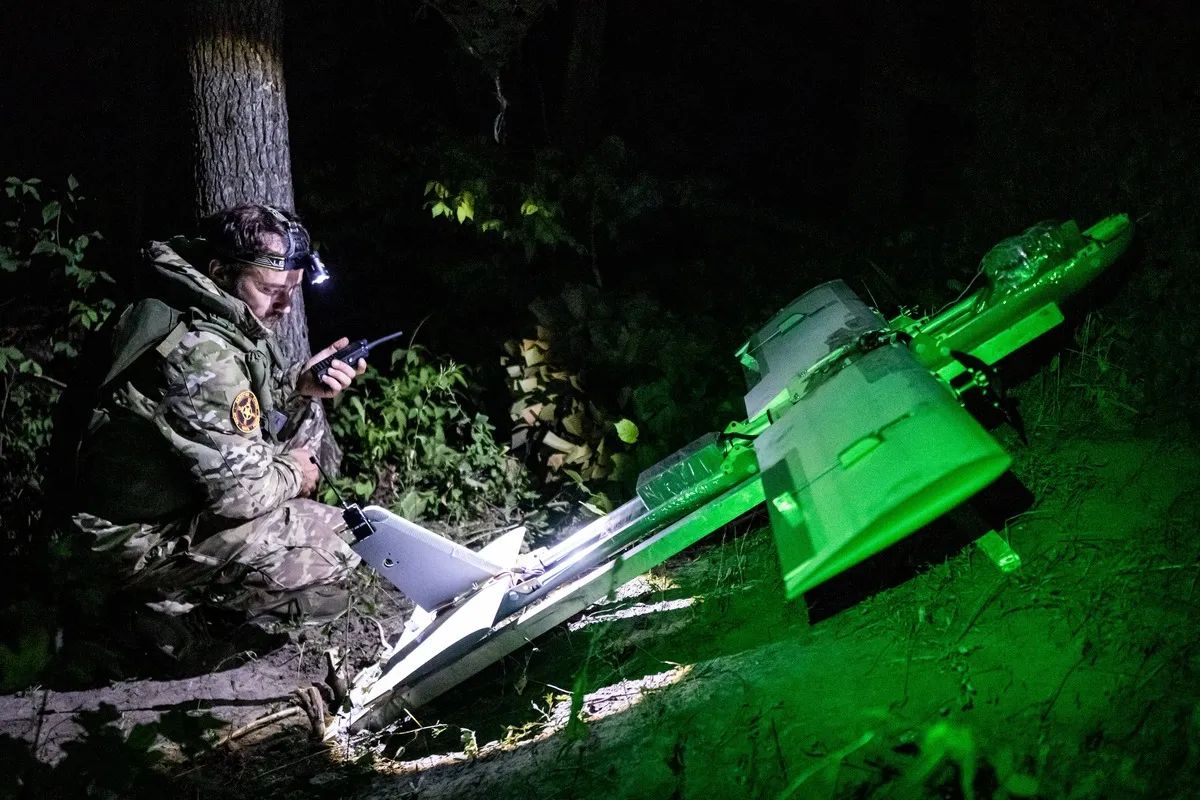
What makes the latest report particularly unsettling is not just the drones themselves but the way they are being launched. DroneSec, an intelligence firm that studied satellite imagery of the new sites, counted at least ten locations scattered across Russia’s western borderlands. Some are described as sitting in remote countryside, deliberately hidden from casual view; others are built into military bases or civilian airports, using existing infrastructure to reduce the time and cost of standing up a strike capability. More than twenty of the launch rails installed at these sites are reportedly designed for Russia’s most advanced long-range attack drones. That detail matters because launching a fixed-wing drone is not as simple as pulling a trigger. It requires the right equipment, trained personnel, logistics, and a clear chain of command. By building these rails in advance, Russia is not just signaling capability—it is preparing the kind of infrastructure that can be activated at short notice. The recent wave of drone attacks on Kyiv, which analysts believe used some of these very sites, suggests that Moscow is treating them as operational assets rather than display pieces. Mike Monnik, the chief executive of DroneSec, said the expansion shows how Russia has boosted its ability to launch greater numbers of drones while simultaneously making the drones themselves harder to intercept. That is a sobering assessment. It means that the threat is not static; it is evolving in real time, with each new generation of drone designed to defeat the defenses that NATO has spent years developing. The long-range rails make the launch phase faster and more flexible, while the shift to jet-powered drones gives commanders a weapon that flies higher, moves faster, and presents a much harder target for ground-based air defenses. In short, the Russians are learning, adapting, and industrializing their drone force at a speed that Western analysts are struggling to match.
Airspace violations have unfortunately become a recurring stress test for NATO. Since Russia launched its full-scale invasion of Ukraine in February 2022, drones and missiles have repeatedly strayed into the territory of neighboring member states. These incidents often force fighter jets stationed in Poland, Romania, and the Baltic countries to scramble, sometimes shooting down unmanned vehicles that spill over from the conflict. The dangerousness of these episodes is hard to overstate: a single miscalculation could easily escalate into a direct military confrontation between nuclear-armed powers. In September 2025, when at least twenty drones crossed into Poland in a single incident, NATO officials openly accused Russia of trying to test the alliance’s response to an attack. Those concerns deepened last month when a Russian cruise missile crashed in eastern Poland, close to the country’s border with Ukraine. The missile did not cause a catastrophe, but it forced NATO into a familiar pattern: emergency meetings, carefully worded statements, and quiet assurances that the alliance would defend every inch of its territory. To many observers, this pattern looks like a scripted rehearsal for something worse. Russia can probe NATO’s air defenses without ever taking responsibility, because drones are small, ambiguous, and easy to disown. Each breach gives Russia valuable intelligence about how quickly NATO reacts, where its radars are weak, and how much pressure it takes to stretch the alliance’s resources. The question is whether these are isolated incidents or deliberate acts of reconnaissance for a future operation. The new report on launch sites suggests that the latter is entirely plausible, especially when combined with Russia’s visible push to expand its drone arsenal. For people living near NATO’s eastern border, every unexplained radar contact is a reminder that their safety depends on decisions being made in Moscow, Washington, and Brussels.
This all comes at an extraordinarily awkward moment for the transatlantic relationship. European allies are openly questioning whether the United States would come to their defense in a real crisis, and that anxiety has been sharpened by President Donald Trump and his administration, who have berated Europe for decades of low defense spending and dependence on the tens of thousands of American troops stationed on the continent. The Pentagon is currently reviewing how it deploys its forces in Europe, and no one in Brussels or Warsaw is quite sure what that review will produce. Meanwhile, Russia appears to be exploiting every sign of division. Germany’s most senior soldier, General Carsten Breuer, recently told The Wall Street Journal that Moscow is using drones to gauge how NATO air defenses react to breaches. “Hybrid attacks are taking place every day in NATO countries,” he said. The term “hybrid attack” is a catch-all for operations that stop short of open fighting: cyberattacks, disinformation campaigns, arson, sabotage, or the targeting of vulnerable infrastructure such as undersea cables. NATO has been waging a quiet defensive war against these tactics for years, but the boundary between hybrid and conventional warfare is becoming harder to police. A full-scale invasion of NATO territory is widely considered unlikely; the more realistic threat is a smaller, probing operation designed to test resolve. U.S. intelligence analysis, reported by the Journal earlier this month, suggests that the Kremlin could try to seize a limited chunk of NATO territory or carry out more powerful hybrid attacks as early as September this year. That could mean a thrust into a Baltic state, a strike on a Polish supply hub, or something even more ambiguous but still unmistakably hostile. The use of long-range drones, launched from hidden sites along Russia’s borders, fits perfectly into this grey-zone strategy. They can deliver a violent message while giving Moscow enough plausibility to deny involvement. For NATO, this is one of the most dangerous periods since the end of the Cold War, precisely because the threat is neither a clear declaration of war nor a simple spy game, but an intentional blurring of the line between peace and conflict.
NATO is not sitting still, of course. Allied commanders are rehearsing how they would respond if Russian forces moved into a Baltic state or if a coordinated wave of drones and missiles struck Polish territory. These exercises involve rapid troop movements, air defense drills, and logistical planning for a conflict that would be fought on European soil. But rehearsals are not the same as certainty. There is a deep, uncomfortable truth underneath all the satellite imagery and intelligence briefings: no one really knows how the next few months will unfold. Russia could continue its hybrid campaign indefinitely, using drones to probe and provoke without ever crossing the threshold that triggers NATO’s collective defense clause. Or it could miscalculate, or decide that a limited strike is worth the risk. The report about the ten secret launch sites is a reminder that preparedness is not just about tanks and troops; it is also about understanding how the enemy thinks and adapting to the weapons of the future. Drones have made war cheaper, faster, and more democratic in the most terrifying sense of the word. They allow a small number of people, operating from a remote command post, to sow chaos across an entire continent. They also force NATO to make impossible choices: use expensive missiles to shoot down cheap drones, or watch them fly deeper into allied airspace. For the families living in Poland, Lithuania, and Latvia, the news of hidden launch sites is not an abstraction. It is a reason to pay attention to the skies, to wonder about the meaning of every distant buzz, and to hope that the diplomats and generals can manage a crisis that has been building for years. What the coming fall brings is uncertain, but one thing is clear: the old era of European security, when distance provided safety, is over. The drones are already there, waiting on their rails, and the question is not whether they will be used, but where.