





The world woke up on Monday to a startling reminder of how radically the geopolitical landscape has shifted under the weight of a single, unpredictable administration. In a casual, matter-of-fact interview with Fox News, President Donald Trump issued a direct and chilling threat to the Sultanate of Oman, a nation that has functioned for decades as a quiet, trusted peace broker in the turbulent Middle East. “If Oman gets in the way, we’ll bomb the country,” he stated, according to reports, in what has been marked as one of the most explicit and aggressive military threats he has ever leveled against a long-standing partner. This wasn’t the usual diplomatic hedging or carefully worded warning aimed at a traditional adversary; it was a blunt, terrifying promise of destruction aimed directly at a nation that has never been an enemy. The shockwaves rippled through foreign ministries and diplomatic lounges across the globe, not just because of the severity of the language, but because of who was being threatened. Oman has always been the bridge, the quiet intermediary, the nation that kept lines of communication open between Washington and Tehran when every other door was slammed shut. The President’s words immediately conjured an image of peaceful coastal cities and ancient forts suddenly framed in the crosshairs of American military power, simply for daring to play the role of mediator they have cultivated for generations.
To fully grasp the seismic nature of this threat, one must understand Oman’s extraordinary and vital position in the world order. Sitting strategically on the Strait of Hormuz, through which roughly one-fifth of the planet’s crude oil glides daily in massive tankers, Oman is effectively the gatekeeper of global energy security. Its capital, Muscat, is a city of distinct character, where ancient Portuguese forts stand alongside gleaming modern docks, and where the air is thick with the scent of frankincense and sea salt. The government has meticulously cultivated an identity of profound neutrality, discretion, and stability in a region perpetually bristling with tension. For years, Omani intelligence officers and diplomats have acted as the trusted postman between Washington and Tehran, carrying secret messages, brokering prisoner swaps, and lowering the temperature when the rhetoric between the two nations got dangerously hot. They are the ones who provided the secret backchannel that helped facilitate the 2015 nuclear deal, and they have repeatedly hosted tense, closed-door negotiations that prevented regional conflicts from spiraling out of control. This is not just abstract geopolitics; it is a matter of human trust, built over decades through handshakes, quiet dinners in Muscat’s upscale hotels, secret flights, and whispered agreements between exhausted envoys. Trump’s barbaric threat effectively declares that this entire infrastructural trust built on human relationships is worthless and disposable. It tells the Omani people, who pride themselves on their role as the world’s peacemakers, that their nation’s most precious diplomatic asset—its reputation for impartiality and reliability—is now a target. Imagine spending your entire career meticulously building a bridge to facilitate understanding, only to find that the strongman standing on one side decides he wants to blow it up simply because it allows too much traffic to cross.
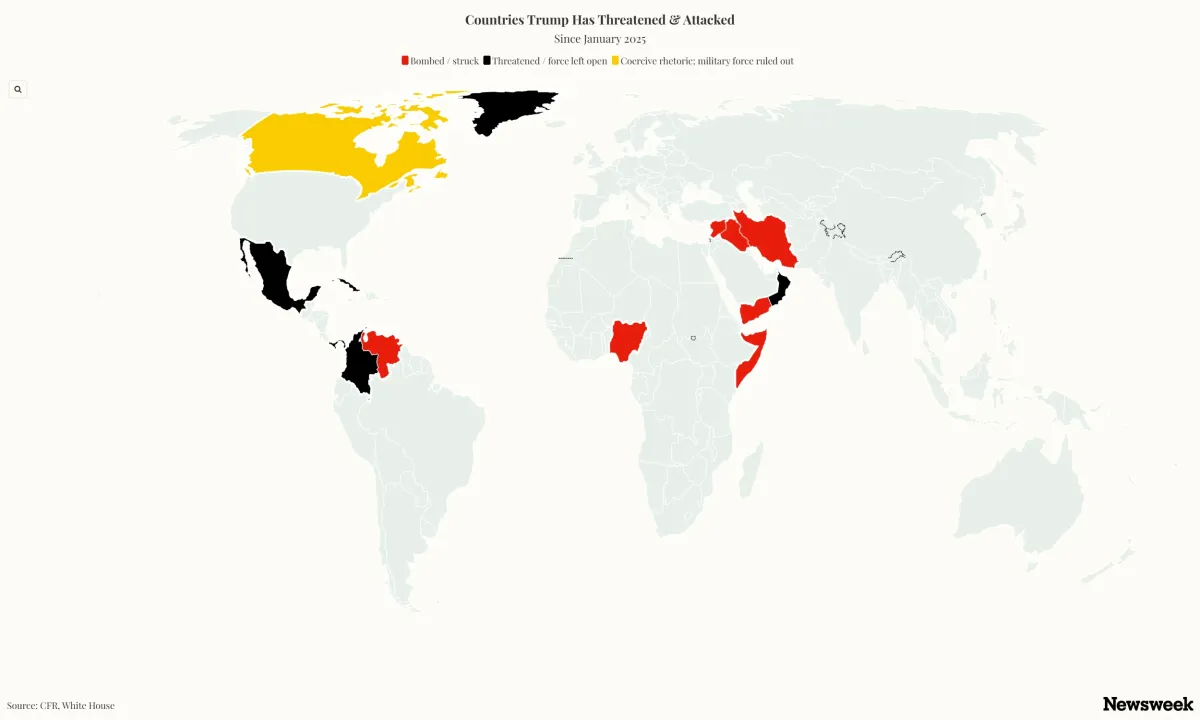
The threat to Oman, however, is not an isolated anomaly in this administration; rather, it is the latest and most troubling symptom of a breathtaking acceleration in American military interventionism under Trump’s second term. Since returning to the Oval Office in January 2025, the U.S. has formally authorized its military to strike targets in at least seven distinct nations, including Somalia, Iraq, Yemen, Iran, Syria, Nigeria, and Venezuela. These actions alone paint a grim and visceral portrait of a globe under constant, humming siege. The June 2025 attack on Iranian nuclear facilities at Fordow, Natanz, and Isfahan—celebrated by the White House with the ominous phrase “completely and totally obliterated”—shook the region to its core, leaving Iranian families to wonder in terrified silence when the next cloud of smoke and fire will rise from their horizon. In Somalia and Syria, relentless drone campaigns against ISIS and al-Shabaab have decimated command structures but have also decimated neighborhoods, creating new cycles of grief, trauma, and resentment that will fester for decades. The January 2026 operation in Venezuela, which resulted in the dramatic capture of President Nicolás Maduro, showcased a newly brazen willingness to topple foreign leaders outright, turning international law into a mere suggestion. For the ordinary people living in these targeted countries, the implications are visceral and immediate: the constant humming of drones overhead, the inexplicable, deafening boom in the distance, the paralyzing fear of being in the wrong place at the wrong time while simply trying to buy bread or walk their children to school. The clinical precision that military spokespeople tout in press briefings loses all its meaning when you are the collateral damage or the terrified bystander caught in the crossfire. This relentless tempo of strikes has normalized a “wartime presidency,” fundamentally transforming the U.S. military from a deterrent force into an ever-ready expeditionary hammer used to solve nearly every foreign policy challenge, regardless of the human cost.
Beyond the actual deployment of missiles, bombs, and special forces, there lies a darker, more pervasive shadow of explicit threats that has plunged global diplomacy into a state of profound anxiety and churn. Trump’s hostile rhetoric hasn’t been reserved solely for the battlefield; it extends aggressively to supposed allies, neutral parties, and even sovereign territories under the protection of other nations. Before even retaking the Oval Office, he refused to rule out using military force to seize Greenland from Denmark or to physically reassert control over the Panama Canal, alarming NATO partners and unsettling the entire hemisphere with the unsettling specter of nineteenth-century imperial annexation. Following the Venezuela operation, his administration hinted at potential future interventions in Cuba, Colombia, and even Mexico, explicitly floating the idea of military strikes against drug cartels that would violate another nation’s sovereign borders. For citizens in these countries, the message is terrifyingly clear: their borders are merely suggestions, and their governments exist only at the sufferance of Washington’s implied final say. The psychological impact of this “shadow war” of rhetoric cannot be overstated. A farmer in Colombia wonders if the distant sound of a plane engine means the arrival of American F-22s. A businessman in Copenhagen jokes nervously to his colleagues about the end of the Danish independence. A diplomat in Mexico City lies awake weighing the cost of cooperation against the cost of defiance. By framing diplomacy as a coin flip between negotiation and annihilation, the U.S. has forcibly forced every nation on earth—friend or foe—to calculate their own vulnerability in real time. This fundamental erosion of the sense of security that underpins international economic exchange, cultural cooperation, and global stability has left the world feeling deeply fragile, as if the very ground upon which alliances were built has turned to sand.
This muscular, trigger-happy approach to foreign policy exists in stark, confusing, and almost contradictory contrast to the foundational promise of Trump’s 2024 campaign. Trump won the presidency by confidently standing on stages across the country and proclaiming he was the man who would keep the U.S. out of “endless wars,” a candidate who famously boasted he could end complex conflicts in a single phone call with a foreign leader. He sold himself to an exhausted electorate as a builder, not a bomber, a dealmaker who would prioritize American prosperity over global policing. Yet, barely a year into his term, he has overseen airstrikes across three continents and is now openly threatening a peaceful, long-standing ally with obliteration. The White House and his staunchest allies attempt to reconcile this glaring contradiction under the banner of “peace through strength,” a resonant slogan for many. They argue that these are not wars in the traditional sense but precision strikes—surgical, limited operations designed to protect U.S. interests or neutralize immediate, existential threats like nuclear proliferation. To them, smashing Iran’s nuclear reactors or capturing a ruthless dictator prevents larger, more deadly wars later down the line. However, for the voters, the millions of working-class Americans who took his “No New Wars” rhetoric at face value and voted for him specifically because they were tired of their sons and daughters coming home in body bags, this explanation is deeply dizzying and hollow. They remember him ridiculing the “stupid” interventions in Iraq and Afghanistan, promising to finally bring the troops home. They now wonder, with a growing sense of confusion and betrayal, how a continuous, endless stream of explosions across the globe constitutes peace. The cognitive dissonance is palpable in living rooms and coffee shops; it resembles a firefighter who promises to stop putting out brush fires by setting a few hundred of his own, stricter, better-managed fires, and then expecting a thank-you from the community.
The cumulative effect of all this force, all these threats, and all this rhetoric has exposed a profound and growing fracture within the very soul of the “America First” movement itself. There is a simmering civil war brewing between the traditional hawks—largely aligned with the Republican defense establishment and arms manufacturers—who laude every strike as a muscular triumph of U.S. resolve, and the populist isolationists who now feel deeply betrayed. These populists, the angry voters in diners and rust-belt towns who make up the passionate core of Trump’s base, didn’t sign up for a permanent bombing campaign in far-off lands. Their frustration reached a boiling point during the escalating conflict with Iran, where prominent influencers within the MAGA sphere openly rebuked the escalation, warning that the President was falling into the exact same trap of Middle East entanglement he swore to avoid at all costs. Yet, this anger is currently bottled up and largely quiet, drowned out by the roar of political victories and the powerful fear of fracturing a winning coalition. So far, the majority of Republican voters continue to give Trump the benefit of the doubt, trusting in the gravitas and authority of their commander-in-chief, and accepting his justifications as necessary evils. But the fault line is unmistakable, etched deep into the bedrock of the movement. As the U.S. continues to lob threats and fire missiles across the globe—from the coasts of Oman to the streets of Caracas—the deepest question isn’t just about foreign policy strategy or geopolitical positioning. It’s a soul-searching inquiry into what kind of America the base actually wanted when they put him in power. They wanted security from the chaos of the outside world, but they are getting that chaos exported everywhere, at an ever-accelerating pace. In that profound, agonizing tension lies the fragile future of Trump’s political revolution, suspended perilously between the human cost of relentless crossfire and the intoxicating seduction of strident, unrepentant military might. The world watches, fearfully and with bated breath, to see which path the commander-in-chief will take next, holding its collective breath as the delicate bridge to Hormuz trembles on the very edge of annihilation.