


As the sun began to set over the horizon of the historic 2026 FIFA Men’s World Cup, a tournament already destined to be remembered as a cultural phenomenon across North America, the footballing world found itself once again collectively holding its breath in the presence of greatness. Argentina had arrived in the United States not merely to participate, but to defend their crown with a fierce, almost poetic grace. Under the guidance of Lionel Scaloni, the Albiceleste had breezed through their opening fixtures in Group J, dismantling opponents with a ruthless efficiency that allowed them to secure qualification to the knockout rounds with a match to spare. Consequently, when the team sheet was announced for the group-stage finale against a spirited Jordan side, the name of Lionel Messi was notably, and understandably, listed among the substitutes. At thirty-nine years of age, every mile on Messi’s odometer is carefully managed, a precious resource preserved for the ultimate battles ahead. Yet, as the match rolled into the second half with Jordan fighting tooth and nail to disrupt the South American giants, the air in the stadium grew thick with anticipation. In the 60th minute, the referee signaled a substitution, and the collective roar of tens of thousands of fans shattered the evening air as the undisputed Greatest of All Time stripped off his training bib. To Jordan’s misfortune, Messi did not treat his half-hour cameo as a mere fitness exercise; instead, he stepped onto the pitch with the hunger of a teenager making his debut, ready to paint another masterpiece on the grandest canvas in sports.
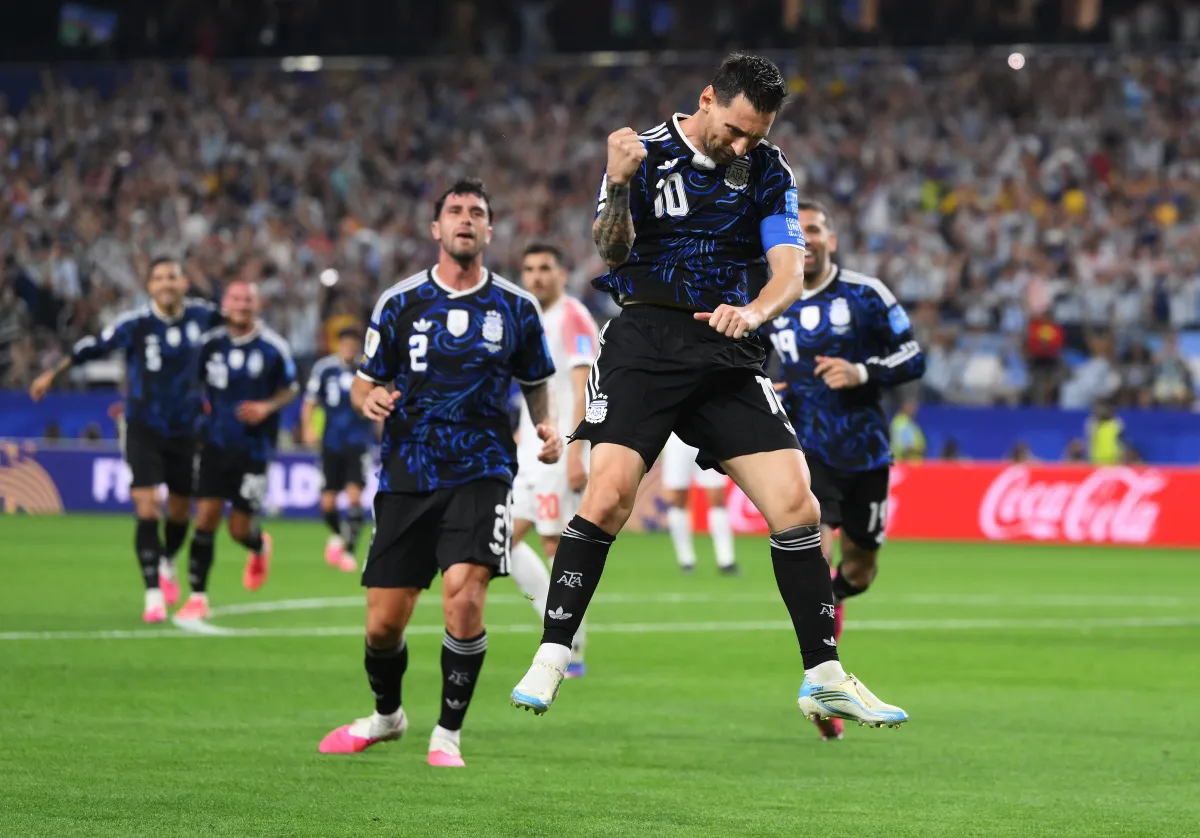
The Jordanians had battled valiantly, putting on a display of defensive grit and tactical discipline that frustrated the reigning world champions for large stretches of the match. But football, at its highest level, is a game of moments, and there is no player in the history of the sport who understands the anatomy of a moment better than Lionel Messi. As the clock ticked towards the 80th minute, a foul just outside the penalty area presented Argentina with a set-piece opportunity in prime territory. A hush fell over the arena, the kind of heavy, pregnant silence that precedes a lightning strike. Messi stood over the ball, his posture relaxed, his eyes scanning the defensive wall and the positioning of the Jordanian goalkeeper who was trying desperately to anticipate the path of the incoming strike. With a short, measured run-up, Messi struck the ball with the trademark precision that has defined his legendary career. The ball launched into the air, curling with a defying trajectory over the desperate leap of the defenders and dipping violently into the top corner of the net, far beyond the reach of the outstretched keeper. It was a classic “golazo”—a goal of breathtaking aesthetic beauty that sent the stadium into an absolute frenzy. The spectacular strike solidified Argentina’s 3-1 victory over Jordan, but more than just securing three points, it served as a poignant reminder that even in the twilight of his career, Messi remains a wizard capable of conjuring magic at any given second.
This particular moment of brilliance was not merely a highlight-reel goal; it was a historic milestone that rewrote the record books of international soccer. With that spectacular free-kick, Messi achieved the astonishing feat of scoring at least once in seven consecutive World Cup matches, a historic streak stretching back to Argentina’s iconic, fairy-tale run during the 2022 World Cup in Qatar. According to insights compiled by sports historians, no male player in the history of the tournament had ever achieved such consistent goal-scoring dominance on the world stage. This tournament also marks Messi’s sixth World Cup appearance, a testament to his freakish longevity, supreme discipline, and enduring passion for the game. He stands alongside his eternal rival, Cristiano Ronaldo, as the only two men in the history of football to take the pitch in six different World Cup tournaments. To witness Messi at thirty-nine years old, moving with the same grace and killer instinct that he possessed a decade ago, is to witness a living legend defying Father Time himself. He is no longer just chasing trophies; he is competing against his own legacy, pushing the boundaries of what is humanly possible in the sport of football.
The sheer scale of Messi’s goal-scoring exploit in this 2026 campaign is nothing short of staggering, especially when one examines the path he carved through the group stage. He kicked off the tournament with an explosive, vintage performance against Algeria, netting a spectacular hat-trick that immediately drew him level with Germany’s legendary Miroslav Klose as the all-time leading male goalscorer in World Cup history. Just days later, as if to prove that his opening performance was no fluke, he delivered a mesmerizing brace against a highly disciplined Austrian side. In doing so, he surpassed Klose’s mark of sixteen goals and even went beyond the legendary standard of seventeen goals established by the Brazilian women’s icon Marta, effectively standing alone at the absolute summit of global football with nineteen all-time World Cup goals. This is not just a statistical triumph; it is a human achievement of the highest order. Messi’s journey across these matches has been defined by a sense of joy and liberation, playing as a man who has already won everything there is to win, yet still finds pure, child-like happiness in putting the ball into the back of the net for his beloved country.
As the tournament transitions into the unforgiving, high-stakes knockout phase, the race for individual accolades is starting to take shape, though Messi currently finds himself in a tier of his own. Entering the Round of 32, the Argentine captain stands two goals clear at the top of the Golden Boot standings with six goals. Behind him, a hungry pack of the modern era’s most explosive young talents—including France’s Kylian Mbappé and Ousmane Dembélé, Brazil’s Vinícius Júnior, and Norway’s goal-scoring machine Erling Haaland—are clustered in second place with four goals apiece. Yet, despite the immense talent of this younger generation, the narrative of the 2026 World Cup still firmly belongs to Lionel Messi. If he continues this jaw-dropping run of form, he is a near-certainty to become the first Argentine player to claim the prestigious tournament Golden Boot since the legendary Mario Kempes guided the nation to glory on home soil back in 1978. However, anyone who has followed Messi’s career knows that individual trophies are merely secondary to his ultimate ambition. Along with his teammates, Messi is driven by a grander historical mission: to guide Argentina to back-to-back world titles, a historic feat of championship defense that has not been accomplished in the men’s game since Pelé’s legendary Brazilian team did so in 1958 and 1962.
The next step on this epic quest will take Argentina to Hard Rock Stadium in Miami, Florida, on Friday, July 3, where they are scheduled to face a resilient Cape Verde side in the highly anticipated Round of 32. For Messi, this match will represent a profoundly emotional and familiar homecoming. Having transitiond his club career to the United States, Messi has taken North American soccer by storm, dominating Major League Soccer as the reigning back-to-back league MVP and successfully leading Inter Miami CF to an MLS Cup championship. The streets of Miami, already deeply infatuated with the Argentine icon, are expected to reach a fever pitch of anticipation as their adopted hero returns to play on his home turf wearing the famous blue and white stripes. The stadium will undoubtedly be a sea of chanting fans, creating a carnival atmosphere that bridges his domestic success with his international duties. As Messi prepares to walk out under the warm Florida sky, the world will watch in awe as a legendary career comes full circle, with the maestro poised to write yet another unforgettable chapter in his eternal footballing love story.