

Josh Allen and Cam Heyward’s Holiday Season Clash Reveals the Rawer Side of NFL Competition
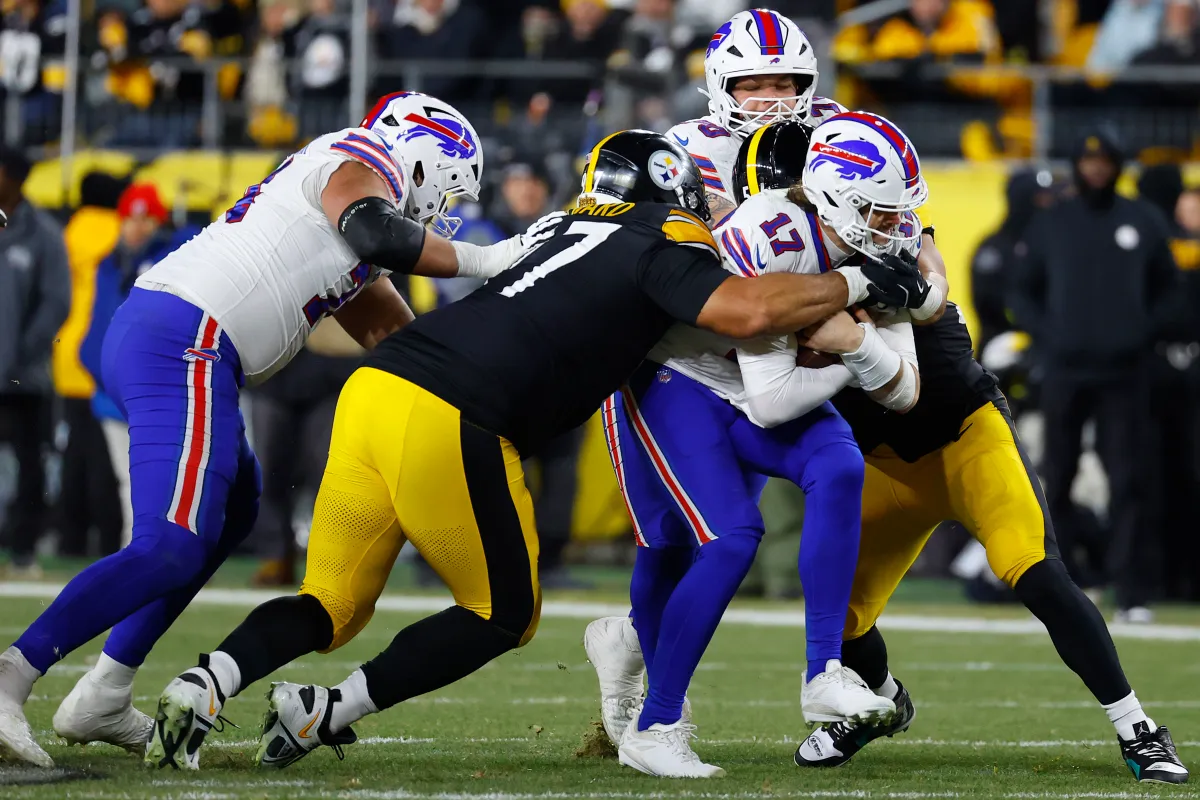
In the frost-bitten chill of a December weekend, the Buffalo Bills and Pittsburgh Steelers faced off in what became less a celebration of holiday spirit and more a showcase of the intense personal rivalries that simmer beneath professional football’s surface. The Bills’ commanding 26-7 victory over the Steelers was overshadowed by a heated exchange between Buffalo quarterback Josh Allen and Pittsburgh’s veteran defensive tackle Cam Heyward, revealing how even the most respected players can find themselves entangled in the game’s emotional undercurrents. What began as routine physical play escalated into a situation that left one player feeling violated and the other defending his competitive instincts, ultimately resulting in financial consequences from the league office.
The confrontation ignited midway through the second quarter, when Heyward, a respected leader and former Walter Payton Man of the Year recipient, claimed Allen intentionally kneed him in the stomach while getting up after a tackle. Heyward’s post-game comments revealed genuine frustration about what he perceived as a double standard in player protection: “I was ticked off the entire game because, as a quarterback, they’re protected, but I’m not. It just pisses me off.” The defensive tackle’s indignation deepened when he alleged Allen had even acknowledged the intentionality of the action, quoting the quarterback as saying, “I had to do something to get you off me.” This moment, occurring with approximately six minutes remaining in the first half, set the tone for a personal battle that would continue throughout the game.
Allen, for his part, didn’t deny the tension between the two players but framed it within the context of competitive fire rather than malicious intent. “Maybe it got me going a little bit,” Allen acknowledged when asked about the interactions with Heyward. The quarterback’s perspective offered a different window into the psychology of high-level competition as he added, “We love the competitiveness out of this game. He’s such a great player. Sometimes, you need fire like that to get you going.” This statement hints at how elite athletes sometimes deliberately seek out or embrace confrontation as a way to elevate their performance, using emotional triggers as fuel for on-field excellence. The contrast between Heyward’s sense of violation and Allen’s embrace of the conflict illustrates the fine line between acceptable competitive tactics and crossing boundaries in professional sports.
The animosity between the two players resurfaced later in the game when Heyward, still visibly frustrated by the earlier incident, was penalized for taunting after confronting Allen following a Buffalo touchdown. This moment captured the ongoing tension that had developed between the two players, with Heyward unable to contain his lingering anger at what he perceived as unfair treatment. The officiating crew’s decision to flag Heyward highlights how the NFL attempts to regulate emotional displays while still allowing for the natural intensity of competition. However, the penalty would prove to be just the beginning of consequences for the Steelers’ defensive stalwart, as the league office would soon weigh in with additional punishment.
On December 6th, nearly a week after the game, the NFL announced an $11,593 fine against Heyward for his conduct during the Bills-Steelers matchup. This financial penalty represents the league’s attempt to discourage behavior it deems detrimental to the game’s image, even when coming from a player with Heyward’s sterling reputation. The fine serves as a reminder of how the NFL attempts to balance allowing for the game’s inherent physicality and emotional intensity while setting boundaries on player conduct. For Heyward, it added financial insult to the injury of defeat, compounding what had already been a frustrating day on multiple levels.
The Allen-Heyward incident exists within a broader conversation about competitive ethics, player protection, and the emotional nature of professional football. While quarterbacks receive special protection under NFL rules—a fact that clearly irritated Heyward during this exchange—the boundaries of acceptable physicality remain somewhat subjective even within the rulebook. The incident raises questions about how players navigate the gray areas between aggressive competition and unsportsmanlike conduct, especially in high-stakes games where emotions naturally run hot. For fans, it offers a glimpse into the complex psychological chess matches that occur alongside the physical battles on every NFL Sunday, reminding us that behind the helmets and pads are human beings processing intense emotions in real-time while performing at the highest level of their profession.