


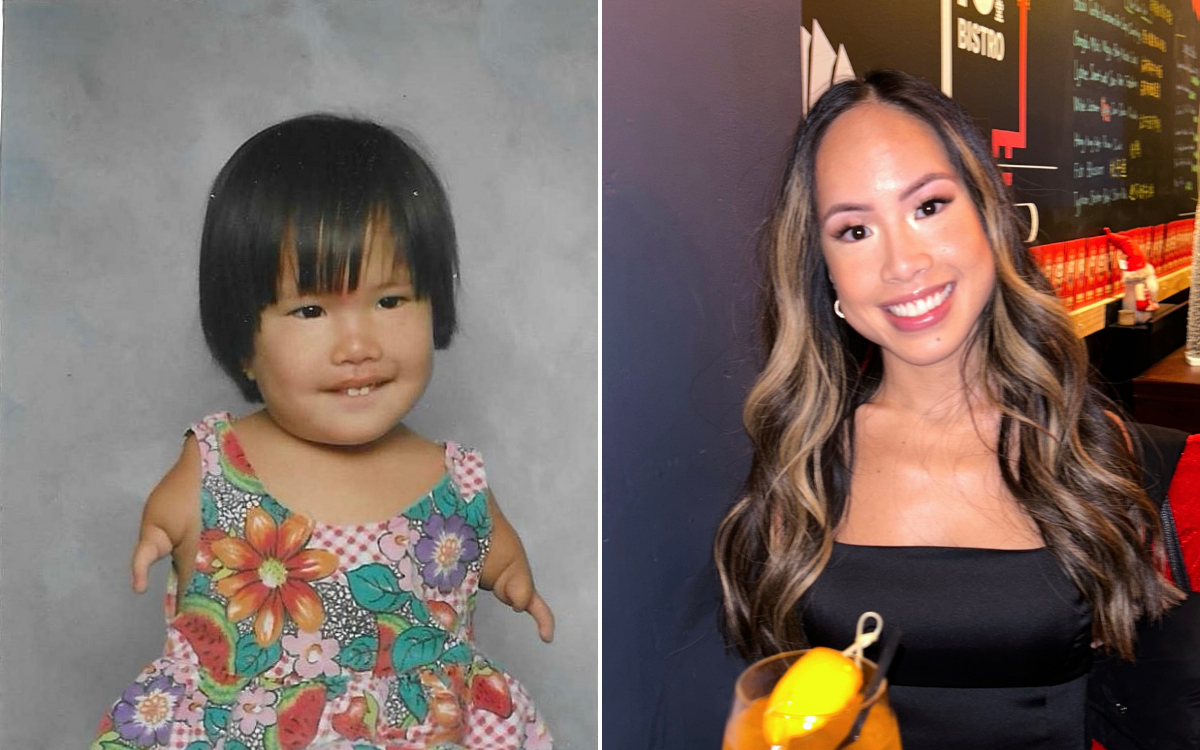
Anna’s journey began in Vietnam, where she was born with a rare congenital limb difference that left her without both arms. The precise origin of her physical difference remained a source of quiet speculation, with a family doctor once suggesting a possible correlation with the devastating chemical legacy of Agent Orange. However, the scientific theories behind her disability carried no weight for the remarkable woman who would soon become her mother. Living in the United States as a single parent, this extraordinary woman had opened her heart and home to the world, fostering dozens of children over the course of her life and ultimately adopting six who faced profound physical and cognitive challenges. The moment she heard about a baby girl in Vietnam born without arms, her decision was instantaneous; she chose love and action over hesitation and doubt. Bringing baby Anna home, however, was a complicated logistical and political process. At the time, the United States maintained no formal diplomatic relations with Vietnam, meaning that Anna could not fly directly to her new home. Instead, she was first transported to Thailand with a small group of other adopted children, and eventually flown to Seattle, where her new mother was waiting nervously and joyfully to hold her for the very first time. Growing up in this bustling, vibrant household, Anna was deeply aware that her family structure was far from ordinary. Their lives were filled with a chaotic, beautiful energy, yet as a self-conscious child, Anna often found this lack of conformity deeply troubling. She was so intensely focused on hiding her own physical differences that her family’s loud, highly visible unconventionality felt like a spotlight she desperately wanted to escape. It took years of growing, healing, and deep self-reflection for Anna to look back and recognize that what she once perceived as embarrassing chaos was, in reality, a rare and exquisite sanctuary of pure, unconditional belonging.
A fundamental element of Anna’s childhood was her mother’s brilliant, sometimes challenging, parenting philosophy, which centered around a refusal to coddle her children. When Anna struggled with basic daily tasks and begged for assistance, her mother would often step back, gently refusing to do for Anna what she could eventually learn to do for herself. While this approach felt frustratingly tough to a young girl who simply wanted her life to be easier, it became the single greatest gift of her life, instilling in her an ironclad sense of independence, resilience, and self-reliance. Her mother worked tirelessly to ensure her children experienced lives rich with wonder and intellectual stimulation, taking them on frequent, exciting adventures to the local library, the bustling city center, and various community outings. Despite these joyful moments, their household also carried profound sorrow. Three of Anna’s adopted siblings, who were born with incredibly severe and complex medical conditions, passed away during her youth. Living alongside such fragile lives and experiencing deep grief at a young age inevitably shaped Anna’s perspective on human existence. Looking back now through the lens of adulthood, she wishes she could whisper to her younger self about just how precious, resilient, and beautiful her family truly was. She would tell that anxious little girl that the people who genuinely matter in this world will never look down on her family’s differences; instead, they will admire, respect, and love them for their boundless compassion. Her mother, she now realizes, is a rare, irreplaceable soul who provided her not only with a second lease on life but with the invaluable toolkit of autonomy, earning her a lifetime of deepest admiration, respect, and love. This legacy of fierce resilience, forged in the quiet corners of their busy household, became the bedrock upon which Anna built her adult identity.
Throughout her childhood, Anna’s most exhausting challenge was the persistent, paralyzing fear of what others thought of her. The desire to blend in, to dissolve into the background of typical childhood, was a constant, dull ache in her chest. In an attempt to purchase a sense of normalcy, she would often beg her mother for the same trendy material items her classmates possessed. One year, she pleaded for the latest, most fashionable Barbie doll, and another year, she begged for an electric guitar for Christmas, desperately hoping these physical symbols of contemporary youth would somehow bridge the gap between her and her peers. The guitar gathered dust, never played, acting merely as a silent monument to her longing for peer acceptance. Looking back, these material requests seem humorous and trivial, but to a young girl drowning in insecurity, they felt like essential lifelines to survival. If Anna could talk to that fragile girl today, she would place a comforting hand on her shoulder and assure her that true beauty lies entirely in our differences. She would explain that life becomes infinitely lighter and more vibrant the moment you stop performing for the approval of others and start stepping into your authentic self. The exhausting weight of trying to hide her limb difference was a burden she did not need to carry, and she wishes her younger self could have understood that her value was never tied to how perfectly she mimicked the crowd. She would tell her that trying to fit into a mold that was never designed for her was a disservice to her incredible spirit, and that the very characteristics she tried so desperately to conceal were the ones that made her uniquely strong. True freedom, she would tell her, is found not in assimilation, but in the radical acceptance of one’s own skin. By shedding the armor of peer performance, she would discover that being different was never a weakness, but her most profound superpower.
Educational environments brought a complex mix of safety and hidden torment. From preschool through the eighth grade, Anna attended a small, intimate Montessori school where the familiar, close-knit environment shielded her from harsh judgment. Her classmates grew up alongside her, making her usage of her feet to write and eat feel like a normal, everyday occurrence rather than a spectacle. Yet, even within this protective bubble, Anna harbored an intense internal struggle characterized by shame, insecurity, and a quiet desire to simply disappear. In a desperate bid to avoid drawing attention to her disability, she adamantly refused to bring her specialized dressing hook to school—an assistive tool that would have allowed her to utilize the restroom independently. Instead, she chose to endure the physical discomfort of going an entire day without drinking water, or would rely on the painful vulnerability of asking her closest friend for physical assistance. When high school arrived, her world began to expand and shift. She spent her first two years at a private, all-girls Catholic school before splitting her time between her local public high school and a nearby community college, a transition that marked her first quiet steps away from the crushing pressure to conform. Seeking to challenge her deep-seated fear of being seen, she made the bold choice to participate in two local beauty pageants during high school—a decision that pushed her far outside her comfort zone and forced her to stand proudly before an audience. By the time she entered university, she discovered a liberating reality: in a massive collegiate environment, people are far too consumed by their own lives, schedules, and doubts to hyper-focus on others. Using her feet to navigate her daily tasks in public became a seamless, worry-free routine, as she realized the world was not watching her with judgment, but simply passing by.
Despite these triumphs, Anna’s youth was heavily defined by a profound social anxiety and a protective instinct to stay firmly within her comfort zone. Whenever her mother signed her up for active programs like art camp, vacation Bible school, or summer learning programs, she experienced intense waves of anxiety and rarely initiated conversations with new children. Her reluctance was rarely about the activities themselves, but rather about the vulnerability of public exposure. She found solace in solitary or highly disciplined activities like figure skating and kung fu—outlets that challenged her physically but did not require the exhausting, unpredictable social performativity that peer group settings did. Making friends felt like navigating a minefield, as the paralyzing fear of rejection whispered that it was safer to remain isolated than to risk being unwanted. This profound fear of emotional vulnerability extended into her romantic life. As her peers began to explore dating, Anna retreated, never pursuing crushes or allowing herself to explore romantic connections until long after she had graduated from college. Today, looking back at that fearful young girl, Anna wishes she could offer her the profound grace of perspective. She would tell her younger self that life is too fleeting to be lived in a state of suspended animation. She would firmly give her younger self permission to make mistakes, permission to experience the harsh sting of rejection, and permission to sit with discomfort, reminding her that these painful experiences are not signs of failure, but are the very threads that weave the rich tapestry of the human experience. Avoiding these trials did not protect her; it only delayed her growth. Real safety, she now knows, does not come from avoiding rejection, but from realizing that rejection cannot diminish your worth. By shielding herself from potential hurt, she was also shielding herself from the beautiful, spontaneous connections that make life worth living.
Now, as an adult who has walked through the fires of self-doubt and emerged whole, Anna possesses a profound message of hope, resilience, and self-reclamation. She understands with absolute clarity that she holds the ultimate power to design a life that is beautiful, positive, and deeply enriching, provided she directs her finite energy toward the things and people that truly matter. She would urge her younger self—and anyone else struggling to find their place in the world—to actively gravitate toward those who offer genuine acceptance, respect, and warmth, while letting go of the need to appease those who judge from afar. There will always be individuals who harbor negative thoughts, construct unfair assumptions, or fail to understand her journey, and she has realized that trying to change their preconceived notions is a futile waste of precious time. Life is simply too short, and her spirit too valuable, to spend a single moment trapped in the prison of worrying about external perceptions and societal standards. By embracing her physical differences not as a source of shame, but as an integral, beautiful facet of her unique human identity, Anna has unlocked a quiet, unshakable confidence that no critic or stare can ever take away from her. She stands today as a living testament to the power of self-love and internal fortitude, proving that our physical circumstances do not define our capacity for joy, connection, or achievement. Her transformative journey from a self-conscious young girl hiding her feet and skipping water to an empowered, independent woman claiming her space in the world teaches us that the ultimate form of independence is the courage to stand tall, look the world in the eye, and be fully, authentically ourselves. By stepping brightly into the light, she has discovered that the path to true joy was never about fitting in; it was about having the courage to stand out.