







The political landscape in Maine has been thoroughly upended by the sudden downfall of Graham Platner, a 41-year-old Democratic U.S. Senate candidate whose insurgent campaign aimed at unseating Republican Senator Susan Collins recently collapsed into a suspension. This rapid descent was triggered by a devastating Politico report featuring a serious allegation from a former romantic partner, who accused him of arriving at her home uninvited and intoxicated in 2021 before sexually assaulting her. This accusation builds upon previous, similar allegations from other women who had dated the former Marine. Although Platner has categorically and repeatedly denied all these claims, the swift and fierce backlash from both sides of the aisle—including high-profile figures like Republican Senator John Kennedy and Democratic Senator John Fetterman—ultimately forced the candidate into a corner, completely dismantling what had once been a promising, grassroots anti-establishment campaign.
In a poignant video address posted to X, Platner announced the suspension of his campaign, framing his departure not as an admission of guilt, but as a forced surrender to a ruthless political machine. He passionately argued that the institutional “system”—composed of corporate media and party elites—acted as “judge, jury, and executioner” without allowing time for a proper, impartial investigation to take place. This perspective has resonated with several prominent conservative figures who, despite their deep ideological differences with the progressive Democrat, have voiced active skepticism regarding the suspicious timing of these allegations. Former Republican Representative Marjorie Taylor Greene publicly questioned the sudden emergence of these multi-year-old claims, suggesting they might be politically motivated attacks orchestrated by powerful lobbying groups like the American-Israel Public Affairs Committee (AIPAC), which Platner had strongly opposed during his primary run.
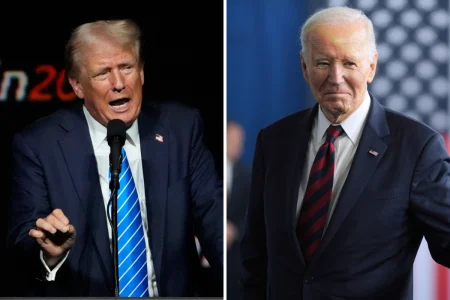
Adding a highly personalized layer of complexity to the national discourse, Donald Trump weighed in on the controversy during an informal press gaggle aboard Air Force One. Trump’s remarks highlighted what he views as a glaring double standard in how the media and the public receive sexual misconduct allegations, noting that when conservative figures face similar accusations, they are often met with skepticism, whereas allegations against certain progressives are believed immediately. Political analysts point out that Trump’s somewhat sympathetic focus on the credibility of the accuser reflects his own personal experiences, having faced numerous historic accusations himself, including the civil suit brought by E. Jean Carroll. While Trump had previously referred to Platner in harsh terms, calling him “a pig” and “a thug,” his nuanced comments on Air Force One drew sharp criticism from prominent Democrats, with former Obama adviser David Axelrod dryly noting on social media that Trump was hardly the ideal character witness.
Beyond the immediate personal drama, seasoned political strategists view the rapid desertion of Platner by top Democratic leaders—including Senate Majority Leader Chuck Schumer and Senator Elizabeth Warren—as a calculated move of institutional self-preservation. Florida Atlantic University political science professor Craig Agranoff observed that because Platner ran a aggressive, outsider campaign that rejected both the Democratic establishment and the influence of AIPAC, it is entirely natural for him to frame his political demise as a conspiracy of outside forces. Agranoff noted that the Democratic leadership recognized the vulnerability Platner posed in a highly winnable and critical swing seat, choosing to cut ties instantly to protect the party’s broader electoral prospects rather than waiting for the truth of the allegations to be fully established through due process.
This sentiment of an “establishment coup” has been loudly echoed by influential right-wing commentators, who argue that the Platner scandal transcends personal misconduct. Steve Bannon, a key architect of the MAGA movement, commented on his podcast that while Platner was clearly “not a good guy,” his populist policies resonated deeply with ordinary voters, leading the established political order to aggressively crush his candidacy in its infancy. Similarly, the Tucker Carlson Network released a statement asserting that Platner’s forced exit was less about his personal behavior and more about a coordinated effort by the Washington “uniparty” to eliminate a candidate who threatened their economic and foreign policy agendas. These commentators argue that the swift elimination of Platner represents a victory for the entrenched political elite over the genuine, democratic will of the people of Maine.
Ultimately, as Platner’s campaign adviser Morris Katz confirmed that the team chose to wind down operations for the sake of the party, the political fallout continues to ripple outward. University of Kentucky political science professor D. Stephen Voss noted that the situation serves as a powerful political weapon, allowing Republicans to criticize the moral integrity of the Democratic Party while simultaneously highlighting the deep, internal fractures within the left. Ultimately, Platner’s swift rise and even faster fall serve as a stark, modern cautionary tale of contemporary American politics, illustrating how a candidate’s anti-establishment message can be entirely neutralized overnight when personal vulnerabilities are thrust into the relentless, highly polarized national spotlight.