





In the hyper-competitive landscape of the modern National Basketball Association, the quest for glory is a two-step journey of excruciating difficulty, where the margin between historic triumph and perpetual obscurity is razor-thin. The first step, a hurdle that dooms dozens of franchises to decades of despair, is the elusive acquisition of a generational, transcendent superstar—a singular human being capable of altering the gravitational pull of the entire league. Yet, as history has repeatedly proven, finding that savior is merely half the battle; the far more complex, intellectually punishing segment of the equation lies in the methodical, patient construction of a complementary ecosystem around that star once he finally arrives. For the San Antonio Spurs, a franchise steeped in the lore of past dynasties but humbled by a grueling six-year postseason exile from 2019 to 2025, this daunting challenge was met with a masterclass in front-office alchemy and developmental patience. While those six seasons of lottery selections and quiet springs were dismissed by casual observers as a meaningless purgatory, they were secretly the foundational bedrock of a new empire. It was during this quiet epoch that the Spurs laid their trap, drafting Keldon Johnson with the unheralded 29th overall pick in 2019—a developmental victory that culminated in his being named the 2025-26 NBA Sixth Man of the Year—and securing the smooth-playing Devin Vassell at number 11 in 2020. When fortune finally smiled upon South Texas in the summer of 2023 with the arrival of the French prodigy Victor Wembanyama, the front office did not rest on its laurels; instead, they weaponized their remaining draft assets to capture defensive menace Stephon Castle with the fourth pick in 2024 and playmaker Dylan Harper with the second overall selection in 2025, ensuring their generational anchor would never have to carry the burden of a franchise alone.
What truly separates this modern iteration of the San Antonio Spurs from the hastily assembled, short-lived superteams of the past decade is the exquisite balance and intellectual synergy of their roster, a carefully curated mixture of homegrown prodigies, elite role players, and seasoned veterans who have bought entirely into the collective, selfless ethos of Spurs basketball. Recognizing that even a talent as unfathomable as Victor Wembanyama requires a veteran hand to guide the ship, the front office executed a masterstroke by acquiring the blistering speed, high basketball IQ, and steady leadership of All-Star point guard De’Aaron Fox, who serves as the team’s ultimate floor general, orchestrating the transition offense and calming the waters when the young rotation faces the intense pressure of the postseason. To solidify the interior defense and provide a physically imposing partner for Wembanyama’s weak-side help, impact acquisitions like the reliable, hard-working center Luke Kornet was integrated, providing screen-setting, vocal defensive communication, and an unselfish locker room presence. Out on the perimeter, the spectacular development of Julian Champagnie into a lethal, high-volume three-point extraordinaire has stretched opposing defenses to their absolute breaking points, ruthlessly punishing opponents who dare to send double-teams toward Wembanyama. Yet, despite the glittering array of individual accolades and diverse skill sets scattered across this deep roster, the spiritual anchor of the team remains Wembanyama himself, a young man who possesses a rare, profound humility that perfectly mirrors his unprecedented physical stature. He is a superstar who understands that championships are won in the trenches of collective effort rather than individual statistical dominance, and he is perpetually the first person to deflect the spotlight and praise, reminding the world that while his name drives the headlines, it is the collective sacrifice, chemistry, and relentless work ethic of his teammates that have made them the favorites to capture the Larry O’Brien Trophy over the formidable New York Knicks.
The ultimate culmination of this visionary team-building process was spectacularly realized on an electric Wednesday night as the San Antonio Spurs hosted the legendary New York Knicks for Game 1 of the 2026 NBA Finals, transforming the iconic Frost Bank Center into a deafening, sold-out cauldron of silver and black nostalgia laced with raw, futuristic hope. For a passionate fan base that spent a long, agonizing decade reminiscing about the beautiful, selfless basketball of the iconic 2014 championship squad, the atmosphere in the arena was thick with a mixture of intense anticipation, nervous kinetic energy, and a profound, collective sense of athletic redemption. For older fans, memories of the classic 1999 Finals between these two historic franchises came rushing back, adding a rich layer of cross-generational drama to the proceedings. The visiting Knicks walked onto the court as a terrifyingly disciplined, deep, and battle-tested juggernaut, comfortably riding the wave of a dominant eleven-game postseason winning streak and boasting a roster built on relentless physical toughness, uncompromising defensive grit, and elite late-game execution that mirrored the legendary Eastern Conference powerhouses of old. This was far more than an ordinary basketball game; it was a monumental clash of sporting civilizations, pitting the blue-collar, high-pressure defensive identity of New York against the elegant, long, and hyper-athletic future of San Antonio’s fast-breaking revolution. Millions of eyes across the global sports landscape tuned in expecting a legendary showcase focused entirely on Wembanyama’s individual offensive wizardry and his historic quest to officially crown himself as the undisputed king of the basketball world. However, as the opening whistle blew and the physical intensity escalated, the ultimate narrative of the night took a sudden, beautifully unexpected detour that stunned the basketball world, proving that the true, terrifying strength of these modern Spurs lies not in a solitary, towering savior, but in an unrelenting wave of fearless, incredibly young talent standing ready to conquer the pressure of the moment.
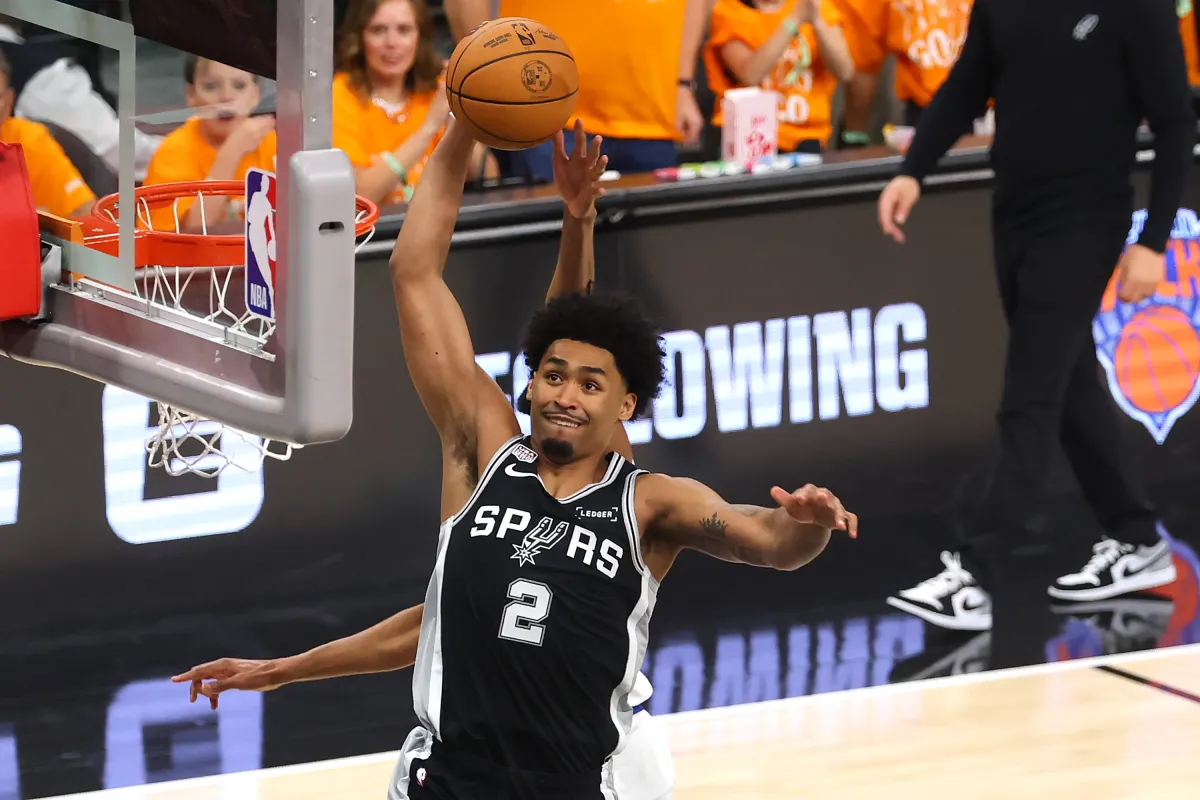
Instead of the established superstars dictating the slow, methodical grind of the game, the emotional and strategic trajectory of Game 1 was suddenly hijacked by a twenty-year-old rookie playing with pure, unadulterated instinct and ice water running through his veins: backup guard Dylan Harper. Stepping onto the hardwood of his first-ever career Finals matchup with the astonishing calmness of a ten-year veteran, the young phenom injected an immediate, electrifying surge of pure adrenaline into the arena, single-handedly destabilizing the Knicks’ highly disciplined defensive schemes with his explosive first step and unwavering confidence. In an absolutely breathtaking display of fearless offensive execution, Harper completely dismantled the traditional narrative of rookie stage fright, securing his permanent place in the historic annals of the sport by becoming the absolute youngest player in NBA history to score ten or more points in a Finals game. Indeed, the basketball pedigree in his bloodlines—growing up under the watchful eye of his father, five-time NBA champion Ron Harper—shined through in every possession, as if the young guard had been prepared for this exact moment his entire life. The miraculous speed of his impact left opposing defenders scrambled and seasoned analysts rubbing their eyes in sheer disbelief as Harper effortlessly eclipsed the double-digit threshold within a mere six minutes of stepping onto the floor off the bench. By the time the halftime whistle sounded and players retreated to their locker rooms, the rookie had accumulated a spectacular twelve points on a blistering four-of-five shooting display from the field, while simultaneously showcasing his elite, physical versatility by battling among the giants to secure six critical rebounds. According to the meticulous tracking of Spurs public relations specialist Jordan Howenstine, Harper’s historic first-quarter explosion made him the first rookie in twenty-five years to score in double digits during the opening period of a Finals game, a legendary feat that sent shockwaves through the sports world and proved that his postseason maturity was far beyond his years.
To truly appreciate the staggering magnitude of Dylan Harper’s historic Finals debut, one must carefully examine the quiet, steady evolution he displayed throughout his freshman campaign, a development defined by consistent adaptation, relentless film study, and an uncanny, clutch-gene ability to elevate his performance when the competitive stakes are at their absolute peak. During the grueling, exhausting marathon of the eighty-two-game regular season, Harper served as the consummate professional off the bench, quietly averaging a highly efficient 11.8 points, 3.9 assists, and 3.4 rebounds in just over twenty-two minutes of nightly action—solid, reliable numbers that would be celebrated on almost any other team but were somewhat overshadowed by the sheer star power and deep rotation of this modern San Antonio squad. However, when the intense pressure of the postseason arrived, Harper’s entire statistical profile surged dramatically across every major category, revealing a rare, elite competitive gear that separates standard rotational pieces from truly transcendent playoff performers. Beyond the raw numbers of the box score, it is his overwhelming physical presence, fluid lateral athleticism, and effortless court vision that leap off the television screen, passing the legendary, subjective “eye test” with brilliant, undeniable colors that leave scouts in awe. Whether he is executing a perfect, wrap-around pass to a cutting teammate or physically stonewalling an opposing guard on the perimeter, his high-IQ play style resonates on a deeply human level, showcasing an athlete playing with a profound sense of self-belief. He approaches the game of basketball with a beautiful combination of childlike joy and cold, calculated patience, navigating through complex, physical defensive coverages with a smooth, deceleration-heavy dribble path that keeps even the elite perimeter defenders of the Knicks constantly off-balance. His veteran teammates constantly laud his listening skills and absolute lack of ego, frequently noting that his rapid rise is not some miraculous hot streak, but the logical, earned result of countless hours spent in the player development lab refining his floaters, shooting mechanics, and defensive rotations.
While the initial, historic triumph of Game 1 belongs entirely to the celebrating fans in San Antonio, the grueling road to the championship remains incredibly long and treacherous, and absolutely nobody in the focused Spurs locker room is foolish enough to write off the resilient, deeply proud New York Knicks after just one game. The Knicks entered these Finals as one of the most formidable, cohesive, and mentally tough opponents the league has witnessed in the modern era, and their spectacular eleven-game postseason winning streak leading into Game 1 was certainly no statistical anomaly; they possess the elite veteran leadership, defensive chemistry, and coaching adaptability required to execute drastic game-plan adjustments, neutralize bench advantages, and transform this series into a long, brutal war of physical attrition. However, as the global basketball community analyzes the tactical adjustments and looks ahead to the remainder of what promises to be an epic series, the most terrifying and undeniable proposition for the remaining twenty-nine NBA franchises is the sobering realization that this current squad represents merely the absolute baseline—the absolute youngest, rawest, and most unpolished version—of the Wembanyama-Harper-Castle triumvirate that San Antonio has meticulously constructed. With Stephon Castle just beginning to tap into the limitless ceiling of his elite defensive capabilities, Dylan Harper already rewriting historic rookie benchmarks at just twenty years old, and Victor Wembanyama continuing to mature into an era-defining force who has yet to even enter his true physical prime, the league is staring down the barrel of a new dynasty. The rest of the basketball world must now confront a chilling, unavoidable reality: while other organizations spend years desperately searching for a single savior, the Spurs have quietly built a self-sustaining, deeply human, and terrifyingly talented empire designed to dominate the sport for the next decade, utilizing Game 1 of the 2026 Finals as a brilliant, historic warning shot destined to echo for years to come.