






The atmosphere inside the arena during the high-stakes pressure cooker of the NBA Finals is unlike anything else in professional sports, a place where legends are forged in the fires of competition or reduced to ash in the blink of an eye. For the San Antonio Spurs and their highly passionate fan base, Game 5 was supposed to be the glorious, definitive declaration of their championship pedigree. Having fought tooth and nail to tie the series at 2-2 against a remarkably relentless New York Knicks squad, the Spurs returned to their home court in Texas with all the momentum in the world behind them. In the first half, it seemed as though they would cruise to an easy, demoralizing victory, constructing an unimaginable lead that ballooned to nearly thirty points. The hometown crowd was absolutely electric, basking in the glow of what felt like an inevitable celebration, but basketball is a notoriously cruel master of momentum. Possession by painful possession, the Knicks chipped away at the massive margin throughout the second half, turning what should have been a blowout into a nerve-wracking, down-to-the-wire thriller. As the final seconds ticked away, a heavy, suffocating anxiety hung over the stadium, with fans watching in utter terror as their team teetered on the precipice of the most catastrophic collapse in Finals history. Yet, amidst the rising dread, a golden opportunity presented itself. Clinging to a razor-thin one-point lead, a brilliant defensive sequence resulted in a steal. All the Spurs needed to do was secure the ball, let the remaining seconds melt off the clock, and wait for the inevitable foul to go to the free-throw line. It was a textbook scenario for a sigh of relief. Instead, what transpired next left the entire basketball world in speechless disbelief.
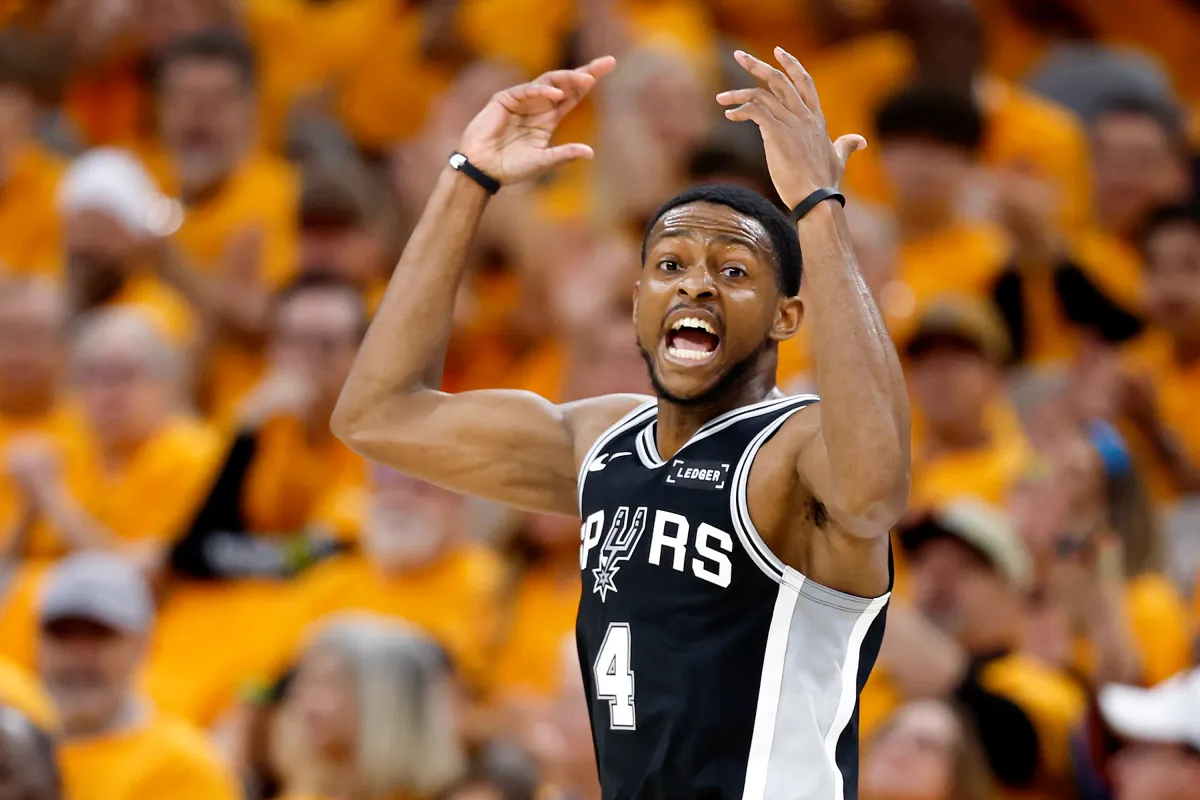
At the absolute center of this storm was De’Aaron Fox, a seasoned, nearly decade-long veteran of the NBA who had been specifically traded to San Antonio to provide a mature, calming presence for a young, inexperienced roster. Throughout the night, however, Fox had struggled immensely, finding himself trapped in a frustrating shooting slump where he converted just six of his fifteen attempts from the floor. When a star player experiences such a rough outing, the psychological burden can be incredibly overwhelming; every missed shot feels like a personal failure, and the temptation to redeem oneself with one single, heroic moment becomes almost irresistible. When the loose ball bounced into his hands in those final, chaotic seconds, Fox’s human instincts collided violently with fundamental game logic. A calmer, more detached veteran mind would have recognized the context, embraced the basketball, shielded it with their body, and stood completely still, forcing the nearest Knicks defender to commit a foul. Had he taken that path, the Spurs would have walked off their home court victorious, holding a commanding 3-2 series lead with all the momentum heading back to Madison Square Garden. But under intense pressure, the human brain can fail to process simple instructions, reverting instead to a desperate desire for self-vindication. In that split second, Fox did not see the clock, nor did he hear the screams of his bench; he saw an open path to the basket, an opportunity to put a spectacular exclamation point on a hard-fought victory and wash away the bitter taste of his poor shooting performance. It was a tragic, deeply human miscalculation born of a desire to be the hero when all his team needed was security.
Rather than stopping to secure the ball, Fox accelerated down the court, driving toward the basket for what he assumed would be a routine, game-sealing layup. The arena held its collective breath, a mixture of confusion and hope rising from the stands as fans watched him rise into the air. But the New York Knicks, fueled by the sheer desperation of their second-half comeback, refused to concede the play. As Fox went up for the shot, a trailing defender closed the gap with astonishing speed, rising from behind to cleanly swat the ball away in a spectacular defensive block. Fox flailed wildly, tumbling heavily to the hardwood floor, his eyes wide with the sudden, terrifying realization of what he had just unleashed. The ball loose, the Knicks scooped it up with ruthless efficiency, instigating a lightning-fast counter-attack while Fox remained sprawled on the court, a helpless spectator to his own nightmare. On the other end of the floor, New York’s OG Anunoby tracked the play like a predator, launching himself into the air like Superman to tip in the missed transition shot with a mere second remaining on the clock. The stadium erupted, not with the cheers of a victorious home team, but with the stunned, guttural roars of traveling Knicks fans and the agonizing silence of thousands of Texans who had just witnessed victory snatched from the absolute jaw of certainty. As the final buzzer sounded, securing a devastating victory for New York, Fox could do nothing but sit on the floor, staring blankly into the middle distance as the weight of the worst choke in modern Finals history settled heavily onto him.
While it is easy to point the finger of blame entirely at Fox, sports are rarely defined by the actions of a single individual, and a true human picture of this loss requires looking at the collective failures of the San Antonio Spurs. Responsibility must also be shared by interim head coach Mitch Johnson, whose tactical decisions down the stretch allowed a thirty-point lead to evaporate into thin air, exposing a lack of preparedness when the Knicks began their aggressive defensive adjustments. Furthermore, the spotlight must inevitably turn toward the young phenom, Victor Wembanyama, who, despite his generational talent and towering presence, showed his youth and vulnerability by missing crucial, momentum-shifting free throws when the pressure reached its absolute peak. In those final minutes, Wembanyama, who has been celebrated as the future face of the global game, seemed to shrink under the immense, suffocating weight of the moment, proving that even the most gifted athletes are susceptible to the human frailties of doubt and anxiety. The entire team became a fragile collective, paralyzed by the fear of losing rather than motivated by the prospect of winning, allowing a relentless New York team to dictate the physical and emotional terms of the game. Yet, because Fox’s mistake was so visually jarring and strategically basic, it is his face that will be corporate-branded onto sports media, serving as the convenient scapegoat for a systemic collapse. It is a harsh reality of professional athletes that their finest games can be completely erased by a single moment of poor judgment, forcing them to carry the weight of an entire organization’s failure on their own shoulders.
To truly understand the gravity of Fox’s blunder, one must look at the historical precedents of late-game catastrophes in the NBA Finals, most notably J.R. Smith’s infamous mistake during the 2018 Finals. In that game, Smith caught an offensive rebound in a tied Game 1 but, believing his team was in the lead, chose to dribble the ball outward to run out the clock, forcing the Cleveland Cavaliers into an overtime period they ultimately lost to the heavily favored Golden State Warriors. However, a crucial difference separates these two moments of infamy: that Cleveland team, despite having LeBron James, was widely regarded as massive underdogs who were highly unlikely to win the championship series against a historically dominant Warriors dynasty, meaning Smith’s mistake merely accelerated an inevitable defeat. In contrast, Fox’s blunder occurred in a highly competitive, dead-locked series where the Spurs held all the cards, boasting a roster capable of winning it all and playing on their home court. Had Fox simply stood still and allowed himself to be fouled, the Spurs would have been firmly in the driver’s seat, heading to New York with a commanding lead and a demoralized opponent. Instead, his split-second decision has completely flipped the script of the series, leaving San Antonio on the precipice of elimination while giving the Knicks an injection of absolute, unshakeable confidence that makes them look virtually unstoppable. It is this context that elevates Fox’s error from a mere late-game mistake to a potentially career-defining tragedy, a moment that will forever alter how his entire professional legacy is perceived by basketball fans alike.
As the dust settles on this catastrophic evening, the true human challenge begins for De’Aaron Fox, who must now find a way to navigate the immense psychological fallout of a mistake witnessed by millions of people across the globe. He is an exceptionally talented basketball player, someone who has dedicated his entire life to honing his craft, earning accolades, and proving his worth on the court, yet he now faces the terrifying prospect of being remembered only for a single, disastrous decision. The sports world can be incredibly unforgiving, reducing decades of hard work, leadership, and athletic excellence down to a single question that will echo through sports bars, talk shows, and social media feeds for years to come: “Why did he shoot that ball?” Unless Fox can somehow lead the Spurs to a miraculous, historic comeback from a 3-1 series deficit to claim the championship trophy in a dramatic Game 7, this singular moment of vulnerability will become the defining chapter of his career. Waking up tomorrow morning, facing the relentless glare of the media cameras, looking into the eyes of his disappointed teammates, and confronting his own self-doubt will require a level of emotional resilience that far exceeds any physical training. It is in these moments of profound failure that the true humanity of sports is revealed, reminding us that behind the multimillion-dollar contracts, the highlight reels, and the adoration of millions are fragile human beings who make mistakes, feel pain, and must find a way to heal and play on.