


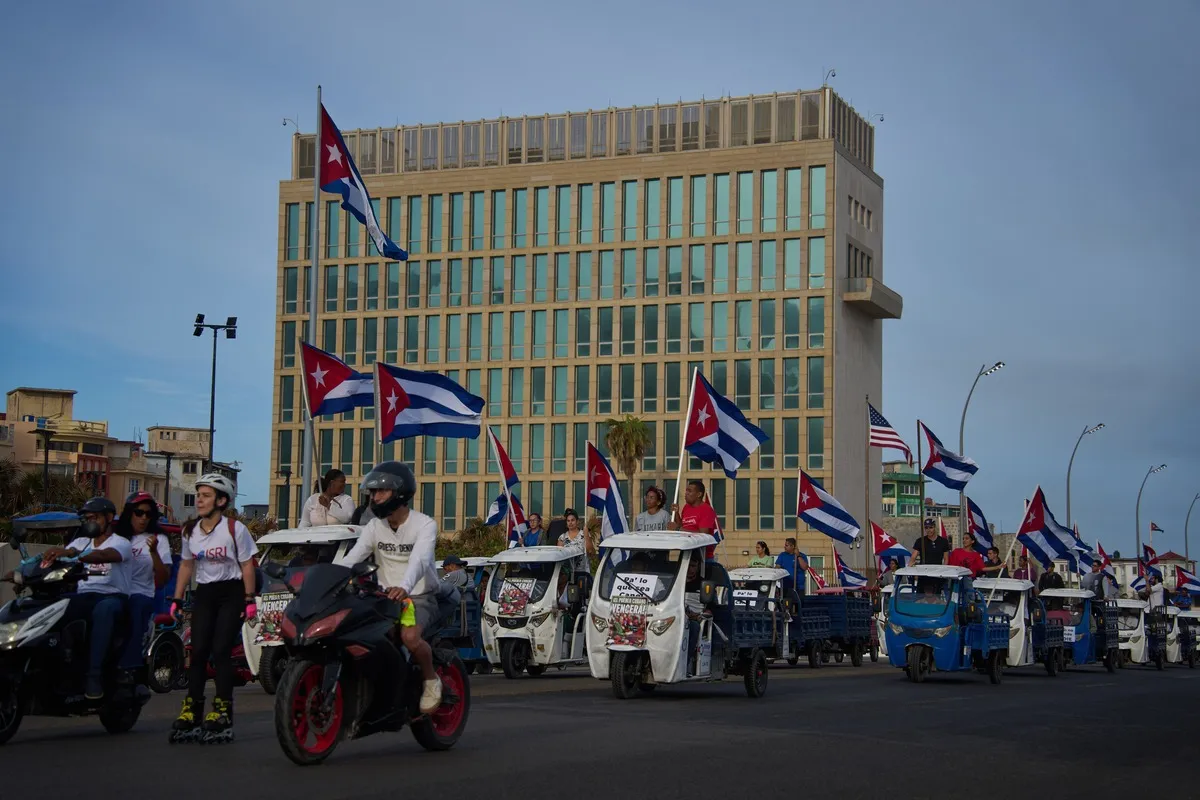
The Spark of Tension in the Caribbean
In the shadowed aftermath of a long and bitter history between the United States and Cuba, tensions flared anew when U.S. President Donald Trump, ever the showman, dropped what seemed like a casual quip that sent shockwaves across the Atlantic. It was late Friday evening, during one of his trademark rallies filled with enthusiastic supporters waving flags, where Trump veered off-script, his voice booming through the microphone as he cracked what he framed as a joke. “You know,” he said with a smirk, gesturing dramatically, “after we finish up our business with Iran—boom, it’s over—we could send the world’s biggest aircraft carrier, the USS Abraham Lincoln, right up to Cuba’s shores. Make ’em give up. Immediately, folks. Immediately.” The crowd erupted in cheers, some laughing, others nodding knowingly, but in Havana, the mood was far from jovial. Cuban officials wasted no time in decrying Trump’s words as not just casual banter but a “clear and direct threat of military aggression,” echoing the island’s deep-seated fears of American intervention. This wasn’t just rhetoric; it harkened back to the dark days of the Cold War, when the U.S. had pondered invasions and backroom plots to oust Fidel Castro’s revolution. For ordinary Cubans, whose lives have been a tapestry of resilience amid scarcity, Trump’s remarks felt like a fresh wound, reopening old scars of perceived domination. Families in Havana’s faded colonial streets shared whispers of worry, imagining the roar of carrier jets overhead, while bartenders in cigar-scented bars debated if this was bravado or blueprint. The USS Abraham Lincoln, a behemoth of steel and firepower capable of housing thousands of sailors and launching fighter jets, wasn’t just a symbol—it was a tool of might, and Trump’s mention painted a vivid picture of potential confrontation. Diplomats in Washington brushed it off as Trump being Trump, his hyperbolic style a staple of his presidency, but in Cuba, it underscored a narrative of vulnerability. This incident wasn’t isolated; it built on months of escalating rhetoric from the Trump administration, which had long positioned Cuba’s communist government as a thorn in America’s side. For those who’ve lived through U.S.-led sanctions and blockades, it wasn’t hard to humanize this threat—as a real danger to their daily struggles, from accessing basic goods to fostering fragile hopes for peace. Trump’s joke, delivered amidst applause, exposed the chasm between American spectacle and Cuban survival, turning a flippant comment into a catalyst for international debate. As news outlets buzzed, analysts predicted this could strain already frayed relations, potentially drawing in allies and complicating global geopolitics. Yet, for Cubans, it was a reminder of their enduring spirit, a defiance born from decades of standing firm against superpower pressure. The story evolves, but the threat lingers, humanizing the abstract geopolitics into the relatable fears of people just trying to live freely. In this context, Trump’s words weren’t mere words; they were a provocation, sparking conversations about power, pride, and the fragility of sovereignty in a world where one man’s jest could cascade into crisis.
A Legacy of Hostility and Historical Grudges
Delving deeper into the undercurrents of this standoff, it’s essential to understand the layered history that has defined U.S.-Cuba relations, a saga fraught with mistrust, economic warfare, and covert operations that feel more like chapters from a spy thriller than diplomatic archives. For over six decades, since Fidel Castro’s revolutionary government seized power in 1959, the United States has viewed Cuba as a rogue state, a communist bastion in its backyard that defied capitalist norms and aligned with adversaries like the Soviet Union during the Cold War. This animosity wasn’t born overnight; it stewed through events like the failed Bay of Pigs invasion in 1961, where the CIA backed a disastrous attempt to overthrow Castro, leading to humiliation for President Kennedy and cementing Cuban resolve. Embargoes followed, strangling the island’s economy, and allegations of assassination plots surfaced years later, painting a picture of relentless hostility. Under President Trump, who returned to office in a surprising turn of political tides, this enmity intensified, as if picking up a narrative left unfinished from his first term. His administration had Cuba squarely in its crosshairs, ramping up pressure that observers describe as unprecedented in modern times. Hints of military intervention floated in the air, especially after U.S. operations in Venezuela—a neighboring nation where American influence was asserted early in January—renewed thoughts of Caribbean dominance. Trump’s approach, often erratic and bombastic, humanizes this history by turning geopolitics into a personal crusade, where past grievances fuel present provocations. Imagine the Cuban people, whose grandparents lived through missile crises and economic sieges, now facing an echo of that fear. Farmers in the verdant countryside, harvesting sugarcane amid power shortages, reflect on how U.S. policies have shaped their reality, limiting access to fertilizers and machinery, fostering a culture of ingenuity born from necessity. In cities like Santiago de Cuba, museums recount the revolution’s heroes, fostering pride but also wariness. Trump’s remarks about the USS Abraham Lincoln weren’t just a nod to military might; they invoked memories of the 1962 Cuban Missile Crisis, when the U.S. Navy blockaded the island, bringing the world to the brink of nuclear war. That historical weight makes his joke feel sinister to Cubans, a personal affront to their sovereignty etched in blood and resilience. Diplomats on both sides play chess with words, but at the human level, it’s about livelihoods: families relying on remittances from exiles in Miami, artists drawing inspiration from embargoed isolation, and doctors practicing medicine with ingenuity despite shortages. This isn’t just about flags and ideologies; it’s a clash of worlds, where American prosperity contrasts sharply with Cuban austerity, humanizing the conflict through stories of individual endurance. As tensions simmer, the legacy of grudges ensures that every threat reverberates deeply, reminding us that history isn’t distant—it’s vividly alive in the hearts of millions.
Sanctions and Economic Warfare: Tightening the Vice
Building on this fraught backdrop, Trump’s administration unveiled a fresh wave of sanctions on Friday, targeting not just regime figures but swathes of ordinary people whose livelihoods are interwoven with Havana’s economy, turning economic policy into a blunt instrument of pressure. These measures, announced alongside his spoken quip about military aggression, were meticulously crafted to cripple Cuba’s ability to function, mirroring a strategy that’s been a cornerstone of U.S. foreign policy towards the island. By sanctioning businesses, importers, and even ancillary operations linked to the Cuban government, Washington aimed to isolate the communist leadership further, making it harder for them to sustain power. For everyday Cubans, this feels like an invisible hand crushing their aspirations, as resources become scarcer and opportunities vanish into bureaucratic red tape. Historically, sanctions have evolved from targeted embargoes to sweeping restrictions, now encompassing digital transactions and international partnerships, effectively walling off Cuba from global trade networks. Think of Maria, a small vendor in a bustling Havana market, whose family business importing textiles is suddenly paralyzed by new rules, forcing her to pivot to local crafts or risk starvation—it’s a human story of adaptation amid adversity. Or consider engineers in state enterprises, innovating renewable energy solutions but hamstrung by blocked access to foreign tech, embodying the frustration of a bright future deferred. Trump’s push, hinting at post-Iran military adventures extending to Cuba, frames these sanctions as a precursor, a soft invasion through wallets and supply chains. This approach humanizes the conflict by spotlighting the economic toll on civilians, where inflation spikes not due to market forces but political vendettas, eroding purchasing power and exacerbating disparities. Families pool rations, children dream of schooling beyond the island’s borders, and artists mourn lost international audiences—all painted by U.S. policy as collateral damage in a larger game. Comparing this to global norms, it’s stark; while American corporations thrive on open markets, Cuban innovators scrape by, fostering a narrative of resilience that’s both inspiring and heartbreaking. The sanctions aren’t faceless: they target specific sectors like tourism and agriculture, vitally important to Cuba’s recovery, and link back to Trump’s earlier boasts, suggesting not just isolation but eventual capitulation. Observers note how this mirrors past efforts, like the 1960 embargo that morphed into the Helms-Burton Act, allowing U.S. citizens to sue for pre-revolution properties—an enduring grudge that fuels division. In human terms, it’s about dignity; Cubans navigate these hurdles with pride, bartering skills and community ties, turning sanctions into a forge for national identity. Yet, the pain is real, a constant reminder of how geopolitical strategies ripple into personal lives, shaping destinies and dreams in ways policymakers might overlook amid boardroom debates.
The Fuel Blockade: Fueling Crisis and Survival
Perhaps the most palpable manifestation of this escalating strife came in early 2026, when the U.S. imposed a crippling fuel blockade on Cuba, amplifying the chaos sown by broader sanctions and Trump’s rhetorical thunderbolts. This blockade, a calculated chokehold on vital energy supplies, has plunged the island into a crisis that feels apocalyptic to its inhabitants, with dwindling fuel reserves triggering widespread blackouts, halting industries, and evaporating much of the nation’s lifeblood—its thriving tourist trade. Picture Alejandro, a fisherman in a coastal village, his boat idled by the scarcity, resorting to paddles and hopes for rainwaters to catch his livelihood, while his family huddles in darkness, candles flickering against humid nights. The blockade isn’t merely logistical; it’s a weapon of exhaustion, forcing Cubans to ration every drop of gasoline or diesel, prioritizing hospitals and emergency services over transportation and commerce. Blackouts became a norm, schools canceled classes, and hospitals operated on generators, straining an already overburdened healthcare system that prides itself on universal access. Tourists, the economic elixir that once buoyed Cuba’s coral-fringed beaches and vibrant markets, vanished as flights dwindled and hotels shuttered, wiping away billions in revenue and leaving bartenders and guides idle, sharing tales of better days by oil lamps. This humanizes the ordeal through lived experiences: Ana, a nurse in Havana, navigating pitch-black wards by memory and torchlight to tend to patients during power outages that could last days, her dedication a beacon in the gloom. Farmers across rural provinces face irrigation pumps silent, crops wilting under a relentless sun, as the blockade undermines agricultural output and heightens food insecurity. It’s a stark contrast to the comfort of distant capitals, where fuel flows freely, underscoring the unequal burden of global politics. Trump’s allusions to military might, juxtaposed with this energy embargo, suggest a multi-pronged assault, where economic strangulation softens targets for potential naval incursions like those hinted with the USS Abraham Lincoln. Cubans, resilient from past hardships like hurricanes and pandemics, innovate—biking through streets adorned with revolutionary murals, cooking communal meals over open fires, and drawing on a culture of self-reliance etched into national DNA. Yet, the toll is evident in rising malnutrition rates and mental health strains, stories of despair balanced by unfaltering spirit. Foreign observers decry the blockade as a form of collective punishment, echoing critiques of how such tactics contravene international norms, particularly the humanitarian needs of vulnerable populations. In essence, the fuel crisis transforms abstract geopolitics into visceral reality, where every extinguished light symbolizes not just logistical failure but the erosion of a people’s hope, humanizing conflict through the lens of everyday struggle and unyielding Cuban grit.
Voices of Defiance: Cuban Leaders Stand Firm
Amid this mounting pressure, Cuban voices rose in unison on Saturday, offering a chorus of defiance that echoed the island’s storied resistance against external threats. Foreign Minister Bruno Rodriguez, a seasoned diplomat with a reputation for unflinching candor, took to social media and press conferences to denounce the U.S. escalation as a perilous elevation of aggression, labeling Trump’s carrier comment a “dangerous” provocation that underscored Washington’s hostile intentions. “The United States has raised the level of aggression against Cuba to dangerous levels,” Rodriguez declared, his words clipped yet resolute, drawing parallels to historical aggressions while emphasizing the island’s right to sovereignty. In a separate address, President Miguel Díaz-Canel, the youthful head of Cuba’s government whose leadership style balances revolutionary fervor with pragmatic appeals, characterized Trump’s threats as reaching an “unprecedented” peak, a stark departure even from the vitriol of past administrations. “We Cubans do not let ourselves be intimidated,” Rodriguez added in his post, a phrase that quickly went viral, resonating with citizens who have long viewed such stances as rallying cries. This response humanizes the narrative by spotlighting leaders not as distant bureaucrats but as representatives of a populace whose pride is palpable in plazas and pueblos alike. Díaz-Canel’s statements, delivered in television broadcasts viewed by millions, exuded calm confidence, recounting Cuba’s history of thwarting invasions—from the Bay of Pigs to Cold War standoffs—while connecting present struggles to past victories. Rodriguez, often a voice of reason in international forums, appealed to global audiences, urging solidarity and highlighting how U.S. actions violate humanitarian principles, affecting everything from elderly care to education. Behind these public faces lie personal stakes: Díaz-Canel, leading a nation in limbo, prioritizes unity, perhaps recalling his own youth during lean times, while Rodriguez, a father and thought leader, embodies the intellectual resistance against imperialism. For ordinary Cubans, these declarations aren’t lofty ideals; they’re affirmations, shared over state-run radio and community gatherings, bolstering morale amid blackouts and shortages. Artists capture it in murals and music, turning defiance into cultural currency, while students pledge allegiance, seeing leadership as a mirror of their tenacity. Internationally, the statements gain traction, prompting sympathy from allies and critiques of U.S. policy as bullying. Yet, they also unveil vulnerabilities—Rodriguez acknowledges the economic bite but frames it as a test of character, humanizing geopolitics through emotional appeals. This isn’t just diplomatic posturing; it’s a narrative of empowerment, where leadership inspires stories of grandparents teaching resilience to grandchildren, ensuring that even under siege, Cuban identity endures unbroken. Breaking through the noise, their voices humanize resilience, transforming threats into opportunities for international empathy and domestic fortitude.
A Broader Horizon: Implications and Uncertain Future
As this unfolding saga hints at broader implications, the U.S.-Cuba standoff reverberates beyond bilateral borders, touching on themes of power dynamics, human rights, and global stability in an interconnected world. Analysts and observers speculate that Trump’s “joke” about deploying the USS Abraham Lincoln could signal a shift towards more assertive foreign policy, possibly emboldening U.S. actions in other hemispheric flashpoints, while Cubans brace for escalation. This incident, coupled with the fuel blockade’s devastating effects, highlights how economic and military pressures intertwine, potentially destabilizing the Caribbean and influencing refugee flows or regional trade. Humanizing this, consider Elena, a Havana resident juggling care for aging parents, whose daily routines are disrupted by shortages, prompting reflections on how such conflicts ripple into migratory dreams and familial separations. Diplomatically, it strains ties with allies; European nations criticize the sanctions as counterproductive, advocating dialogue over aggression, while Latin American counterparts rally in support of Cuba, viewing U.S. posturing as neo-imperialism. On a human scale, the story unfolds in personal narratives: chefs adapting recipes without gas, musicians performing acoustic sets, and educators teaching amid uncertainty, each anecdote underscoring the intangible losses of culture and community. Breaking news cycles amplify debates—journalists interview veterans of past U.S. interventions, drawing parallels that remind audiences of the human cost of wars. Yet, optimism persists in Cuba’s inventive spirit; communities harness solar ingenuity or bartering systems to mitigate impacts, embodying a philosophy of “lo cubano” that turns crisis into strength. Internationally, Trump’s approach raises questions about accountability, with some calling for UN involvement to address humanitarian concerns. This narrative isn’t static; updates pour in, from possible military maneuvers to prisoner exchanges, keeping the world on edge. For Cubans, it’s a call to vigilance, humanized through generations who have weathered storms larger than this. Ultimately, as tensions evolve, the story humanizes geopolitics by centering the indomitable human factor—resilience in the face of adversity, the unyielding quest for dignity, and the hope that tomorrow might bring resolution rather than rupture. In this volatile tableau, every development carries weight, reminding us that beneath banners and borders, lives intersect in profound ways. This is indeed a breaking story, with threads of history, humanity, and uncertainty weaving a tapestry yet to fully unfold.