





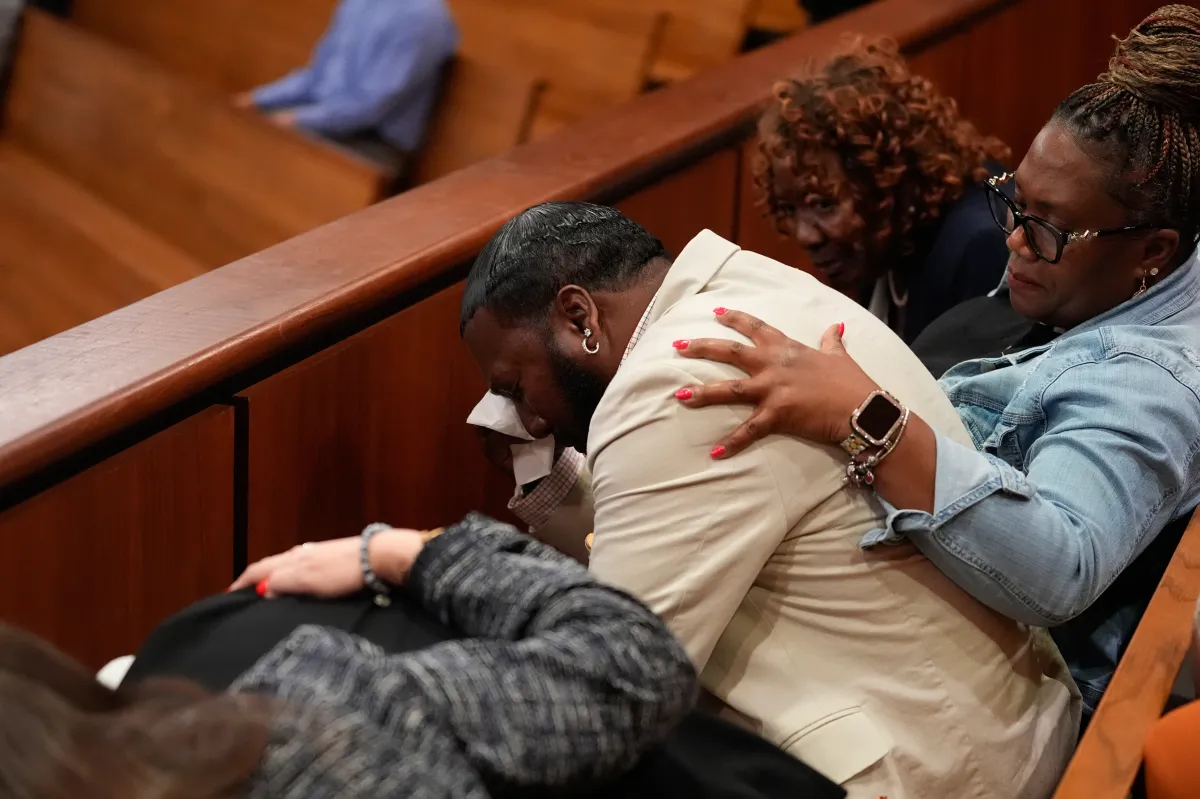
The devastating atmosphere inside the Richland County courtroom was heavy with a grief that no legal verdict could ever hope to alleviate. It was there, just two days shy of the painful one-year anniversary of fourteen-year-old Cyrus Carmack-Belton’s tragic death, that a jury acquitted South Carolina convenience store owner Rick Chow of murder. As the “not guilty” verdict was read aloud, the courtroom seemed to lose its collective breath. Cyrus’s father, Troy Belton, stood in somber silence, surrounded by family members who hung their heads, wept openly, and clung to one another in raw, unfiltered agony. For a family waiting a year for what they believed would be a clear-cut path to accountability, the system’s answer felt like a door slammed shut on their grief. Yet, even as the defense celebrated a monumental courtroom victory, the legal echoes of that fatal encounter were far from silenced. Almost immediately after leaving the courthouse, the family’s attorney, Todd Rutherford, made it clear that while the criminal trial had concluded, the fight for Cyrus’s memory was merely transitioning to a different, deeply personal legal arena: a civil wrongful death lawsuit.
To understand the profound community outrage and the family’s lingering despair, one must look back to the sweltering May afternoon in 2023 inside Chow’s Columbia convenience store, where a minor misunderstanding escalated into an ultimate tragedy. Cyrus, a vibrant teenager with his whole life ahead of him, had entered the establishment, where he was suddenly and aggressively suspected of shoplifting low-value bottles of water. Terrified and seeking only to remove himself from the brewing confrontation, the fourteen-year-old fled the store and ran out into the surrounding neighborhood. Rather than letting the authorities handle the perceived infraction, Rick Chow and his son took matters into their own hands, initiating a high-stakes foot pursuit through the streets. Surveillance footage and witness testimonies later captured a harrowing sequence of events, showing a young boy desperately fleeing a pair of grown men. The pursuit ended in violence when Chow drew his firearm and discharged a single, fatal bullet that struck Cyrus squarely in the back. The sheer asymmetry of the situation—a child losing his life over a suspicion involving bottled water—sent shockwaves through the community and established the central, heartbreaking tension of the subsequent murder trial.
When the criminal trial finally commenced, the prosecution and the defense presented two irreconcilable narratives of those final, chaotic moments, forcing the jury to deliberate for eight grueling hours over the course of several days. The state’s prosecutors built their case on the objective, physical reality of the shooting, arguing that Cyrus was actively running away from his pursuers and posed no immediate physical threat to anyone when he was shot. They pointed to the medical evidence that the boy was shot in the back as proof of his vulnerability and desperation to escape, rather than any intent to harm. Conversely, Chow’s defense team painted a picture of self-defense and parental instinct, arguing that the store owner truly believed his son’s life was in imminent danger because they suspected Cyrus was armed with a handgun during the chase. In the eyes of the law, because this was a criminal proceeding, the prosecution bore the exceptionally heavy burden of proving Chow’s guilt “beyond a reasonable doubt.” Ultimately, the jury’s acquittal did not mean they endorsed Chow’s actions or found his behavior morally upright; rather, it indicated that the state had failed to meet this stringent, highly demanding legal threshold, leaving Cyrus’s family to reconcile a system that protectively favors the accused with their own search for basic justice.
The acquittal provoked immediate, deep-seated disbelief from the family’s legal representation, sparking a fierce determination to seek alternative justice. Todd Rutherford, a seasoned attorney with nearly three decades of legal experience in South Carolina, spoke to reporters with an intensity born of genuine shock and frustration, admitting he had never seen a case where a child shot in the back while fleeing yielded such an outcome. Rutherford expressed his profound inability to comprehend how a jury could look at the undisputed facts of the case—an unarmed youth fleeing an accusation of minor theft, shot from behind—and return a verdict of not guilty. It was this sense of systemic failure that fueled the family’s decision to bypass the criminal court’s shortcomings and immediately initiate civil litigation against Chow. By taking this step, the Belton family is refusing to let the criminal verdict be the final word on Cyrus’s life, opting instead to hold Chow personally and financially accountable for the devastating loss of their son through a wrongful death action that focuses entirely on the civil liability of his actions.
This transition from criminal prosecution to a civil lawsuit highlights a crucial, often misunderstood distinction within the American legal system regarding the standards of proof. As prominent defense attorney Todd Spodek explained, a criminal acquittal does not insulate an individual from civil liability, because the rules of engagement in a civil courtroom are vastly different. While a criminal conviction requires a jury to be virtually certain of guilt beyond a reasonable doubt, a civil wrongful death claim operates under the “preponderance of the evidence” standard, meaning the family only needs to prove that their version of events is more likely true than not. Furthermore, Spodek noted that the civil trial will not merely ask whether Chow perceived an initial threat, but will scrutinize the entire timeline of the pursuit, questioning whether the escalation to deadly force remained reasonable and justified as Cyrus was running away. In this less demanding legal forum, the family’s legal team can re-present the heartbreaking facts of the chase, aiming to prove that Chow’s reckless decision to pursue and shoot a fleeing teenager constituted a fatal act of negligence and disproportionate force.
As the Carmack-Belton family prepares to return to the courtroom for this next, exhausting chapter of their legal battle, they do so under the heavy shadow of a permanent, agonizing loss. No civil payout or favorable court judgment can ever bring back a fourteen-year-old child whose life was cut short over a dispute about bottles of water, but the civil lawsuit represents a vital avenue for public validation and systemic accountability. It allows Cyrus’s family to keep his memory alive, ensuring that his name is not forgotten and that the community continues to grapple with the ethics of vigilante justice and the value placed on young Black lives. For Troy Belton and the rest of Cyrus’s loved ones, the impending civil trial is more than a legal maneuver; it is a profound, enduring act of love and defiance. They are standing up to declare that Cyrus’s life mattered, that his tragic death was entirely preventable, and that they will continue to voice their demand for justice until every legal avenue has been thoroughly exhausted.