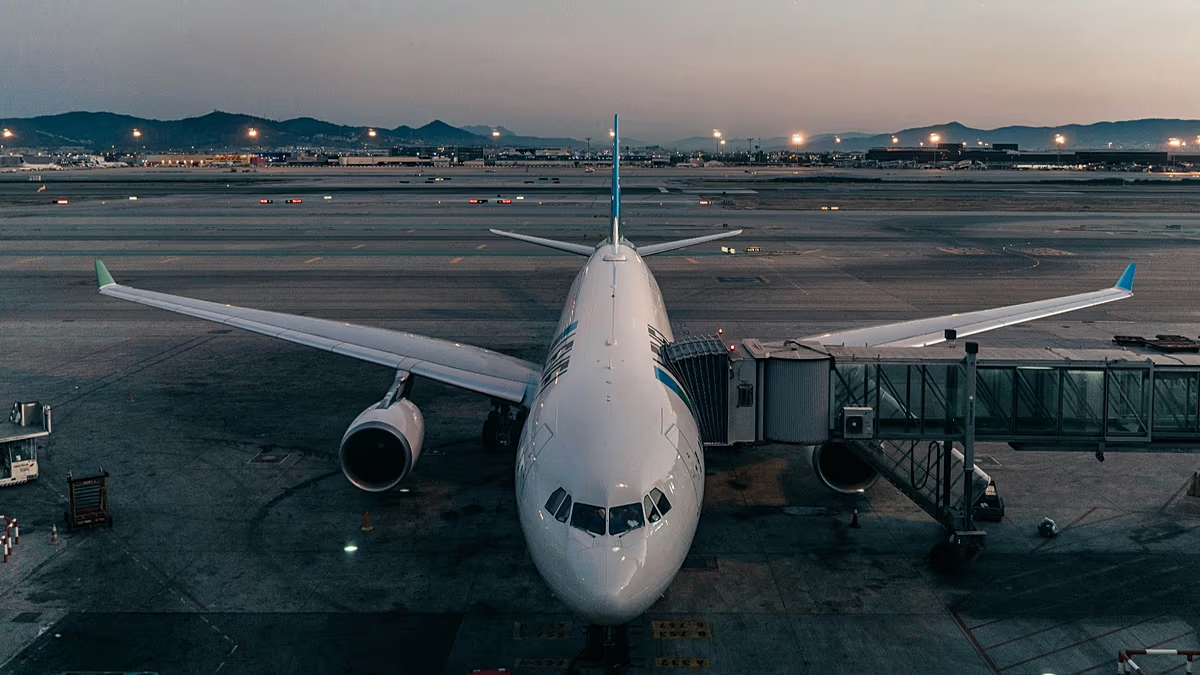





The visceral thrill of the annual summer holiday is a deeply human experience, a shared social ritual that represents months of hard work, financial saving, and eager anticipation. From the moment the suitcases are packed to the early-morning crawl to the airport terminal, the journey is meant to be a magical prelude to a well-deserved escape from the monotony of daily life. Unfortunately, this collective dream of peaceful travel is increasingly shattered by a small, highly disruptive minority of passengers whose erratic, anti-social actions turn routine journeys into high-altitude nightmares for everyone on board. As the peak summer travel season gets underway, sending millions of hopeful vacationers into the skies, the UK government is seriously contemplating a sweeping, zero-tolerance policy that could fundamentally alter the landscape of modern commercial aviation. Under ambitious new proposals currently being explored with aviation chiefs, the government is looking to introduce a national, multi-carrier blacklist designed to completely ground unruly travelers. Instead of receiving a mere slap on the wrist or an isolated ban from a single airline, passengers who engage in serious misconduct—including extreme drunkenness, physical and verbal abuse of flight crews, or mid-air violence—would find themselves locked out of booking flights with any British airline. It is a bold, protective step that aims to safeguard the safety and sanity of the traveling public, ensuring that those who choose to act as a menace are left behind at the gate while the rest of the world takes flight. The proposal marks a dramatic departure from standard regulatory approaches, transforming the penalty for air rage from a localized corporate issue into a unified, industry-wide ban that completely strips offenders of their boarding privileges across the entire aviation network.
At the core of this legislative push lies a glaring loophole that has long frustrated airline personnel and law-abiding travelers alike: the fractured, fragmented nature of passenger discipline within the private market. Under current industry protocols, if a passenger behaves egregiously on a flight operated by a budget carrier like Ryanair, that specific airline can issue a lifetime ban, but that does absolutely nothing to prevent the individual from purchasing a ticket with a competitor like British Airways or EasyJet the very next morning. This lack of systemic communication enables repeat offenders to hop from one carrier to another, exploiting security blind spots and exposing various flight crews to the same predictable, hazardous pattern of abuse. To address this structural vulnerability, officials from the British government’s Department for Transport are organizing a series of high-level meetings with aviation executives to map out a centralized, national database. This proposed collective blacklist would be co-managed by the state and the aviation sector, linking ticket booking portals in real-time. If an individual is added to the registry due to dangerous behavior, the system would automatically flag and reject their attempts to book flights across all participating airlines. For the dedicated cabin crews who must manage high-stress situations at 35,000 feet with no escape route, this unified corporate-governmental front represents more than just a bureaucratic update; it is a vital shield that restores a measure of respect, protection, and peace of mind to their daily workplace. By forcing carriers to act in solidarity rather than isolation, the system effectively constructs a comprehensive safety net designed to neutralize troublemakers before they can step foot inside any aircraft cabin.
This prospective crackdown is fueled by a larger, culturally loaded debate surrounding the unique and often chaotic environment of the modern airport. Once passengers step past the security checkpoint, they enter a liminal space where normal societal clocks and rules seem to dissolve entirely, creating an atmosphere where it is widely accepted that it is always “five o’clock somewhere.” This temporal distortion has nurtured a deeply ingrained culture of pre-flight drinking, where early-morning pints and heavy cocktails are viewed as standard holiday starters. While the vast majority of holidaymakers can enjoy a traditional airport beverage responsibly, the complete absence of local licensing laws in departure lounges has contributed to a worrying escalation of alcohol-fueled air rage. The issue reached a boiling point recently when Ryanair’s outspoken chief executive, Michael O’Leary, passionately called for a ban on early-morning drinking before flights, highlighting that Europe’s busiest budget carrier is now forced to divert nearly one flight every single day due to unruly passenger behavior. A flight diversion is a massive operational crisis that inflicts untold psychological stress on crew members, disrupts the travel plans of hundreds of innocent passengers, and costs airlines tens of thousands of pounds in landing fees, fuel, and ecological waste. The proposed national blacklist serves as a direct legislative response to this systemic chaos, aiming to force travelers to weigh the fun of excessive airport drinking against the very real risk of losing their right to fly altogether, thereby redefining our collective relationship with alcohol in the sky.
However, establishing a nationwide flight ban list is far simpler in theory than it is in practical execution, primarily due to the complex web of modern data privacy regulations. The primary legal hurdle to this shared database is the General Data Protection Regulation (GDPR), alongside various domestic privacy laws that strictly regulate the storage and sharing of personal consumer data. Under existing regulations, airlines are legally forbidden from sharing sensitive information—including names, passport numbers, and behavioral incident reports—with rival companies, meaning that warning a competitor about a dangerous flyer could actually trigger severe legal penalties and multimillion-pound fines for the warning airline. This legal paradox has effectively protected the anonymity of troublesome passengers at the expense of public safety. To overcome this hurdle, legal and policy experts from the Department for Transport must draft a highly targeted statutory framework that legally permits this specific classification of data sharing under a public safety or national security exemption. Furthermore, the government must design robust appeal mechanisms to prevent situations where travelers with identical names are mistakenly swept onto the blacklist, ensuring the system remains exceptionally precise, fair, and reserved exclusively for the most severe cases of verbal or physical hostility. Navigating this legal minefield requires a delicate balance between preserving individual civil liberties and maintaining collective national transit safety.
Despite these regulatory and logistical gridlocks, the aviation sector has expressed overwhelming support for the government’s proposal, viewing it as a long-overdue mechanism to protect front-line workers. Airlines UK, the influential trade body representing British carriers, has warmly welcomed the initiative and pledged to work closely with ministers to develop a secure, practical model. For the thousands of flight attendants and pilots who keep our skies safe, the proposed blacklist is a deeply personal issue that addresses the severe, unpublicized psychological toll of their daily work. Cabin crews are highly trained safety professionals, experts in evacuation, medical care, and physical security, yet they are increasingly forced to act as high-altitude bouncers, verbal punching bags, and physical targets for disgruntled, aggressive flyers. The reality of working in a small, pressurized tube while enduring threats of violence, racial slurs, or physical altercations is an unacceptable workplace hazard that no employee in any other sector would be expected to tolerate. By creating a unified national blacklist, the industry seeks to send an unequivocal, collective message: flying is an earned privilege, not an absolute right. This historic policy shift prioritizes the safety and dignity of the working crew and the peaceful, law-abiding majority, refusing to allow a tiny, selfish group of passengers to hijack the travel experience for everyone else, and elevating workplace protection to a primary industry standard.
As the Department for Transport prepares to meet with aviation leaders, the travel industry stands on the precipice of a defining cultural moment. The history of flight has always been associated with progress, freedom, and the beautiful ability to connect diverse cultures, but these freedoms can only endure when anchored to a shared sense of personal responsibility and mutual respect. The potential creation of a national aviation blacklist reminds us that air travel is, at its heart, a collective human endeavor where our behavior directly impacts the peace of mind and physical safety of dozens of strangers around us. This proposed policy is not an attempt to police human joy, nor is it designed to strip away the lighthearted traditions that make vacations so exciting for multi-generational families and hard-working individuals. Rather, it is a compassionate, protective boundary designed to ensure that the skies remain a safe sanctuary for everyone who boards an aircraft. By establishing a firm, unified deterrent that permanently grounds those who exhibit toxic or dangerous behavior, the government and the aviation industry can successfully restore a sense of safety, civility, and wonder to air travel, ensuring that the journey itself remains as pleasant and peaceful as the destination waiting on the horizon. It is a necessary evolution for a modern society, proving that our collective safety will always triumph over individual hubris.