


There is a profound, often unrecognized difference between traveling to a new country and actually building a home there. While the physical act of boarding a flight and crossing a border can be accomplished in a matter of hours, the psychological transition from an anxious outsider to a settled local is a slow, vulnerable process that can take months or even years. Newly arrived expatriates are immediately confronted with a daunting checklist of challenges: decoding a new language, wrestling with labyrinthine local bureaucracies, establishing a reliable network of friends, and finding those comforting daily landmarks—like a favorite coffee shop or a trusted neighborhood doctor—that ground us in our daily lives. Recognizing these hidden hurdles, the relocation and insurance experts at William Russell undertook a comprehensive data-driven study to determine which corners of the globe genuinely make this transition easiest for newcomers. As William Cooper, the director and co-owner of William Russell, wisely points out, a truly welcoming destination is defined far less by how easily you can pass through customs, and much more by how effortlessly you can build a stable, dignified life once you unpack your bags. The presence of accessible healthcare, robust employment opportunities, and a reliable financial system during the critical first six to twelve months can make the ultimate difference between an expat packing up in defeat or thriving in their new home for decades to come.
To move beyond mere anecdotes and subjective traveler reviews, the researchers at William Russell developed a sophisticated methodology to quantify what makes a country genuinely hospitable. They created a comprehensive scoring system out of ten, evaluating nations against six crucial pillars of integration: the lived experiences of expats already on the ground, the overall size of the existing migrant community, foreign-born employment rates, public attitudes toward immigration, national safety, and visa accessibility. To gather this intelligence, they synthesized trusted global datasets, marrying qualitative insights from InterNations’ highly regarded Expat Insider survey with hard economic and social indicators from the OECD, the World Bank, the Global Peace Index, and the Henley Global database. By analyzing these diverse factors, the study successfully moved past superficial tourist appeal to evaluate the structural integrity of each country’s social fabric. The resulting index reveals that welcoming societies are not born by accident; rather, they are deliberately constructed through inclusive labor markets, transparent administrative procedures, and a foundational culture of social trust that views foreigners not as burdens, but as vital contributors to the national collective.
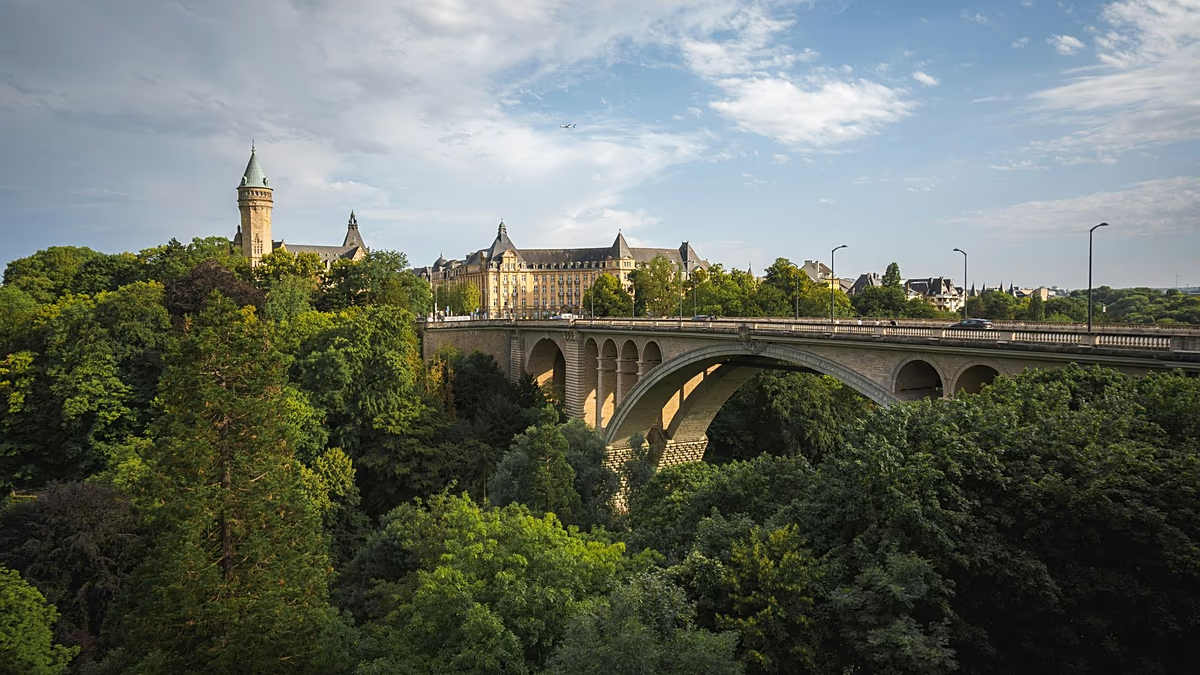
At the very pinnacle of this global ranking sits Iceland, earning an extraordinary score of 8.94 out of ten and establishing itself as the world’s most welcoming sanctuary for newcomers. Though the remote Nordic island is famous for its dramatic, icy landscapes, the warmth of its societal embrace is unmatched, boasting a staggering foreign-born employment rate of 84.2%. Iceland’s success lies in its rare combination of abundant economic opportunities, remarkably straightforward administrative processes, and an incredibly high level of societal safety and trust that instantly lowers the blood pressure of any anxious new arrival. Close behind in second place is Luxembourg, scoring an impressive 8.69 out of ten. This tiny European powerhouse has transformed its demographic reality into its greatest strength, with over half of its resident population originating from abroad. In Luxembourg, accommodating international residents is not an afterthought, but a core administrative design; vital services like banking, housing, and schooling are inherently built to cater to a global clientele, while the typical workplace is a multilingual, diverse environment where colleagues hold a shared understanding of what it means to build a life in a new land.
The top-ten list of welcoming countries spans the globe, offering a fascinating map of societies that actively champion the expat journey. Switzerland claimed the fifth position with a score of 8.36, bolstered by a remarkably high visa openness score of 93 and a robust foreign-born employment rate of 77.1%, proving that its legendary precision extends to how it integrates global talent. Ireland followed closely in sixth place with a score of 7.89, utilizing its famous warmth and dynamic economy to ease the transition for newcomers, while the final stretch of the top ten featured a diverse trio of European nations: Czechia in eighth, Portugal in ninth, and Austria in tenth. Beyond Europe, the Southern Hemisphere shone brightly, with New Zealand capturing third place with an 8.57 score and Australia taking fourth with 8.54, both celebrated for their high quality of life and deeply established immigrant communities. Rounding out the global top ten was Colombia in seventh place with a score of 7.71, highlighting that a warm welcome can be found in vibrant, culturally rich emerging markets just as easily as in wealthy Western nations, provided there is a fundamental openness to those coming from afar.
When we zoom in from the national level to look at individual cities—where the actual textures of our daily lives unfold—the dynamics of welcoming change dramatically. Drawing data from the Happy City Index and Numbeo, the researchers evaluated the world’s major urban centers based on happiness, physical safety, and the daily friendliness of the local public. Zürich emerged as the absolute gold standard for urban integration, topping the global chart with an outstanding score of 9.06 out of ten, driven by an exceptional safety rating of 76.7 and a remarkably low “social friction” score of 24.9. In stark contrast, legendary megacities like London, Paris, and New York were conspicuously absent from the upper echelons of the list. The analysts hypothesized that the sheer scale, breakneck pace, and overwhelming density of these enormous metropolises can paradoxically heighten a newcomer’s sense of anonymity, making the daily struggle to form meaningful human connections and build a supportive community feel agonizingly difficult amidst the chaotic urban rush.
Ultimately, the city rankings prove that manageable urban planning, public safety, and intuitive infrastructure are the secret ingredients to making a city feel like a home. Following Zürich, Singapore and Tokyo tied for a spectacular second place with identical scores of 8.97, illustrating that hyper-modern, safe, and hyper-efficient Asian hubs can offer an incredibly smooth landing for expats. The remaining top ten represented a diverse array of urban sanctuaries: Copenhagen took fourth place with an 8.72, Munich secured fifth with 8.63, Prague captured sixth with 7.86, and Warsaw claimed eighth with 7.52, while Dubai, Seoul, and Hong Kong rounded out the list in seventh, ninth, and tenth respectively. Each of these cities, in its own unique way, prioritizes low social friction and robust public safety, ensuring that residents do not have to expend all of their energy simply surviving the environment. By choosing a destination where the social, economic, and institutional systems are designed to support and include outsiders, global citizens can transform the daunting leap of moving abroad from a stressful survival trial into a deeply fulfilling, life-affirming adventure of self-reinvention.