


The world of travel is constantly evolving, and for 2026, a new celestial trend is capturing the imagination of adventurers. More and more, trips are being planned not around bustling cities or famous landmarks, but around the simple, profound act of looking up at the night sky. Stargazing has moved from a niche hobby to a mainstream travel motivation, with people seeking out locations where the Milky Way is visible to the naked eye and where annual meteor showers can be observed in all their fiery glory. This shift reflects a deeper desire for connection—not just with nature, but with the universe itself. It’s a move away from the constant noise of digital life toward the silent, awe-inspiring spectacle of the cosmos. From the deserts of Namibia to the peaks of the French Pyrenees, travelers are charting courses to the darkest corners of the map, hoping to witness a view that has inspired humanity for millennia.
To help guide these cosmic travelers, eSIM provider Holafly has introduced its inaugural “Clean Sky Index,” a new ranking designed to identify the best stargazing destinations on the planet. However, this is not just another list of the darkest places on Earth. The index acknowledges that a truly great stargazing trip requires a delicate balance. A location might have the darkest skies in the world, but if it takes a week of arduous travel to reach, it may not be practical for the average visitor. The index, therefore, is built on finding destinations that offer the “best overall balance between exceptional night skies and practical travel.” It’s a pragmatic approach that considers not just the view, but the entire experience. The ranking was compiled by analyzing various locations using four weighted criteria. Light pollution, which accounts for 35% of the score, is paramount, measured by Sky Quality Meter readings and the Bortle scale—a nine-level system that classifies the darkness of the night sky, with Class 1 being the darkest and best for observation.
The remaining criteria ensure that the top spots are not just dark, but also accessible and accommodating. Clear-night frequency, making up 30% of the score, measures the percentage of cloud-free nights each year, ensuring that visitors have a high chance of actually seeing the stars. Accessibility, at 20%, is based on travel time from major international hubs, prioritizing destinations that can be reached with relative ease. The final 15% of the score is dedicated to Dark Sky certification, recognizing destinations that have been officially designated by DarkSky International for their commitment to preserving the night environment. These criteria are not just arbitrary numbers; they represent a holistic view of what makes a great stargazing trip. To ensure the list was geographically diverse and not dominated by a single country, Holafly limited the final shortlist to no more than three destinations per country. They also assessed both certified and non-certified locations to prioritize the actual quality of the sky over the presence of a certificate, ensuring that hidden gems with pristine skies but no official designation could still be recognized.
Taking the number one spot on this inaugural index is Pic du Midi in France, a choice that perfectly exemplifies the index’s philosophy of balance. This world-renowned observatory, perched high in the French Pyrenees, was highlighted for its magnificent sky conditions and its relative ease of access. Unlike some of the other destinations on the list, which may be incredibly dark but are located in some of the most remote corners of the planet, Pic du Midi can be reached from London in under four hours. This accessibility makes it an ideal choice for European travelers looking for a quick yet unforgettable cosmic escape. The observatory itself adds a layer of scientific history to the experience, blending the stunning natural night sky with the human quest to understand it. Achieving the perfect balance between natural wonder and travel convenience, Pic du Midi sets a new standard for what a stargazing trip can be, proving that you don’t have to endure a multi-day expedition to see the stars in spectacular fashion.
The rest of the top five showcases the incredible diversity of environments that offer world-class celestial views. In second place is Australia’s Warrumbungle National Park in New South Wales, a location steeped in astronomical history. It was the first place in Australia to be recognized as a Dark Sky Park and is home to the Siding Spring Observatory, a major research facility, blending scientific significance with the rugged beauty of the Australian outback. Following closely in third is Grasslands National Park in Canada. Designated as the country’s darkest Dark Sky Preserve back in 2009, it holds a top rating on the Bortle scale, meaning its skies are exceptionally pristine and virtually untouched by light pollution. The fourth spot goes to a place with perhaps the most awe-inspiring darkness of all: NamibRand Nature Reserve in Namibia. The study recorded the darkest skies here, a truly humbling sight, but it lost points due to its remote location in the African desert, making it a destination for the most dedicated and adventurous travelers. Rounding out the top five is AlUla in Saudi Arabia, a place of stunning desert landscapes and ancient history, which holds the world’s third-largest Dark Sky Park designation, covering over 6,000 square kilometers of protected desert.
The remaining spots in the top 10 further challenge the notion that great stargazing always requires a trek into the wilderness. Chile’s Atacama Desert, one of the driest places on Earth and a paradise for professional astronomers, secured the sixth position. But notably, the list also features destinations that are surprisingly accessible. La Palma in Spain, part of the Canary Islands, is a well-known astronomical hotspot that placed seventh. Aoraki Mackenzie in New Zealand, a massive Dark Sky Reserve and a stunning landscape of mountains and glaciers, came in eighth. Even the United States is represented with two entries: Mauna Kea in Hawaii at ninth, which sits atop a dormant volcano and is considered one of the best astronomical observation sites in the world, and Cherry Springs State Park in Pennsylvania at tenth. The inclusion of the latter, a relatively accessible park in the eastern US, demonstrates that even in a densely populated region like the East Coast, pockets of true darkness can be found, proving that world-class dark skies are within easier reach than many travelers might expect.
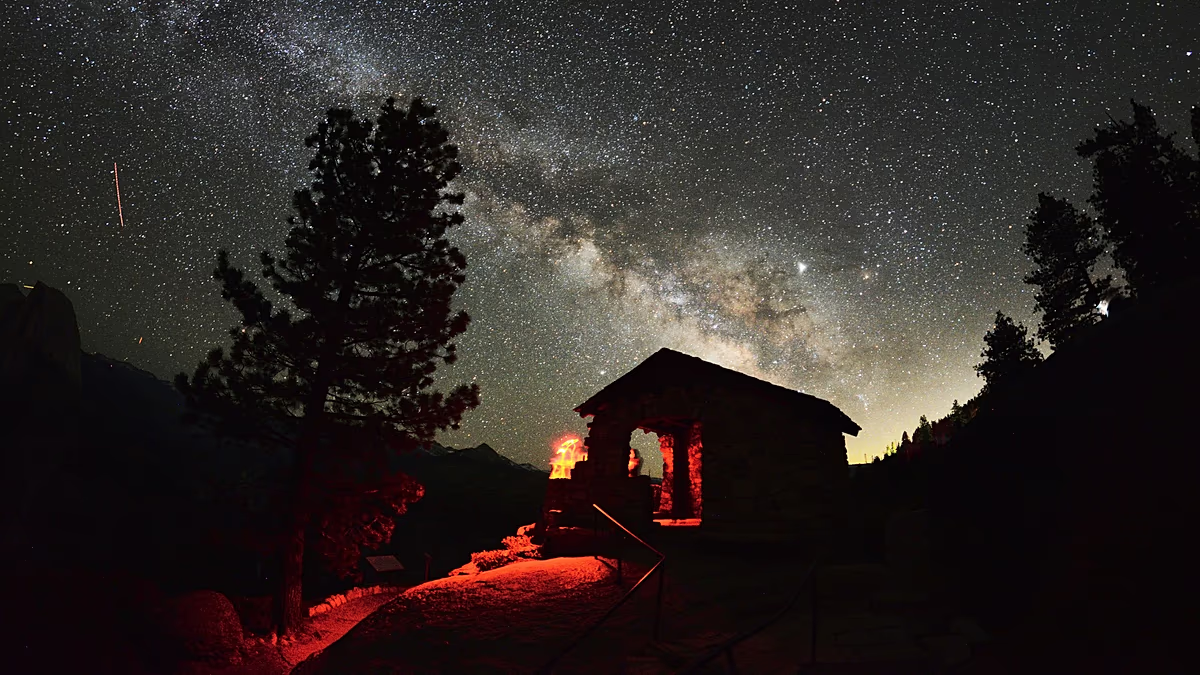
Ultimately, the “Clean Sky Index” does more than just rank destinations; it tells a story about the future of travel. We are no longer just searching for photogenic landscapes; we are searching for experiences that rekindle our sense of wonder. Millions of people have never seen the true majesty of the Milky Way, a hazy river of stars that arches across the night sky in areas free from artificial light. The rise of astro-tourism is a response to this profound disconnect from our natural environment. These trips are about more than just looking at stars; they are about feeling small in the face of the cosmos, and simultaneously connected to something vast and beautiful. This index serves as an essential guide for those ready to book a trip that offers not just a vacation, but a humbling, breathtaking, and deeply human experience. It highlights the fact that the ultimate escape isn’t always about a far-flung beach, but sometimes about a clear night sky and a chance to see the universe in all its brilliant, silent glory.