


Travel has always been an exercise in vulnerable optimism, a transitional state where the physical and mental exhaustion of departure lounges eventually gives way to the breathless anticipation of discovering a new destination. Yet, for thousands of international visitors landing in Portugal over the past several months, that initial spark of vacation excitement has frequently been dampened by the frustrating reality of endless, slow-moving queues snaking through airport arrival halls. Recognizing that a country’s entry points set the definitive tone for its entire hospitality experience, Portuguese authorities have stepped in with a major, human-centric intervention designed to restore ease, dignity, and efficiency to the travel process. On Friday, the Portuguese Interior Minister, Luís Neves, announced a decisive operational shift: the deployment of an additional 340 Public Security Police (PSP) officers to national airports, scheduled to begin on July 4. This robust measure represents a massive mobilization of national security resources, specifically engineered to alleviate the grueling bottlenecks that have plagued transit hubs just as the peak summer travel season begins. By positioning trained, empathetic human faces at the front lines of border control, Portugal is endeavoring to transform its airports from places of bureaucratic anxiety back into warm, welcoming portals, proving that even in an automated world, human intervention remains the ultimate remedy for administrative gridlock.
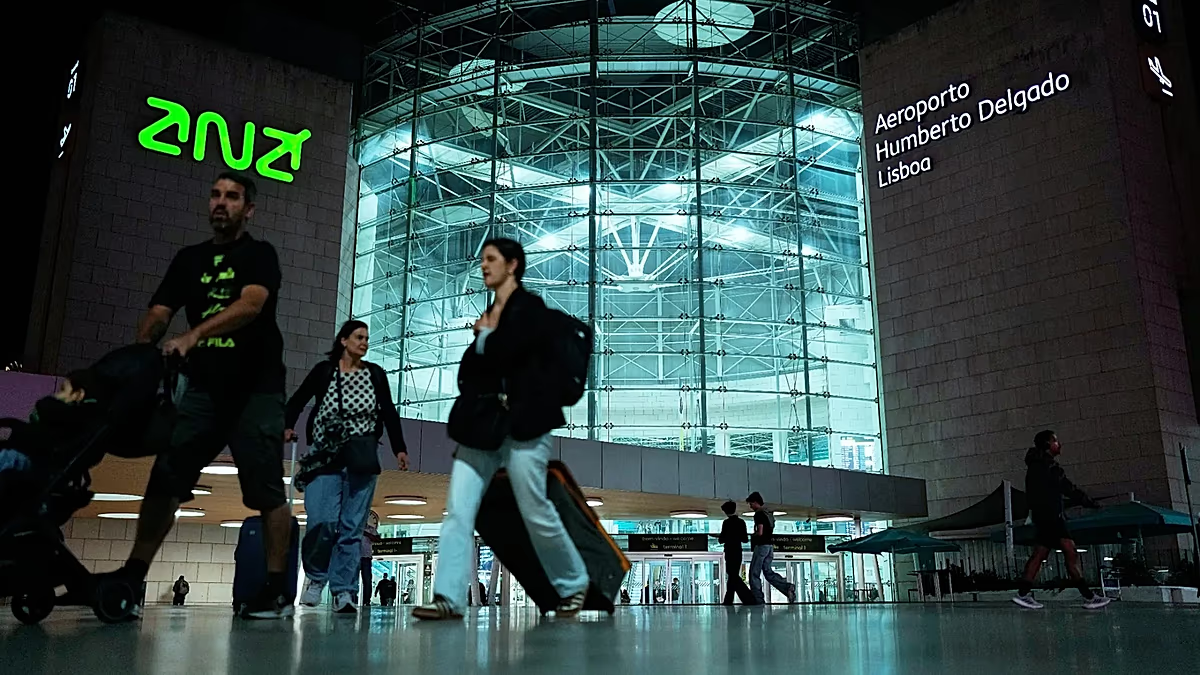
The logistical blueprint of this sweeping deployment reveals a highly calculated, regional strategy designed to target the country’s most vulnerable transit points during the year’s busiest travel months. According to Minister Neves, these 340 PSP officers are not merely being reassigned to airport duties overnight; they are currently undergoing rigorous, specialized training tailored directly to the complex demands of airport dynamics, international migration laws, document verification, and stressful crowd management. The geographic distribution of these reinforcements reflects the modern realities of Portugal’s tourism boom, focusing heavily on pressure points where traffic is thickest. Lisbon’s Humberto Delgado Airport, which serves as the primary transcontinental gateway for the nation and bears the brunt of long-haul arrivals, will receive the largest allocation with 140 dedicated officers. Meanwhile, the northern industrial and cultural landmark of Porto will welcome 100 officers to Francisco Sá Carneiro Airport to manage its own rapidly rising passenger volumes. The remaining cohort of officers will be strategically dispersed among the country’s premier vacation magnets, including Faro in the sun-drenched Algarve, Funchal in the subtropical paradise of Madeira, and Ponta Delgada in the remote, volcanic Azores archipelago. This balanced distribution ensures that from the mainland coast to the furthest reaches of the autonomous islands, the national border infrastructure is equipped to handle the incoming tide of global travelers with speed, professionalism, and reassuring hospitality.
To fully understand why this massive deployment is so critical, one must examine the profound psychological and physical toll that airport bottlenecks impose on modern travelers. For families traveling with tired young children, elderly passengers navigating unfamiliar terminals, or business professionals working on tight schedules, standing for three hours in a hot, crowded immigration hall is not simply an administrative inconvenience; it is a distressing experience that can overshadow the joy of travel. In recent weeks, Lisbon Airport has become the focal point of these grueling queues, sparking a fierce debate over who is truly responsible for the delays. The Portuguese government has largely linked the administrative friction to the ongoing phased rollout of the European Union’s highly anticipated Entry/Exit System (EES). Designed to digitize and modernize the Schengen area’s external borders, the EES aims to replace traditional passport-stamping with an automated digital database that registers the biometric profiles—including facial images and fingerprints—of non-EU nationals. This is particularly impactful for British tourists post-Brexit, who are now processed as third-country nationals, significantly increasing the volume of passengers requiring deeper scrutiny. While the transition to this system promises enhanced long-term continental security, the immediate reality has been one of technical friction, as airport staff, border agents, and travelers adapt to the learning curves and hardware configurations required to pull off such a massive digital shift.
However, this narrative of technological teething problems has met with polite but firm resistance from broader European authorities, highlighting the intricate political dynamics that often govern continental transit. In an official communication sent to the Lusa news agency, a representative for the European Commission explicitly denied that the delays and long lines at Portuguese airports are linked to the implementation or performance of the Entry/Exit System. The Commission clarified that the operational challenges and elongated waiting times observed in Portugal do not stem from any functional failures, software glitches, or systemic defects in the centralized EES architecture. Instead, EU officials have subtly pointed toward localized variables, such as terminal infrastructure constraints, flight scheduling, and baseline staffing levels, while maintaining that they remain in constant, cooperative contact with Lisbon to provide whatever technical assistance and guidance may be required. This diplomatic disagreement highlights a classic tension in international governance: the divide between regional digital standards and the physical, boots-on-the-ground reality of managing human flow. Regardless of whether the root cause lies in Brussels’ databases or Lisbon’s structural limitations, the negative impact on the passenger remains identical, prompting the Portuguese cabinet to bypass scholastic debates and deploy quick, tactile solutions, which included an emergency advance guard of 48 PSP officers dispatched to Lisbon Airport last week to act as an immediate shock absorber.
Despite the administrative disputes and finger-pointing, there are highly encouraging signs that the situation in Portuguese terminals is already beginning to stabilize, offering a sense of relief to anyone planning a trip to the Iberian Peninsula this summer. During his press briefing on Friday, Minister Neves adopted a highly optimistic tone, highlighting that recent, tactical operational adjustments have already led to a noticeable reduction in severe bottleneck incidents over the preceding days. To illustrate his point, the minister cited a recent Saturday as a model of resilience and success, noting that it was historically one of the highest-volume transit days of the entire year for passenger traffic across the country’s aviation network. In spite of this immense pressure, Neves reported that the day passed with remarkable smoothness, demonstrating that when resources are deployed dynamically and proactively, the national infrastructure can withstand even the most intense seasonal surges. This successful weekend serves as a vital proof of concept, reassuring both anxious travelers and local tourism businesses—many of whom worry that negative global headlines about airport lines could drive lucrative summer tourism toward competing destinations like Spain, Italy, or Greece—that the country’s aviation gateways are robust and highly capable of self-correction.
Ultimately, Portugal’s decision to invest heavily in human personnel at its secure borders highlights a profound truth about the modern hospitality industry: security and a warm welcome are not mutually exclusive, but rather complementary aspects of the same service. As a country internationally famed for its deep-seated culture of hospitality, stunning coastlines, and open-door philosophy, Portugal recognizes that a visitor’s vacation begins the moment they step off the aircraft, not when they arrive at their resort. By positioning hundreds of trained, sympathetic officers to guide international guests through the labyrinth of post-pandemic and digital border transitions, the government is sending a clear message that it deeply values the time, comfort, and peace of mind of its global visitors. These PSP officers represent far more than passport checkers; they are the initial ambassadors of a nation that prides itself on being a peaceful sanctuary in an increasingly complex world. As the summer months unfold and global travel reaches historic heights, this thoughtful integration of human empathy, tactical administrative adjustments, and robust resource allocation will likely serve as an exemplary blueprint for other European nations striving to safeguard their borders without losing their hospitable spirit in the process.