





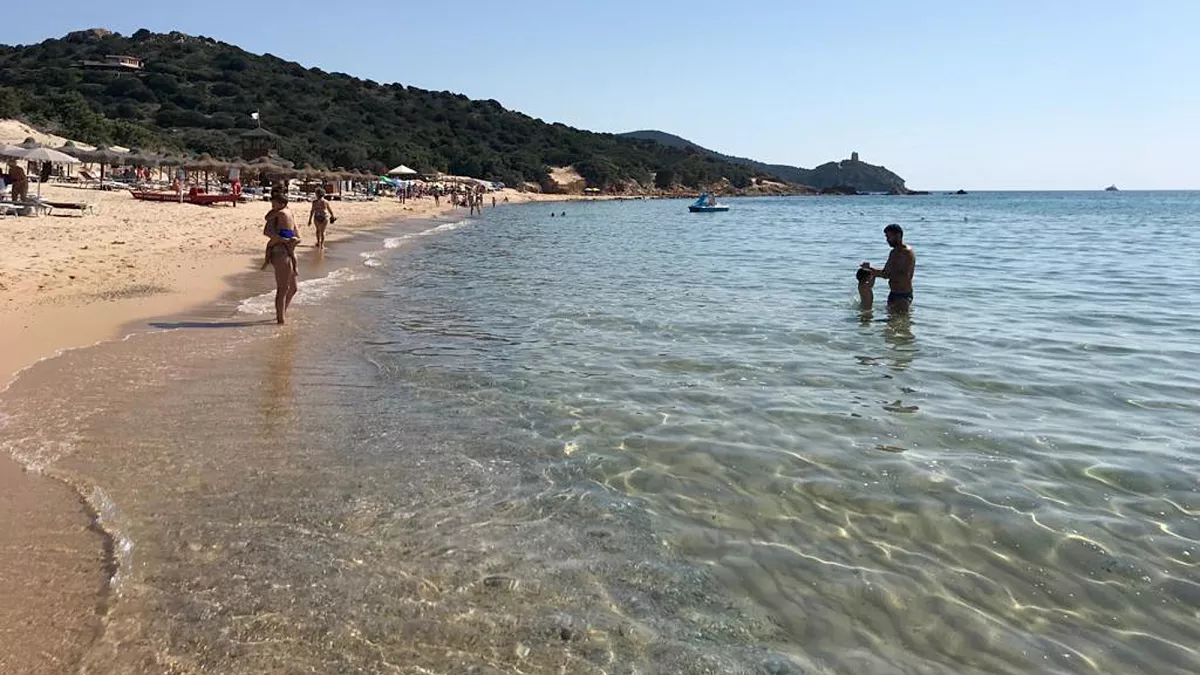
Nestled along the wild, wind-swept northeastern coast of Sardinia lies Cala Finanza, a place where the earth seems to whisper ancient secrets to the sea. Here, the crystalline waters of the Mediterranean lap gently against rugged, sun-bleached cliffs, framing a view that has taken the breath away from generations of travelers: the majestic, towering silhouette of the Tavolara island, rising like a limestone giant from the emerald depths. For decades, this pristine sanctuary has stood as a testament to Sardinia’s untamed beauty, a delicate ecosystem protected by the fierce love of its inhabitants. However, this paradise recently became the battleground for a high-stakes conflict between global luxury capital and local preservation. A Brazilian real estate giant, JHSF, set its sights on this stretch of coastline with plans to construct an exclusive “glamour camping” or “glamping” resort under the banner of the Tavolara Bay project. The proposal immediately drew alarming parallels to controversial global tourism developments, most notably the luxury resort backed by Donald Trump’s son-in-law, Jared Kushner, in the fragile lagoon near Vlorë, Albania. Fears of an “Albanian-style” national scandal—where ecological treasures are bartered away for elite profits—rippled through the local community, igniting a powerful movement of resistance that would challenge the highest offices of the Italian government.
The conflict centered on a highly controversial legislative maneuver: the invocation of simplified Special Economic Zone (ZES) authorization procedures. Traditionally used to stimulate depressed industrial areas, these fast-track ZES rules were utilized by the developers to bypass the rigorous network of environmental and landscape regulations that have long safeguarded Sardinia’s shores. Chief among these protections is Italy’s national law governing marine protected areas, alongside the island’s legendary 2006 regional landscape plan. Championed nearly two decades ago by then-Regional President Renato Soru, this visionary policy effectively locked down Sardinian coasts by imposing an absolute ban on any construction within 300 meters of the sea. By attempting to use ZES procedures to sidestep these coastal restrictions, the developer sought to convert an old seaside villa and install twenty high-end, removable cabins. While developers argued that this “glamping” initiative would have a minimal footprint with no net increase in overall floor space, locals and conservationists saw through the rhetoric. They recognized the project as a dangerous precedent—a legal wedge that, if left unchallenged, would render regional environmental protections obsolete and open the floodgates for unrestricted private development along Italy’s most vulnerable coastlines.
The response from the community was swift, passionate, and deeply human, uniting a diverse coalition of ordinary citizens and seasoned environmental defenders who refused to watch their heritage be dismantled. Rallies and spontaneous demonstrations erupted across the municipality of Loiri Porto San Paolo, turning peaceful town squares into vibrant forums of resistance where voices cracked with emotion and determination. Standing shoulder-to-shoulder were grandmothers, fishermen, and local youths, flanked by the formidable defenses of Italy’s major conservation groups, including the WWF, Legambiente, and Italia Nostra. This grassroots mobilization welcomed an alliance of fiercely independent local organizations such as the Gruppo di intervento giuridico, Liberu, Rosso Mori, and the Comitato Costituzione attiva Sassari, alongside cultural and ecological groups like Surra, Movimento ambiente Sardegna, Bardianía de sa Nurra, Gruttes, and Nurnet. For these protectors, the fight was not merely about halting concrete mixers; it was a defense of their cultural identity, their collective memory, and their sacred duty to hand down an unblemished coastline to future generations. The protests were fueled by a deep-seated belief that some landscapes are so spiritually and ecologically precious that they must remain priceless, utterly closed to the highest bidder.
As the waves of public outrage intensified, local and regional leaders stepped forward to translate the community’s passion into formidable legal and political defense. Caught at the fiery center of this public storm was Francesco Lai, the Mayor of Loiri Porto San Paolo, who listened closely to his constituents and chose to actively champion their cause rather than succumb to the pressures of external corporate investment. Simultaneously, the newly elected President of the Sardinian Regional Government, Alessandra Todde, mounted a fierce offensive from her office in Cagliari. Recognizing the ZES authorization as a direct assault on Sardinian self-determination and environmental sovereignty, Todde launched a formal appeal with the Regional Administrative Court (TAR). With the critical court hearing scheduled for July 8th, Todde threw down a political gauntlet, declaring her absolute readiness to fight the battle all the way to the Constitutional Court of Italy if necessary. This resolute stance by local leadership sent a clear, unambiguous signal to Rome: Sardinia would not stand by and watch its constitutional rights and regional planning laws be trampled underfoot by administrative shortcuts designed to favor foreign developers.
The turning point in this intense David-and-Goliath struggle came on July 2nd, when the Department for the South at Palazzo Chigi in Rome yielded to the overwhelming pressure and officially revoked the ZES authorizations that had been granted to the Tavolara Bay project back in February. This dramatic government intervention represented an extraordinary victory for the rule of law and the power of public mobilization, rendering the upcoming court battles effectively moot. When the news of the revocation reached the towns and villages surrounding Tavolara Bay, a profound sense of relief and quiet triumph washed over the region. The threat of turning Cala Finanza into an exclusive enclave for wealthy tourists was dismantled, and the delicate marine protected area was saved from the invasive footfall of commercial exploitation. Mayor Francesco Lai characterized the outcome as an vital triumph of community-led democracy, praising the courage of the citizens who stood up to be counted. The decision confirmed that even in an era of globalization, the collective will of a united community, backed by sound environmental legislation, can halt the march of powerful multinational corporations.
Ultimately, the preservation of Cala Finanza stands as a milestone and a powerful warning for the future of sustainable tourism across the Mediterranean. The victory sends a clear message to international investors, property developers, and political bodies alike: natural wonders are not commodities to be hollowed out and sold to the highest bidder, and the local communities who inhabit these landscapes will not be sidelined. Mayor Lai eloquently captured this sentiment, reflecting that this entire dramatic process must serve as a permanent lesson to all, proving once and for all that “Sardinia is not up for grabs.” As the sun sets over the undisturbed cliffs of Loiri Porto San Paolo and the waters of Tavolara continue to glisten in their natural state, the triumph of Cala Finanza stands as a beacon of hope. It proves that when humanity aligns its laws with the rhythm of the natural world and the preservation of communal heritage, it can successfully protect the earth’s most beautiful corners, keeping them wild, free, and accessible to all for generations to come.