



If you’ve ever tried to build a life on the road, you know the search for the perfect remote-work city is a lot more complicated than finding a decent Wi-Fi signal. Sure, a fast connection matters, but so do the little things: whether you can afford a nice apartment, whether there’s a café where you can camp out for hours without feeling guilty, whether you can actually meet people after work, and whether the weather makes you want to step outside at all. Digital nomads are no longer just backpackers with laptops; they’re a global movement, and the places they choose to stay for months at a time are being judged more carefully than ever. That’s exactly what a new study from the independent VPN review platform vpn.jpn.com set out to do. The researchers ranked 104 of the world’s largest cities, starting with 150 based on population and then cutting 46 for various reasons, and evaluated them on the factors that truly make or break a longer stay: the density of places to work from, going-out options, cultural venues, national internet speeds, local price levels, and the number of “comfortable working days” — defined as days with an average temperature between 15°C and 28°C and less than 5mm of rain. Each city received a score out of 100, and the results paint a fascinating picture of where the world’s remote workers are best served.
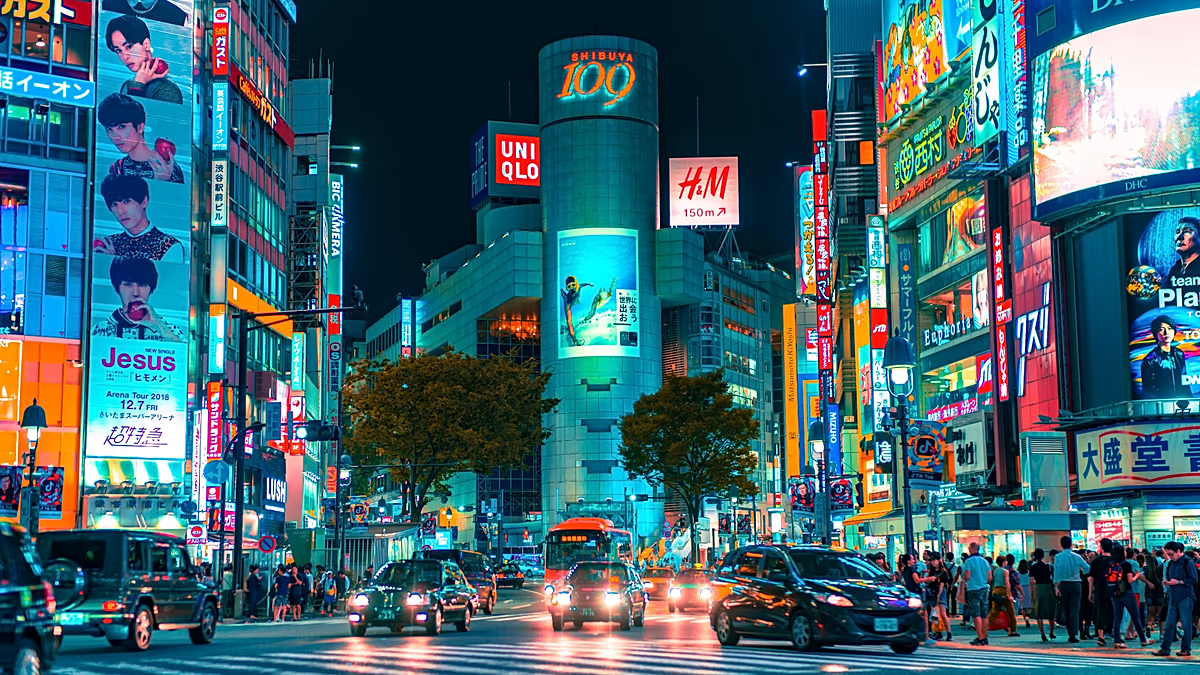
At the top of the list, surprisingly to some, is Seoul. The South Korean capital took the crown with an overall score of 73.60, and it’s easy to see why. For a city that big, it’s remarkably easy to find a place to plug in: there are nearly 60 places to work from per square kilometre, which means you’re never far from a laptop-friendly table. But work is only part of the equation. Seoul also offers an incredible 172.94 going-out options per square kilometre and more than ten cultural venues, so your evenings and weekends are packed with possibilities. The internet is the fastest in the top ten, with download speeds averaging 69.27 Mbps, and while Seoul isn’t cheap, it’s still about 36% more affordable than the United States baseline. Just behind Seoul is Tokyo, with a score of 72.61. Tokyo has slightly fewer work-friendly spots per square kilometre — 56.43 — and is a little pricier, but it more than makes up for it after hours. The Japanese capital has a staggering 395.12 going-out venues per square kilometre, more than double Seoul’s number and the highest rate in the entire top ten. It also has 12.71 cultural venues per square kilometre, making it a place where you could live for years and still feel like you’ve barely scratched the surface. For a digital nomad, Tokyo is less a city and more a never-ending adventure that happens to have excellent infrastructure.
In third place, Hanoi proves that you don’t need to spend a fortune to live well. The Vietnamese capital scored 71.86, and its biggest draw is affordability: prices there are nearly 71% lower than the US benchmark, which means your remote salary can stretch much further than it would in most other major cities. Hanoi also has the highest concentration of places to work in the top ten, with 96.88 spots per square kilometre, so finding a quiet corner to get work done is rarely a problem. The weather is another huge plus, with 180 comfortable working days — far more than Seoul’s 105 or Tokyo’s 103. The downside is the internet, which is noticeably slower at just 16.12 Mbps nationally, so if you rely on heavy video calls or large file transfers, you might need to plan around it. Still, for nomads who value lifestyle and savings over raw speed, Hanoi is an incredibly compelling choice. Right behind it is Taipei, with a score of 70.98. The Taiwanese capital offers 48.24 places to work per square kilometre and an impressive 295.77 going-out venues, so there’s always something to do when your laptop closes. It also has 10.71 cultural venues per square kilometre, and prices are around 57% below the US benchmark. The fifth spot belongs to Osaka, another Japanese city, with a score of 70.15. Osaka has 350.27 going-out options per square kilometre, second only to Tokyo, and 45.80 work spots per square kilometre. It’s a city with a distinct personality — friendlier, grittier, and more food-obsessed than Tokyo, and for many nomads, that’s exactly the appeal.
The first non-Asian city on the list is Barcelona, which takes sixth place with a score of 68.11. Spain’s most famous Mediterranean city has fewer work-from spots than its Asian counterparts, but it compensates with lifestyle and connectivity. Spain has the fastest national upload speed in the top 15 at 36.71 Mbps, which is great for content creators and video editors. Barcelona also has 104.83 going-out options and 8.97 cultural venues per square kilometre, plus 164 comfortable working days, so you can actually enjoy the city rather than just work in it. Just behind Barcelona is Madrid, in seventh place, with a score of 66.67. The two Spanish cities share the same national internet and price-level scores, so the difference comes down to the city itself. Barcelona edges ahead with slightly more places to work, more going-out options, more cultural venues, and 43 additional comfortable working days. But Madrid has its own energy — a deeper, more traditional Spanish rhythm, with late dinners, long evenings, and a sense that life is meant to be lived outdoors. Then comes São Paulo, in eighth place, also scoring 66.67. The Brazilian megacity has the highest number of comfortable working days in the top ten at 252, which means the weather is almost always on your side. Prices are around 53% lower than the US benchmark, and while São Paulo isn’t the safest or easiest city to navigate, it has a vibrant cultural scene, incredible food, and a fierce work ethic that resonates with many remote professionals.
The ninth spot brings us back to Japan, with Nagoya scoring 64.97. Nagoya often flies under the radar compared to Tokyo and Osaka, but it benefits from the same national infrastructure: strong internet speeds with uploads of 33.07 Mbps and downloads of 58.72 Mbps. There are 23.45 places to work from and 144.32 going-out options per square kilometre, which is plenty for a city that feels more laid-back than its bigger siblings. The main drawback is the weather, with just 83 comfortable working days, the lowest figure among the top 15. If you don’t mind a bit of heat and humidity, though, Nagoya offers a more relaxed, authentic Japanese experience at a lower cost. Rounding out the top ten is Ho Chi Minh City, with a score of 64.28, giving Vietnam a second city in the leading group. The southern Vietnamese metropolis has 56.73 places to work from per square kilometre, almost matching Seoul, and prices that are around 70% lower than the US benchmark. It’s a city of constant motion — motorbikes flooding the streets, street food sizzling on every corner, and a growing community of expats and remote workers who’ve discovered that their money goes further here than almost anywhere else. With Vietnam’s improving internet infrastructure and a cost of living that allows you to live comfortably on a modest income, Ho Chi Minh City is quickly becoming a favourite for nomads who want maximum freedom with minimum financial stress.
What’s striking about this ranking is how much of the top ten is dominated by East and Southeast Asian cities. Japan alone has three cities in the top ten, and South Korea, Taiwan, and Vietnam each claim a spot. Spain is the only European entry, and São Paulo is the only one from the Americas. This isn’t just about cheap living or fast internet; it’s about a combination of factors that together create a genuinely comfortable environment for remote work. The best city for one person might be a nightmare for another. A digital nomad who thrives on nightlife and big-city energy might choose Tokyo, while a budget-conscious writer who loves warm weather might prefer Hanoi or Ho Chi Minh City. Someone who needs reliable video calls and a strong professional network might lean toward Seoul or Barcelona, while a sun-seeker who wants to escape the cold could find their paradise in São Paulo. The real lesson from this study is that the ideal remote-work destination is deeply personal. The infrastructure matters, but so does the feeling you get when you step out your front door. Do you want to be surrounded by neon lights and endless entertainment? Do you want to sip cheap coffee in a quiet café while the rain falls outside? Do you want to finish work and wander through ancient temples, modern art galleries, or bustling night markets? The ranking gives you a starting point, but the real decision comes down to what kind of life you want to live while you work. And perhaps that’s the most human thing about being a digital nomad: you’re not just choosing a city, you’re choosing a version of yourself. Whether it’s the speed of Seoul, the energy of Tokyo, the affordability of Hanoi, the charm of Barcelona, or the warmth of São Paulo, the world is full of places that can support your work — but only a few will feel like home. The good news is, with so many incredible cities now competing for your attention, you can afford to be picky.