


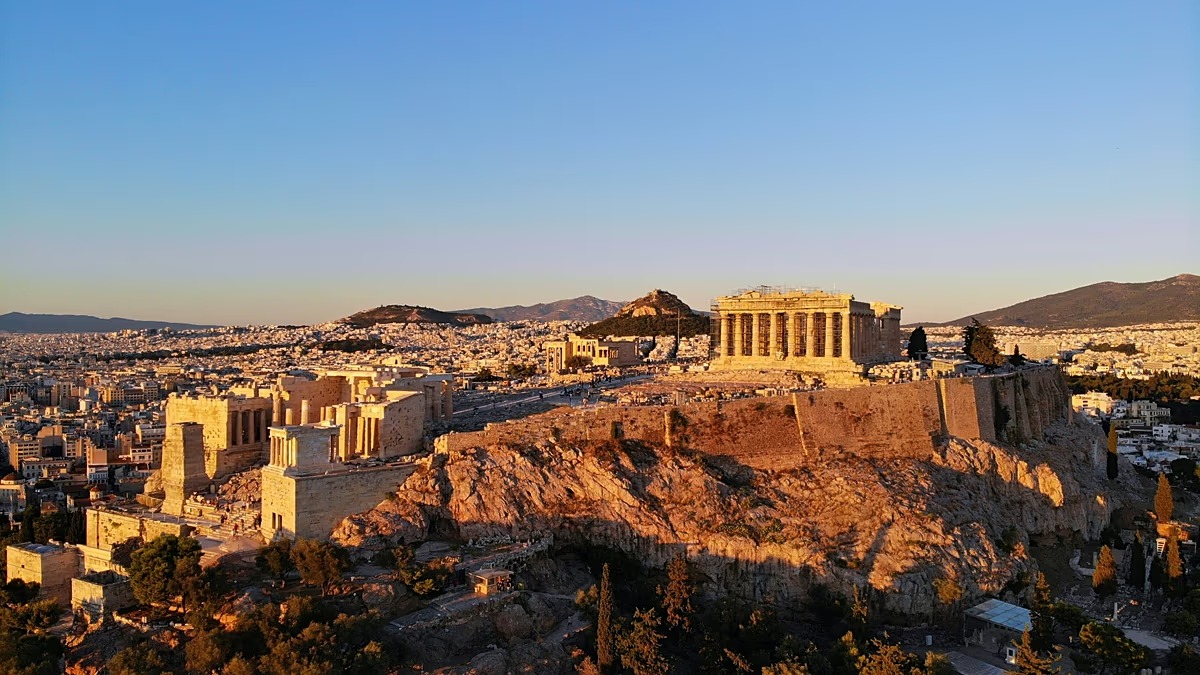
It’s that familiar stretch of the calendar when the travel industry dusts off its crystal ball, and this year Skyscanner has made an especially compelling case for the journeys we’ll be taking in 2027. Their freshly released Travel Trends report, built on global search insights and original research from more than 28,000 travellers, pulls together data from an eclectic mix of sources—TikTok, ClassPass, Wise, Universal Music Group for Brands, and AllTrails—to sketch a portrait of a traveller who is restless, reflective, and increasingly hungry for meaning. Among the most evocative predictions is a trend called “Grand Odysseys,” and it arrives with extraordinary momentum thanks, in no small part, to The Odyssey, Christopher Nolan’s blockbuster adaptation of Homer’s ancient epic. Skyscanner suggests that this history-focussed surge is born out of a collective need to escape a fast-paced, overwhelming world; people are turning to the past not as escapism, but as a way of finding context, grounding, and connection to timeless human stories. The evidence is hard to ignore: cinematic releases are dramatically driving real-world bookings, with films and television shows like The Odyssey and Gladiator inspiring travellers to walk where legends were told. TikTok data shows that video views for cinematic travel content have surged +346% year on year, while posts tagged #HeroJourney have grown by an astonishing +452%. Perhaps most tellingly, The Odyssey itself reportedly prompted a third of people to plan a trip inspired by the epic, and almost half of Millennials—43%—say they have been moved by films and TV shows set in antiquity, from the war-torn plains of Troy to the myth-drenched landscapes of Ancient Greece. A full 24% of them have already taken the leap and travelled in the footsteps of ancient stories, and among Gen Z that figure rises to 30%. These are not merely vacations; they are pilgrimages for a modern age, attempts to stand in the same places where heroes once hesitated, suffered, and triumphed, and to feel, if only for a moment, that our own struggles are part of a larger, older narrative.
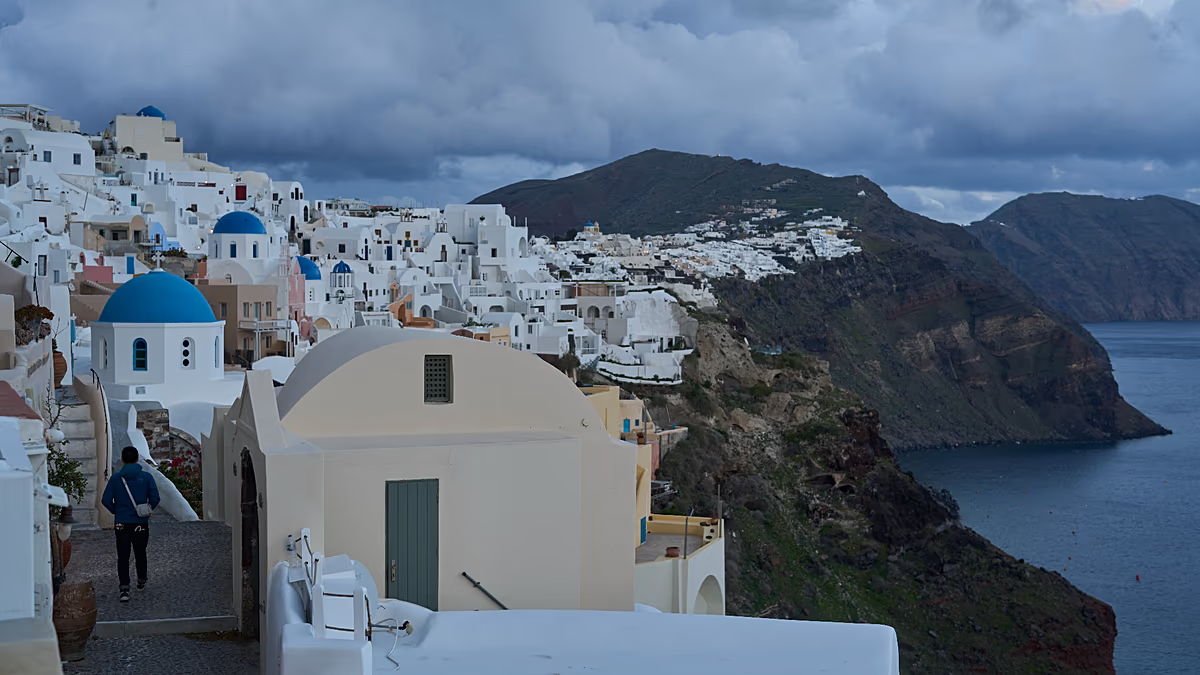
For those who want to live out their own odyssey with hiking boots instead of a ship’s rudder, AllTrails—a Skyscanner report partner—has identified the top five historic hikes for 2027, and the list reads like it was pulled from the margins of a well-worn copy of Homer. In first place is Corfu’s Cape Drastis Loop, a route on the Greek island said to be Homer’s mythical land of Phaeacia, the place where a shipwrecked and exhausted Odysseus finally washed ashore and shared the story of his epic ten-year journey home. Next up is the route connecting Horcones Viewpoint, Horcones Lagoon, and Espejo Lagoon in Argentina, where intrepid walkers can traverse shimmering glacial lakes while hiking in the immense shadow of Mount Aconcagua, South America’s highest peak—a landscape so raw and monumental that it seems to demand a myth of its own. In third place is China’s Xi’an City Wall, a spectacular Ming Dynasty fortification where visitors can stroll along ancient battlements, pass beneath imposing gateways, and watch centuries of history unfold in the sweeping views below. Fourth on the list is Monte Santa Caterina on the Italian island of Favignana, where adventurous travellers can climb to the island’s highest point and discover a historic castle steeped in local lore, a place long associated with Odysseus’ legendary voyage through the Mediterranean. And finally, Rizes Cave—also known as the Cave of Eumaeus—on the rugged island of Ithaca, Greece, offers perhaps the most resonant conclusion to the theme: walkers wind through olive groves high above the Ionian Sea before arriving at the very cave where Odysseus, according to the epic, sought refuge after finally returning home. As Shelby Eagleburger, head of data integrity at AllTrails, puts it beautifully: “It’s grounding to visit a trail and realise you’re seeing the same rugged peaks, ancient forests, and horizons that travellers did thousands of years ago. Historic routes remind us that exploring the outdoors is a universal human experience, and it connects us across generations. How we travel evolves, but the pull of natural landscapes stays the same.” That quiet sense of continuity, of being one small footsteps in an ancient and ongoing story, is exactly what Grand Odysseys seems to promise.
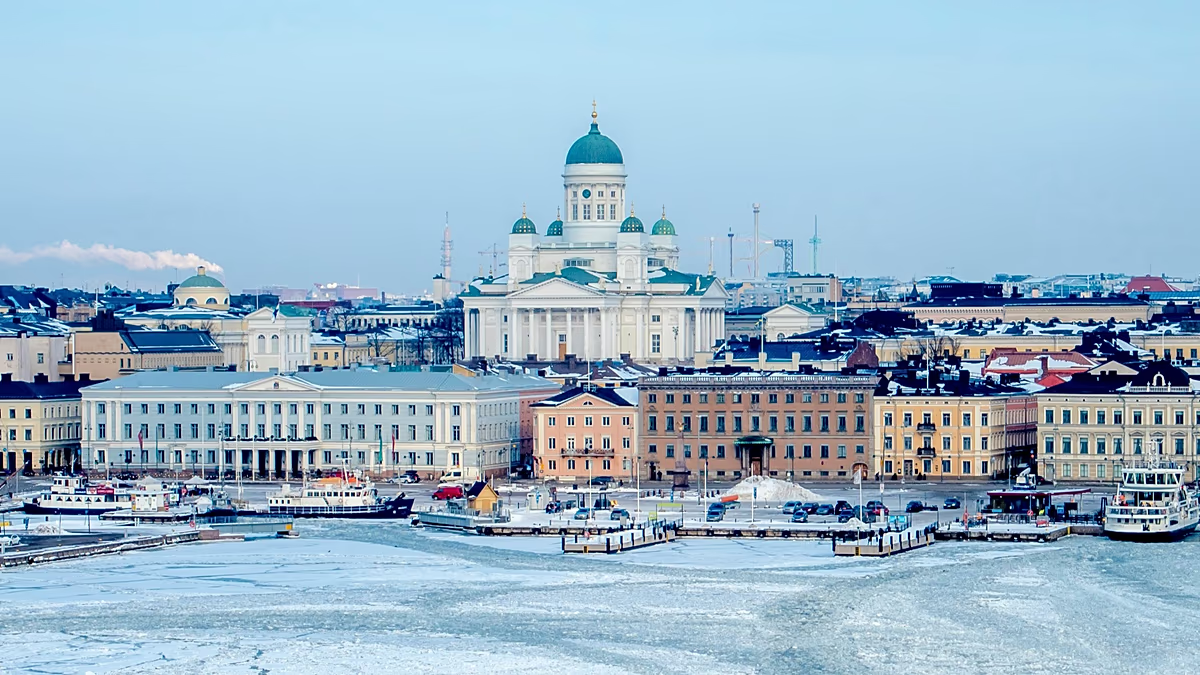
But not every 2027 trend requires an epic quest or a plane ticket to a mythic ruin. One of the report’s most striking predictions is “Signal Severance,” a trend born of our collective exhaustion with being always on, always reachable, always surveilled by notifications. One in four Gen Z travellers say they plan to disconnect in 2027, and Skyscanner’s data suggests that many of us are now actively craving a less connected world, seeking out remote travel spots, off-grid cottages, and destinations where it is genuinely possible to switch off entirely. The Nordic countries, predictably, are emerging as havens for this digital detox; Finland, in particular, with destinations like Kittilä and Rovaniemi, is seeing rising demand among travellers who want to trade the pinging of group chats for the crackle of a fire and the vast, silent Arctic sky. Yet even as travellers switch off their phones, many still want a tangible reminder of where they’ve been. Souvenirs, it turns out, are having a serious comeback—but not the mass-produced keychain kind. Skyscanner believes that the best souvenirs of 2027 are the ones you have to travel for, with travellers increasingly building entire itineraries around unique regional apparel, artisanal crafts, and location-exclusive items that simply cannot be bought online. One in four travellers has already taken a trip specifically to hunt down something unavailable elsewhere, from the vastly popular Trader Joe’s tote bag in the United States to the impossibly chic merchandise of the Ritz Paris. There is a deeper logic here: in an age where everything can be delivered to your door in two days, the act of journeying somewhere to find a physical object transforms it from mere merchandise into a story, a lived experience, a piece of the place itself that you can carry home with you.
Travel, in 2027, is also becoming more personal, more fluid, and more attuned to the milestones of real life. Weddings and travel have always been intertwined, of course, but couples are increasingly rewriting the old script, moving away from highly gendered, carefully segregated celebrations and embracing what the report calls the “sten do”—a joyful, deliberately blended combination of the traditional stag and hen parties. A quarter of travellers now say they are opting for these combined celebrations abroad, and the reasoning makes perfect sense: they’re more fun, less expensive, and infinitely easier to organise than two separate extravaganzas. Why fly to Las Vegas with one group and Barcelona with another when you can gather everyone you love in one beautiful place, toast the couple, swim at midnight, and dance until dawn with no bridesmaids in pastels or groomsmen in rented tuxedos in sight? At the same time, the line between vacation and self-improvement has officially blurred, giving rise to the gym-cation, a trend that is set to explode in 2027. If you’ve ever booked a hotel partly because of its fitness centre, you’re not alone: the report found that 67% of Millennials are more likely to book a hotel that serves a nutritious breakfast, while 40% of Gen Z travellers say they actively prioritise hotels with proper gyms. TikTok data reinforces the shift, with video views for “Gym Hotel” content up a staggering +659% year on year. The old image of a holiday asa total break from routine has evolved into something more holistic; for many, the ideal break no longer means abandoning their health regimen, but finding a beautiful place where movement, nourishment, and rest can coexist.
Sound is another powerful force shaping 2027 travel, and it’s not just about playlists on a plane. Increasingly, travellers are basing entire trips around seeing live music and experiencing unusual, once-in-a-lifetime events, with cultural immersion taking centre stage. Traditional carnivals, in particular, rank highly among both Gen Z—33%—and Millennials—30%—as must-attend experiences, places where music, colour, costume, and centuries of local tradition collide into something electric. The report also found that 25% of travellers now say the setting of a concert is almost as important as the set list itself; they want performances held in ancient caves, atop desert dunes, inside crumbling amphitheatres, or against the looming silhouette of pyramids, where the architecture of centuries ago becomes a collaborator in the music. It’s a reminder that travel has always been about collecting moments, not just sights, and there is perhaps no more potent way to create a lasting memory than to hear a favourite song echo off stones that have been standing since before your great-grandparents’ great-grandparents were born. Then there are the travellers who take a more pragmatic approach to wonder: the “currency chasers.” These are the people who have realised that a strong dollar, pound, or euro can be its own kind of travel inspiration, and they are deliberately switching destinations to take advantage of favourable foreign exchange rates. According to Skyscanner’s data, 45% of Gen Z and 40% of Millennial travellers have already changed their plans to get more bang for their buck, and Vietnam has emerged as a particularly beloved choice for this trend, thanks to a currency that allows tourists to eat spectacularly, stay in beautiful hotels, and explore breath-taking landscapes while spending relatively little. This is not simply budget travel; it is strategic travel, a clever, empowered way of stretching both money and experiences, and it speaks to a broader shift in how we think about value on holiday—not just what a trip costs, but what it returns, in memories, stories, and ease.
Taken together, Skyscanner’s seven trends for 2027 paint a portrait of a traveller who is more intentional, more embodied, and more emotionally engaged than we have seen in years. Across Grand Odysseys, Signal Severance, souvenir-hunting, blended celebrations, gym-cations, music-driven immersions, and currency chasers, a common thread runs through them all: travellers are no longer content to simply consume a destination. They want to feel something there—awe, release, connection, strength, joy, or even just peace. They are walking in the footsteps of ancient heroes to remind themselves that resilience is possible; they are switching off their phones to remember what their own inner voices sound like; they are seeking out handmade objects and local traditions to hold onto authenticity in a disposable world; they are combining celebrations, prioritising their health, chasing extraordinary soundscapes, and making their money work smarter so that they can say yes to more of life. In many ways, 2027 is shaping up to be the year we stop treating travel asa checklist of famous landmarks and start treating it asa quest—for meaning, for balance, for beauty, for a version of ourselves that feels more alive. And perhaps that is the most human travel trend of all: the realisation that the journey matters less than what it awakens in us, and that the best trips, whether they follow Odysseus across the Ionian or simply lead to a quiet Finnish cabin with no signal, are the ones that remind us we are part of something larger, older, and infinitely more wondrous than our daily feeds ever could.