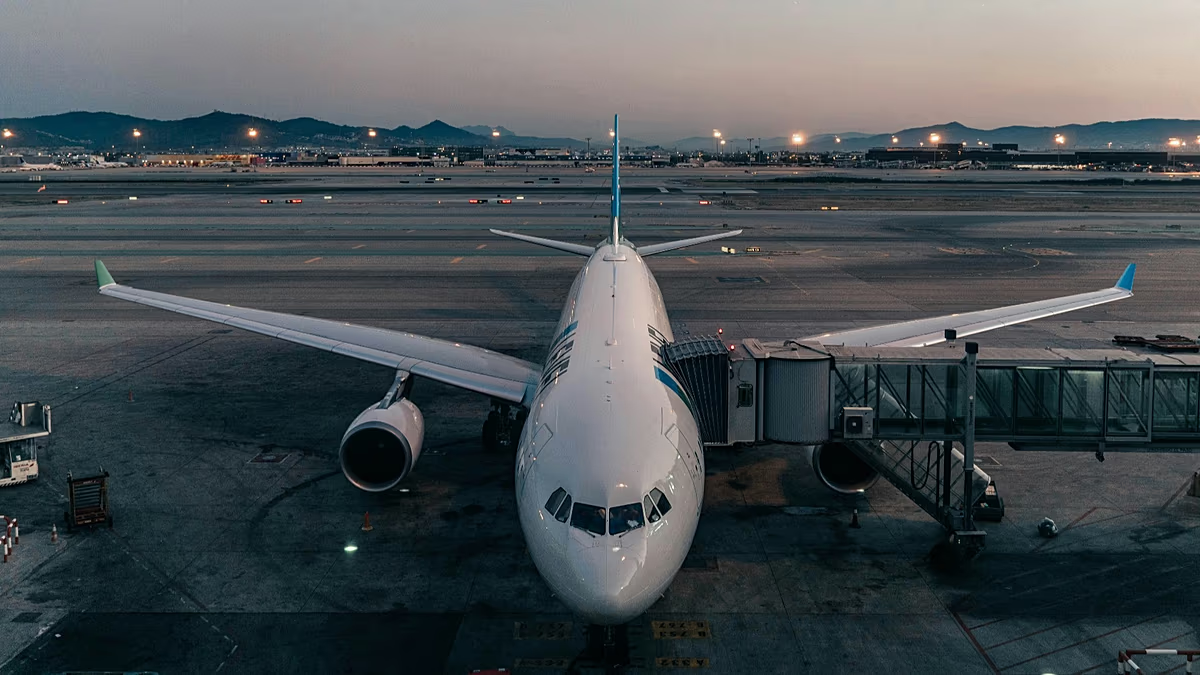





For generations of British families, the annual summer holiday has represented more than just a simple break from the daily grind; it has been a sacred, deeply human ritual of connection, relaxation, and escape. From the excitement of packing suitcases to the quiet anticipation built up over long, gray winter months, the journey itself was once a seamless prelude to the ultimate reward of a sunny Mediterranean beach or a historic European city. However, as the peak travel season of this year rapidly approaches, that sense of joy is increasingly being eclipsed by a dark cloud of administrative anxiety and physical exhaustion. The cozy routine of arriving at the airport with just enough time to grab a coffee and browse the duty-free shops has been entirely shattered. In a striking move that has sent shockwaves through the travel community, Wizz Air—one of Europe’s largest low-cost aviation mainstays—has issued a stark warning to holidaymakers, advising them to drastically alter their airport rituals. Travelers are now being urged to abandon the traditional two-hour arrival window and instead present themselves at terminals a full three hours before their scheduled takeoffs. This drastic adjustment has not been suggested lightly; it comes in direct response to a growing epidemic of missed flights, where desperate passengers have watched their hard-earned vacations vanish before their eyes while trapped in agonizingly slow-moving passport control queues. The simple freedom of movement that travelers once took for granted has suddenly devolved into a high-stakes survival challenge. Beyond just arriving early, airline representatives are now offering pragmatic, almost survivalist advice: urging passengers to pack heavy-duty portable power banks so their phones do not die during hours of standing in line, and to carry ample fresh water to keep physical and emotional exhaustion at bay as they navigate these grueling newly established checkpoints.
At the absolute epicenter of this unprecedented travel crisis is the European Union’s brand-new Entry/Exit System, more commonly referred to by its ominous acronym, the EES. Originally envisioned as a high-tech solution to streamline border security, this complex digital infrastructure has instead introduced a massive layer of friction for anyone traveling from outside the European Union. Since the historic reality of Brexit came into full force, British citizens have had to adjust to the unsettling truth of being categorized as “third-country nationals,” a bureaucratic label that renders them subject to rigorous and time-consuming border checks that did not exist during their decades of EU membership. Under the strict mandates of the EES setup, travelers entering the vast Schengen free-movement zone must now submit to mandatory biometric registration. This means that every single person, from young excited backpackers to elderly vacationers, must have their fingerprints electronically scanned and their facial images captured by digital cameras at automated kiosks. Once this sensitive data is absorbed into the system, it is cataloged and then cross-referenced again when they attempt to exit the country, a double-layer process that has added minutes to every individual passport transaction. The statistical footprint of this digital dragnet is stultifying: since the system’s initial, quieter trial runs began in October of last year, it has recorded nearly eighty million separate entries and exits, while flagging over thirty-five thousand formal refusals of entry. The complete, official rollout across all Schengen borders in mid-April was supposed to mark a triumph of modern technology, but it has instead triggered localized pandemonium. In major tourist draws across Spain, Portugal, and France, the resulting bottlenecks have been so extreme that Greek border authorities, realizing the catastrophic economic damage of stranded tourists, reportedly took the ultimate emergency step of almost entirely suspending these biometric checks for British passport holders just to prevent their international airports from collapsing into absolute madness.
Rather than projecting a swift resolution to these early teething problems, travel industry authorities and aviation watchdogs are warning that the situation is on a direct trajectory to get significantly worse. ACI Europe, a highly respected trade body representing the continent’s airport operators, has validated the deepest fears of the traveling public by predicting that queue times could easily balloon to a staggering three and a half hours as the heavy summer traffic peak arrives. While some regional airport administrations are attempting to mitigate this brewing disaster by temporarily turning off the EES software and reverting to manual checks during moments of extreme congestion, ACI Europe warns that these desperate measures will not be enough. They have openly projected that as millions of vacationers descend upon European transport hubs during July and August, the system’s inherent structural limitations will cause conditions to deteriorate even further, ultimately rendering the queues completely unmanageable for understaffed border agencies. The human cost of this systemic failure is painful to contemplate. It translates to airport terminals choked with thousands of hot, frustrated people, parents desperately trying to comfort screaming toddlers who have been standing in line for hours, and elderly travelers struggling to withstand the physical toll of prolonged queues without seating. For those embarking on journey itineraries that involve connecting flights, the situation has turned international travel into a stressful game of chance; a single delay at an initial biometric desk can easily trigger a catastrophic chain reaction, leaving vulnerable families stranded in unfamiliar airports, weeping at customer service desks, and desperately trying to rebook expensive alternative routes home.
Adding yet another heavy layer of anxiety to this summer’s travel equation is a turbulent global landscape marked by escalating geopolitical unrest and severe macroeconomic instability. The ongoing, highly volatile conflicts in the Middle East have cast a long, dark shadow over the global aviation sector, directly impacting international flight pathways and creating severe anxieties regarding the steady supply of critical jet fuel resources. This localized instability has forced commercial airlines to be incredibly cautious with their operational logistics, which has in turn triggered a fascinating psychological shift in how everyday consumers approach booking their long-awaited summer holidays. Rather than committing to early, cost-effective reservations, a massive wave of travelers is holding back, choosing instead to wait until the absolute last minute to book their flights in an anxious bid to navigate the shifting sands of global security and unpredictable flight disruptions. While prominent airline chief executives—including those steering EasyJet, Jet2, and Wizz Air—are putting on a brave face of unwavering confidence, assuring the public that their operations have successfully adapted, that fuel reserves are secure, and that flight schedules will remain intact, consumers remain understandably skeptical. There is also the compounding threat of inflation at play; Wizz Air’s leadership has frankly acknowledged that if crude oil prices remain stubbornly high due to global tensions, ticket prices will inevitably have to rise in the future to keep carriers solvent, even if airlines are temporarily trying to insulate passengers by finding cost-cutting efficiencies in other areas of their corporate infrastructure.
Yet, perhaps the most profoundly saddening aspect of this summer’s European travel landscape is that for a shocking portion of the population, the stress of long biometric airport queues is a luxury of which they can only dream. A landmark consumer survey conducted by YouGov and SumUp has pulled back the curtain on the quiet, widespread financial desperation sweeping through homes, revealing that a staggering one in five British citizens simply cannot afford to go on a holiday of any kind this year. The brutal cost-of-living crisis, marked by skyrocketing grocery bills, prohibitive energy costs, and relentless mortgage rate increases, has stripped domestic budgets of any discretionary spending. The study showed that thirty percent of Britons have been forced to make the painful emotional concession of completely postponing their travel plans, while another nine percent are actively slashing the length of their trips to the absolute minimum to save on food and accommodation. This painful economic paralysis is not a burden borne by the British public alone; the survey’s findings paint a remarkably grim, unified picture across the European continent. In countries long celebrated for their vibrant holiday cultures—including France, Germany, Italy, and Spain—the percentage of citizens who are completely priced out of a summer vacation sits in an almost identical, heartbreaking bracket of eighteen to twenty-one percent. For these millions of families, the cherished dream of laughing together under a foreign sun has been replaced by the quiet, heavy reality of staying home, watched over by the stress of unpaid bills and the distressing feeling of being left behind by an increasingly expensive world.
For the fortunate travelers who are still able to embark on their journeys this summer, staying armed with accurate information about who is affected by the EES and who is legally exempt is the ultimate self-defense tool against airport chaos. The newly established mandate is broad and unforgiving: it applies to all non-EU and non-Schengen citizens traveling into the zone for short-term stays of up to ninety days within a rolling one-hundred-and-eighty-day period. This net catches not only standard British tourists and business travelers, but also individuals who actually own properties in Europe but lack a formal local residence permit. However, there are vital geographical exceptions to keep in mind; the popular travel destinations of Ireland and Cyprus are completely exempt from the EES platform, meaning that travelers heading to these islands will continue to experience traditional manual passport inspections rather than biometric scanning. Furthermore, the system incorporates a detailed list of personal exemptions designed to protect specific classes of travelers from the digital queue. These exemptions cover all citizens of Schengen and EU member states, as well as third-country nationals who possess valid long-term visas or official residence cards. Additionally, direct family members of EU citizens holding recognized residence permits, international train and plane crew members on active duty, and military personnel traveling on NATO or treaty business can bypass the electronic kiosks entirely, alongside citizens of European microstates like Monaco, Andorra, and San Marino. As Europe transitions into this highly monitored digital age, navigating the continent requires a new level of preparation, transformation, and empathy, reminding us that while borders may close and systems may fail, the fundamental human desire to explore, connect, and discover remains absolutely unbreakable.