


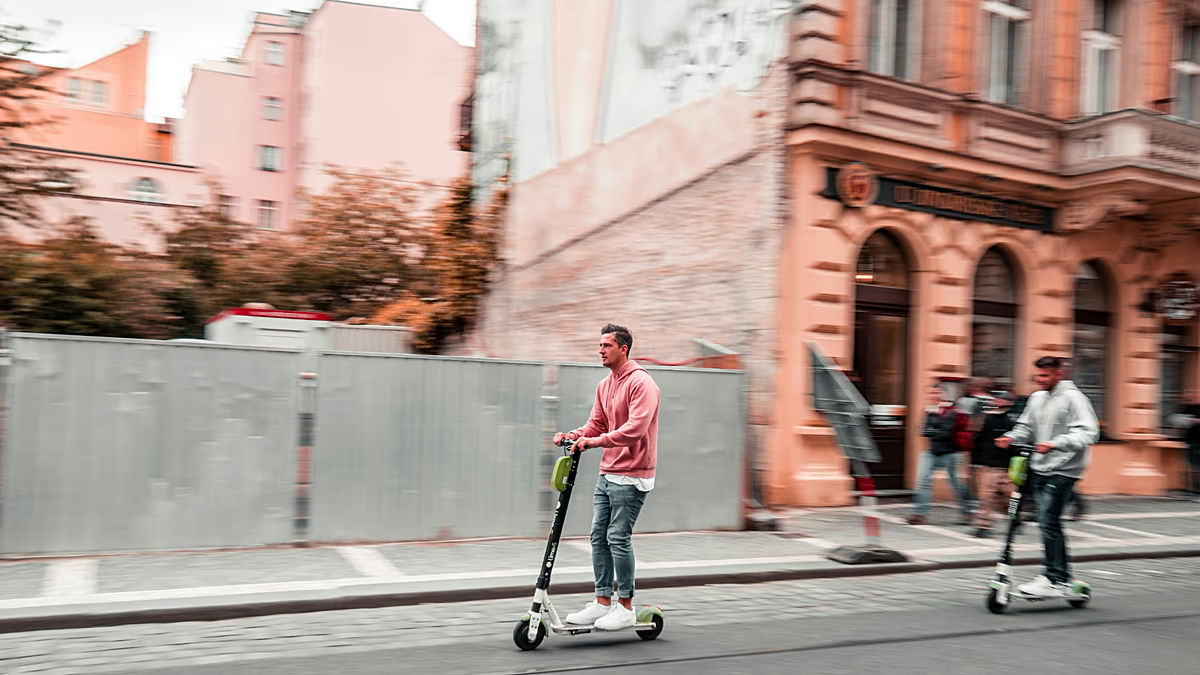
For years, the winding cobblestone corridors and historic boulevards of Brussels have hummed with the high-pitched buzz of shared electric scooters, a modern technological novelty that promised to revolutionize how people navigated the European capital. However, what began as a utopian vision of eco-friendly, effortless urban mobility has slowly deteriorated into a chaotic public nuisance, prompting the Brussels-Capital Region to take a decisive and historic step. Come January 2027, the city will officially put the brakes on rental e-scooters, joining a growing movement of major European metropolises that are reclaiming their public spaces from these fast-moving, dockless vehicles. The regional government announced that it will not renew the commercial operating licenses of Bolt and Dott—the last two e-scooter providers remaining in the city—when they expire at the end of December 2026. This bold policy shift marks the end of a turbulent trial period with micro-mobility, signalizing a return to traditional, highly organized, and less hazardous transit alternatives. For the everyday commuter, the tourist, and the local shopkeeper alike, this decision represents a fundamental reimagining of what a safe, beautiful, and functional European city should look and feel like, prioritizing human wellness over corporate convenience.
The catalyst for this drastic policy U-turn is a deeply concerning public safety crisis characterized by skyrocketing injury rates, which have left local emergency departments overwhelmed and communities on edge. According to official regional figures published by The Brussels Times, some 666 people were injured in recorded e-scooter accidents in 2025 alone, representing a staggering 26% spike in incidents compared to the previous year. Medical experts and orthopedic surgeons have long warned that the fundamental mechanical design of the e-scooter makes it an inherently unstable and dangerous vehicle for the average rider. Unlike bicycles, which feature large, shock-absorbing wheels and a central posture that allows riders to brace for impact, e-scooters are built with small, rigid tires and a high center of gravity. This physical geometry means that when a rider hits a patch of uneven paving, a slippery street car track, or a stray leaf, they are thrown forward with violent momentum, resulting in particularly severe head and facial trauma. The human toll behind these statistics is profound: thousands of reconstructive surgeries, life-altering concussions, and cracked teeth have turned what was marketed as a fun, breezy commute into a daily physical hazard on the streets of Brussels.
Beyond the physical danger to the riders themselves, the physical presence of parked and abandoned e-scooters has ignited a fierce debate over the democratization of public pavements and walking zones. Under the “dockless” business model popularized by tech companies, users are permitted to park their rented vehicles virtually anywhere, which has led to a visual and physical degradation of the sidewalk eco-system. Sidewalks, which should serve as safe sanctuaries for pedestrians, have instead become hazardous obstacle courses littered with discarded metal frames, blocking entrances to subway stations, residential doorways, and shopping arcades. This careless clutter poses an agonizing daily struggle for the city’s most vulnerable residents, particularly the elderly, parents pushing baby strollers, and persons with reduced mobility or visual impairments. A simple walk to the local bakery can become a treacherous journey for a blind resident trying to navigate a sidewalk blocked by an invisible, heavy scooter, forcing them to dangerously step off the curb and into the path of oncoming vehicle traffic. By banning these shared machines, Brussels is actively deciding that urban walkways must remain fully accessible, safe, and welcoming places of leisure for all of its citizens.
In a highly unexpected and alarming turn of events, the Brussels government also uncovered a dark, shadowy side to the micro-mobility boom, revealing that these silent vehicles had been thoroughly co-opted by organized crime syndicates. Local law enforcement agencies noticed that the anonymity and agility of rental e-scooters made them the ideal tool for drug traffickers operating in the dense, narrow alleys of the city center, where police patrol cars struggle to navigate. Because these rental apps allow users to quickly unlock vehicles on a whim, criminals could execute swift transactions and make rapid, untraceable getaways without the burden of maintaining private, registered cars. Most shockingly, the Brussels provincial government revealed that rental e-scooters were directly linked to 25 separate street shootings throughout 2025, as rival gangs utilized the highly agile and silent machines to execute drive-by attacks and slip away before police could establish a perimeter. This startling connection between a supposed green-energy transport initiative and violent street crime fundamentally shattered the public’s perception of the scooter, forcing municipal authorities to recognize that the unregulated mobility tech had inadvertently created a dangerous tool for illegal underworld exploitation.
While the imminent departure of the e-scooter marks the end of an era, municipal planners are quick to emphasize that the city is not reverting to car-centric isolationism, but is instead redirecting its energy toward a healthier bike-sharing revolution. From 2027 onward, Brussels will lean heavily into expanding and fortifying its network of shared bicycles, replacing the erratic scooter fleets with highly visible, structurally stable, and heavily regulated e-bikes. Cycling has deep cultural roots in Belgium, and the city believes that by focusing investments down this path, it can offer a safer, more predictable way for residents to commute without compromising on environmental sustainability. Bicycles have larger pneumatic tires, superior braking systems, and a physical profile that integrates far more naturally into the city’s expanding network of protected bike lanes. This transition is expected to foster a far more harmonious relationship between cyclists, pedestrians, and motorists, replacing the chaotic free-for-all of the e-scooter boom with an ordered, elegant system of urban commuting that respects the shared boundaries of public space.
With this sweeping ban, Brussels is far from an outlier; rather, it is jumping into a powerful, emerging tide of European capitals that are actively dismantling the micro-mobility experiments of the past decade. Cities like Paris, Madrid, and Prague have already taken dramatic legislative steps to banish or severely limit rental e-scooters, recognizing that the initial excitement of tech-driven disruption did not align with the long-term safety and wellness of their residents. The unfolding story of Brussels serves as a cautionary tale for modern urban planners worldwide, highlighting that innovation must always be balanced against public health, civilian safety, accessibility, and law and order. As these brightly colored scooters disappear from the grand squares and historical promenades of Brussels over the coming year, they leave behind a valuable lesson about the true value of public space. By reclaiming its streets, Brussels is paving the way for a quieter, safer, and infinitely more walkable world, proving that true urban progress is measured not by how fast we can zip through our streets, but by how safely we can walk them together.