


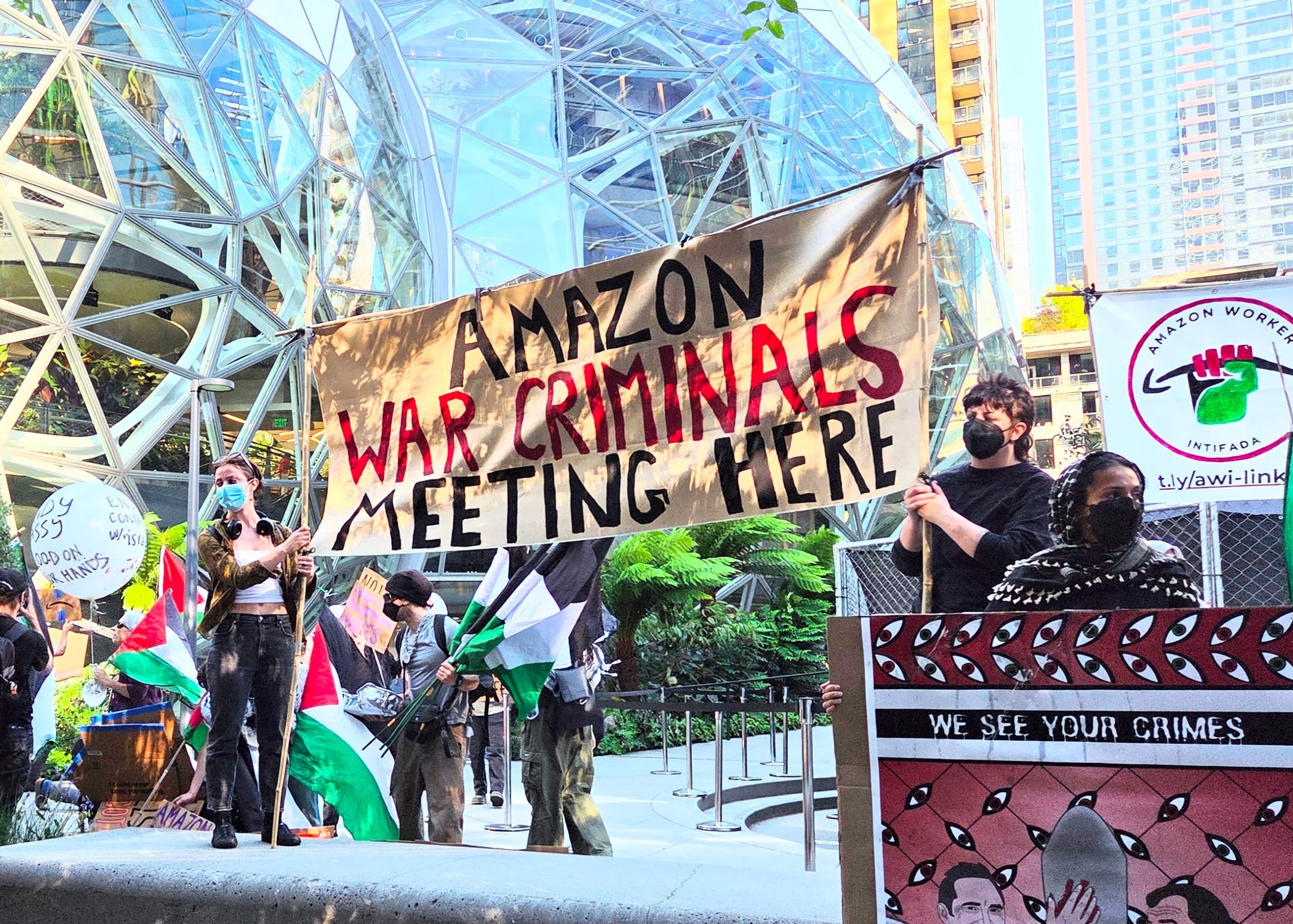
Under the damp, darkening skies of a Seattle autumn evening, the iconic glass domes of the Amazon Spheres glowed with a warm, futuristic hum—an architectural marvel designed to mimic a lush, climate-controlled rainforest in the heart of a bustling concrete metropolis. Yet, on this particular Thursday, the boundary between the curated tranquility inside and the raw, turbulent realities of the global landscape outside dissolved. A gathering of roughly two dozen passionate protesters assembled on the sidewalks, their hands gripped tightly around cardboard signs and megaphones, their voices slicing through the ambient traffic noise of the downtown core. These were not merely onlookers voicing abstract complaints; they were carrying deeply personal, agonizing grievances, holding up banners that depicted high-ranking Amazon executives with symbolic blood on their hands. For these demonstrators, the glowing glass structures before them did not represent innovation, progress, or professional triumph, but rather a fortress of corporate complicity. They had gathered to demand that one of the wealthiest corporations on earth immediately sever its technological ties with the Israeli government, specifically condemning what they described as an ongoing, systematic genocide against Palestinians in Gaza. As the twilight deepened, the contrast grew starker: inside, the bright, comfortable warmth of corporate privilege; outside, the cold concrete, the rhythmic beating of drums, and a desperate plea for human rights that refused to be ignored or swept under the rug.
The immediate catalyst for this specific demonstration was a high-profile gathering taking place in the upper tiers of the Spheres, though the true nature of this event depended entirely on whom you asked. To the protesters, who identified as the Amazon Worker Intifada, the evening was a gathering of global elites—an exclusive, closed-door collective featuring top-tier Amazon executives, U.S. State Department officials, local political leaders, and Australian government representatives who had descended upon Seattle on the eve of a highly anticipated World Cup soccer match between the United States and Australia. They believed these powerful actors were convening behind closed doors to solidify partnerships that directly fuel geopolitical violence. Amazon, however, offered a more festive narrative when contacted the following day, claiming the gathering was a community-focused celebration designed to bring together Seattle’s business community, sports enthusiasts, Australian members of parliament, and local employees to share in the excitement of the upcoming match, while noting that a separate, private meeting had already concluded before the protesters arrived. Regardless of the corporate narrative, the tension on the ground was raw and deeply personal. Attendees dressed in formal business attire were forced to navigate a gauntlet of chanting protesters, while a bewildered wedding party, complete with a bride in a white gown and a groom in a suit, emerged from a nearby restaurant to plead, unsuccessfully, with the demonstrators to silence their drums. In the aftermath, the protest organizers claimed a tactical and symbolic victory, noting that their physical presence forced arriving delegations to use alternate, backdoor entrances to evade the public outcry, though the evening was marred by moments of physical friction, including reports of an attendee aggressively grabbing and shoving a protester’s camera.
At the absolute center of this moral battlefield lies a highly lucrative, deeply controversial cloud-computing agreement known as Project Nimbus. Signed in 2021, this $1.2 billion contract split between Amazon and Google was designed to provide the Israeli government and its military complex with advanced cloud computing networks, database storage, and cutting-edge artificial intelligence capabilities. To the tech executives sitting in boardroom offices, Project Nimbus represents a massive business achievement—a testament to the power of American technological infrastructure to secure massive foreign government defense portfolios. But to the database engineers, software developers, and human rights advocates standing in the shadow of the Spheres, the contract is a horrifying weaponization of their creative labor. They argue that artificial intelligence and cloud databases are no longer neutral, invisible back-end utilities; in the modern theater of war, they serve as the very nervous system of surveillance, targeting, and resource denial. From drone pathfinding to biometric identification and the systemic monitoring of occupied territories, the infrastructure provided by American tech giants is directly integrated into the machinery of state violence. This realization has triggered an existential crisis within the tech sector, forcing workers to confront a stark and troubling reality: the code they write to solve administrative or logistical problems in the comfort of a comfortable office building can easily be repurposed across the globe to decide who lives, who dies, and whose homeland is systematically erased.
This collective crisis of conscience is not a distant, academic debate; it is lived out daily in the deeply personal struggles of individual workers, perhaps none more visible than Ahmed Shahrour. A Palestinian software engineer who once worked for Amazon’s Whole Foods division in Seattle, Shahrour found himself standing on the pavement outside his former employer’s headquarters, holding a megaphone and leading the very chants that echoed off the glass walls. Shahrour’s professional journey at Amazon came to an abrupt, painful end in October, when he was terminated after using the company’s internal Slack communication channels to fiercely criticize the company’s financial and technological entanglement with Israel. Amazon defended its decision by asserting that Shahrour had repeatedly violated company workplace guidelines by misusing corporate resources, alleging that he used internal platforms to broadcast non-work-related messages concerning the highly sensitive geopolitical conflict. Yet to Shahrour, this explanation was nothing more than a convenient corporate shield—a calculated act of systemic corporate retaliation meant to send a chilling signal to any internal critic who dared to question the ethical boundaries of Amazon’s defense contracts. His termination highlights the deeply unequal power dynamic at play: while corporations claim to foster inclusive and diverse workplaces that value global perspectives, that tolerance often ends abruptly when those diverse perspectives begin to threaten lucrative government contracts, leaving marginalized workers to choose between their ethical convictions and their economic survival.
The brewing rebellion within the Pacific Northwest’s tech corridor is far from isolated to Amazon’s campus, as a parallel, equally fiercely contested battle has been raging just across Lake Washington at Microsoft’s headquarters in Redmond. Under the banner of “No Azure for Apartheid,” a highly organized coalition of current and former Microsoft employees has spent more than a year raising their voices against their own employer’s defense agreements with the Israeli military. The tactics used by these Microsoft workers have been remarkably bold and disruptive, ranging from setting up a physical protest encampment directly on the manicured lawns of the Redmond campus—which ultimately resulted in the police arrest of twenty individuals for trespassing—to the dramatic, physical occupation of the executive offices of Microsoft President Brad Smith. Like Amazon, Microsoft responded to this internal dissent with administrative force, terminating several prominent activist employees under the auspices of policy and behavioral infractions. However, this relentless grassroots pressure has started to yield fractures in the corporate fortress; following a groundbreaking investigative report by The Guardian revealing that an Israeli military unit had been utilizing Microsoft’s Azure cloud infrastructure to warehouse intercepted Palestinian phone calls and private communications, Microsoft was forced to suspend the unit’s access and initiate a formal internal review. This review ultimately led to a public commitment by Microsoft to significantly tighten human rights standards and oversight on its contracts with national security agencies, illustrating that despite corporate attempts to silence workers, organized collective action remains a powerful lever for ethical accountability.
The protest outside the Amazon Spheres on a chilly Thursday evening stands as a powerful symbol of a profound shift in the soul of the tech industry, marking a point of no return for how high-tech labor perceives its role in the global order. For decades, tech companies attracted the world’s brightest minds with the romanticized promise of changing the world for the better, fostering a workplace culture of intellectual freedom, creativity, and social progressiveness. Today, that carefully curated illusion is crumbling under the weight of multi-billion-dollar defense contracts and the cold realities of modern algorithmic warfare. The workers standing in the cold Seattle rain, alongside those who have been fired, arrested, or sidelined, represent a new generation of labor that refuses to allow their intellectual output to be divorced from human consequences. As the glowing, futuristic Spheres continue to stand as a testament to unparalleled wealth and technological achievement, they also reflect a deep moral divide that cannot be easily patched with corporate statements, code-of-conduct policies, or public relations campaigns. The persistent, booming echo of drums and megaphones bouncing off the glass structures serves as a haunting reminder to the executives inside that the human cost of their technology cannot be permanently insulated behind high-tech glass walls, and that as long as corporate profits are tied to global suffering, the streets outside will remain a battleground for justice.