


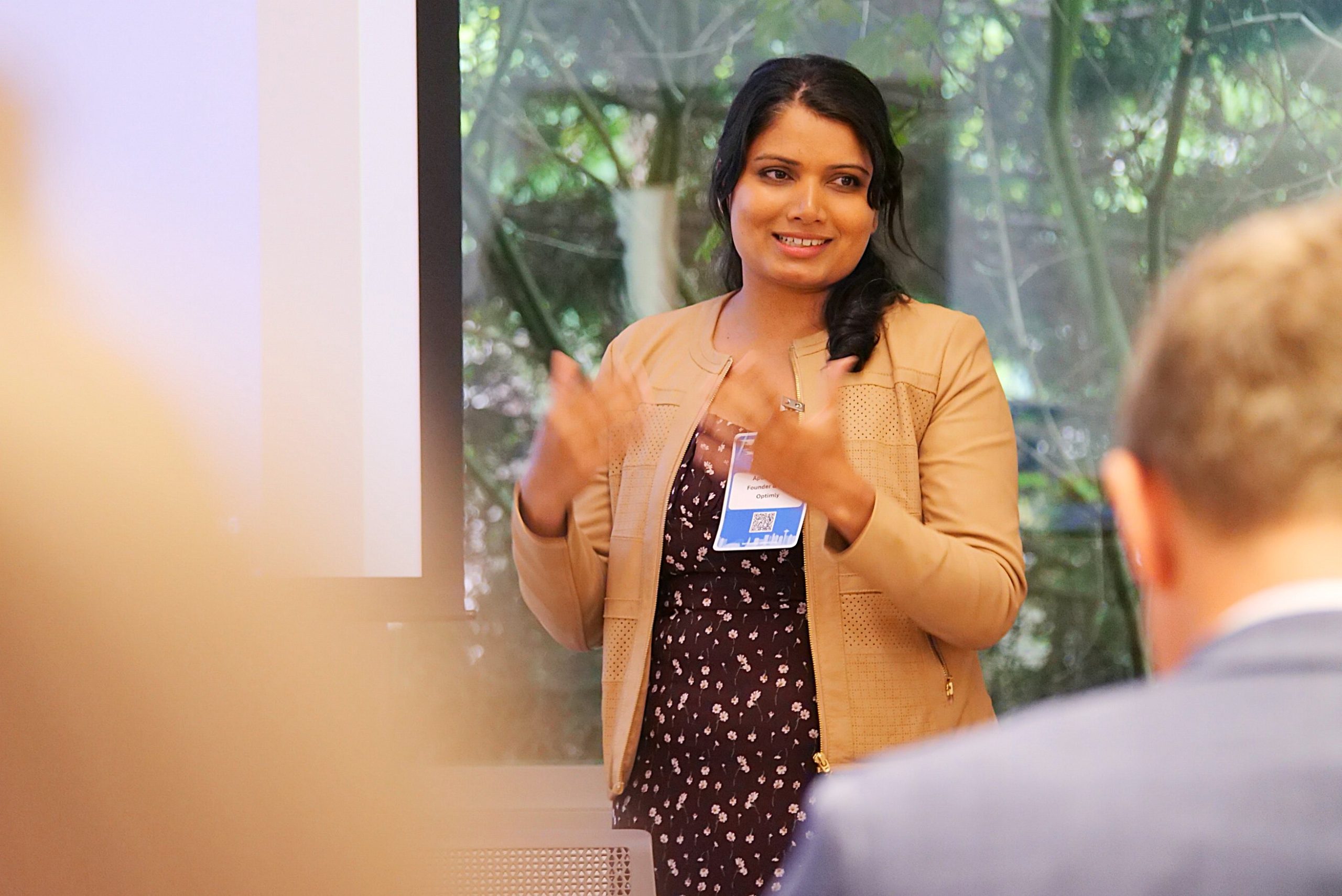
When Apurva Luty strolled into the Flywheel Investment Conference in Wenatchee, Washington, this past spring, she was a last-minute entrant with zero expectations. She walked out clutching three giant ceremonial checks. In a clean sweep, her fledgling startup, Optimly, won a $150,000 investment from the Flywheel Angel Network, a $5,000 fan-favorite award, and a $50,000 relocation incentive. While she ultimately declined the move to remain at Seattle’s prestigious AI House incubator, the sudden windfall catalyzed a major milestone: securing a total of $800,000 in pre-seed funding. This sudden injection of capital, which also drew support from Mighty Capital and AI House, highlights a growing realization among investors that as consumers shift from search engines to conversational AI, companies are losing control over how they are portrayed online.
Optimly’s rise targets a silent crisis brewing for modern marketers. Millions of shoppers have abandoned standard Google searches, choosing instead to ask ChatGPT, Claude, or Gemini for product recommendations and brand summaries. However, large language models do not typically learn about a company from its official website. Instead, these algorithms scrape a chaotic web of Reddit threads, Wikipedia articles, outdated reviews, and analyst reports, synthesizing this disparate data into a single, sometimes flawed, summary. To solve this, Optimly constructed a public, verified directory called the AI Brand Index, alongside a premium platform called BrandVault. Together, these tools allow brands to claim their profiles and rewrite their descriptions in the precise, factual, structured language that AI agents can easily parse, moving far beyond standard marketing copy.
The inspiration behind Optimly stems from Luty’s decade-long career at the intersection of consumer insights and major technological transitions. Armed with a background in public policy and economics from the University of Oregon, she spent years studying how people decide who to trust online. At Microsoft, she helped navigate the launch of the Surface line; at Meta, she guided product marketing insights for the Quest VR headset during the company’s massive pivot; and at Discord, she led user experience research. Luty realized that each of these roles was about helping humans understand brand-new technology. With the rise of generative AI, she recognized that the next great technological shift required a reverse approach: helping the technology itself understand the brands.
Optimly’s proof of concept arrived almost overnight when a small experiment revealed just how hungry AI technology is for structured metadata. Luty’s team initially published a bare-bones directory of 200 brands just to see if anyone would pay attention. Within days, automated crawlers from major tech firms swarmed the site. OpenAI alone deployed three distinct bots—one scraping for training data, another building a private directory, and a third retrieving live, real-time answers for active ChatGPT users. Today, Anthropic’s Claude also pulls from the platform. The index now fields over 11,000 agent requests every week, and more than 100 brands have proactively sought out and claimed their profiles to correct how they are represented.
While a handful of startups have emerged in the burgeoning fields of Generative Engine Optimization (GEO) and Answer Engine Optimization (AEO), Luty points out that most of these competitors merely advise companies to publish more web content. Optimly, by contrast, focuses on a concrete, closed-loop feedback system. Brands pay a monthly subscription ranging from $100 to $799 to manage their verified entries, map how AI engines describe them, and receive alerts when inaccuracies crop up. Optimly’s ultimate goal is to prove direct attribution, showing clients that a specific change made on their dashboard directly alters what an AI chatbot says about them in a live query.
With its pre-seed funding secured, Optimly is transitioning into its next phase of growth. Luty, who previously raised $100,000 from Right Side Capital Management and Forum Ventures, is actively hiring a Seattle-based technical co-founder and a senior founding engineer to build out the team on Pier 70. Backed by a small crew of contract developers, a data engineering intern, and a suite of her own custom AI agents, Luty is focusing her energy on running rigorous A/B tests to make these brand corrections entirely repeatable. By transforming how businesses talk to machines, Optimly is building the foundational trust layer for the artificial intelligence era.