



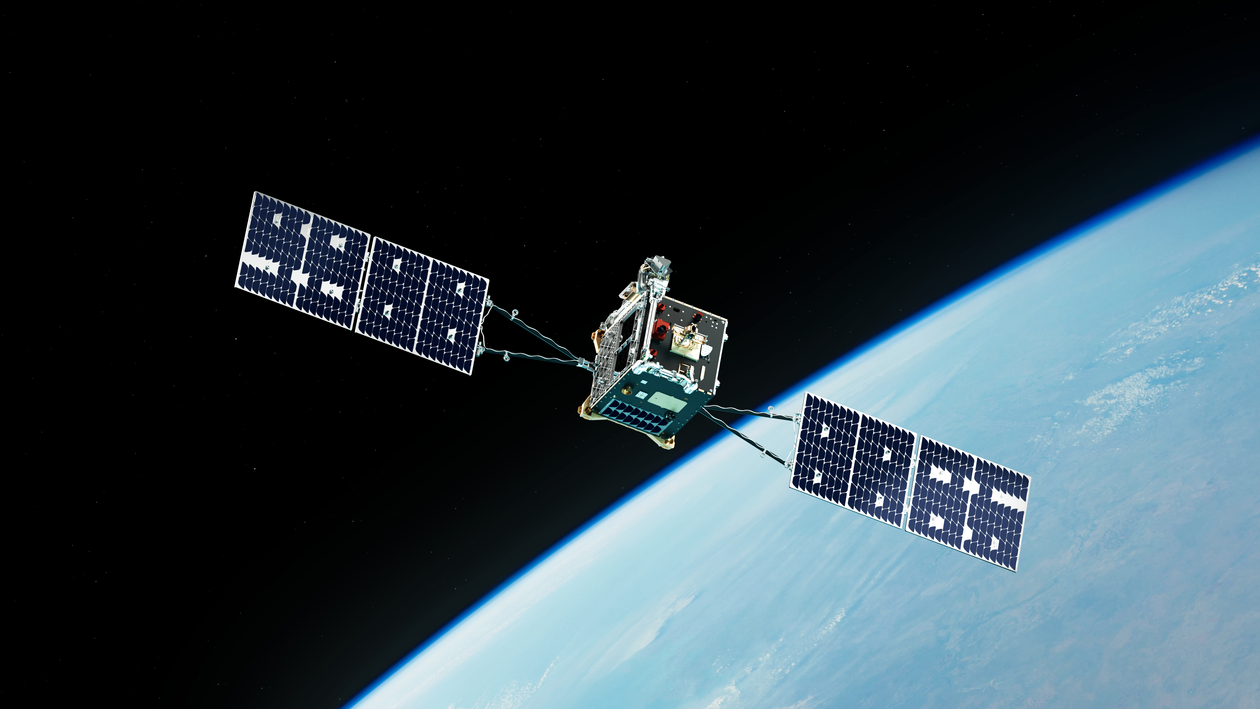
At a small company in Tukwila, Washington, a spacecraft roughly the size of a kitchen oven, with solar arrays folded like wings, is waiting for its ride to space. For years, Starfish Space has been designing, building, testing, and at times struggling to perfect machines that could one day repair, inspect, or retire other satellites. Now that “one day” is no longer a distant promise. The company’s first full-size Otter is scheduled to launch no earlier than October from Vandenberg Space Force Base in California, sharing a ride on SpaceX’s Transporter-18 rideshare mission. Weighing 660 pounds, or about 300 kilograms, Otter may be small by spacecraft standards, but its mission is enormous: it will demonstrate the ability to approach and inspect inoperable satellites, a service funded by NASA as part of a $15 million effort called the Small Spacecraft Propulsion and Inspection Capability mission, or SSPICY. “This is the moment Otter becomes real,” co-founder Austin Link said in a news release. “It’s no longer something we’re designing for the future. The first Otter is built, it has a customer and a mission, and it’s going to space.” For a team that has spent countless hours in clean rooms, running simulations, and dreaming of a future where space junk gets a second chance, those words carry real weight. The launch is not just a technical milestone. It is the beginning of a new chapter for a young company with big ambitions and for an industry slowly learning to take care of what humanity leaves in orbit. There is something almost emotional about seeing a vehicle you designed become a real spacecraft, ready to leave Earth. And after years of prototypes, setbacks, and stubborn persistence, Otter is ready.
The road to this launch has been neither straight nor easy. Starfish Space was founded in 2019 by Link and Trevor Bennett, two engineers who met at Jeff Bezos’ Blue Origin and shared a conviction that the growing problem of dead satellites demanded a practical solution. In 2023, the company launched a scaled-down prototype called Otter Pup, about the size of a microwave oven. That mission hit trouble when technical difficulties prevented docking with its target satellite, but it still managed to demonstrate the satellite-tracking system that Otter relies on. A second Otter Pup went up last year and has spent months practicing close approaches. “We have been in the vicinity with it since about June, and we’re consistently flying quite close to that spacecraft with the intention of Otter Pup 2 actually being a docking mission,” Bennett said. Now the full-size Otter is ready for its own debut. After separating from its Falcon 9 rocket and finishing the delicate process of commissioning its systems, Otter will begin a patient, careful journey toward multiple decommissioned satellites. The exact targets won’t be chosen until Otter reaches orbit. Bennett explained that the team has studied several candidate spacecraft and will pick among them based on conditions at the time. None of the targets are operational, which means there is no risk of interrupting a working mission. “These are spacecraft that are in family with satellites that NASA would be interested in servicing,” he said. “By being decommissioned satellites, there is no concern about trying to maintain the operational mission while we do our mission.” It is a thoughtful approach, one that respects the fact that in space, every movement has consequences, and a mistake can mean losing a rare chance to learn something valuable.
What will Otter actually do up there? It will fly close to satellites that have been drifting silently for years, some of which have not been seen up close since their launch. “What’s really interesting about some of these spacecraft is that they have not been seen in a long time,” Bennett said. “There is not only value in doing the commercial mission that we set out to do, but we provide some of that data back to NASA and say, ‘This is how your spacecraft have held up over the years in orbit’ — which is an interesting learning for them as well.” The targets range in size from a few hundred kilograms to several tons, so Otter must be adaptable and precise. This is not just a technical exercise; it is a kind of space archaeology, a way of reading the history of a satellite in its scratches, faded materials, damaged components, and orbital posture. Every inspection will provide clues about how spacecraft age in the harsh environment above Earth. And the insights Otter gathers during SSPICY will feed directly into future missions that involve docking with other satellites. Otter is designed not only to observe, but to service satellites for extended operations or to dispose of them when they are beyond saving. “Success in the mission is to actually go and provide this commercial inspection service on a number of these different spacecraft, and that will be a huge win in and of itself,” Bennett said. “But we’re also bringing Otter along to provide servicing well beyond that, so we could go and inspect more spacecraft, or potentially do some additional docking past the initial mission.” How long will the mission last? Bennett said that’s an open question. Between transits, observations, and follow-up maneuvers, the mission could stretch over a couple of years, with the possibility of an even longer extension. In space, as on Earth, good work doesn’t always stay within the original schedule.
Starfish Space is already thinking far beyond this first mission. The company has lined up a satellite disposal contract with the Pentagon’s Space Development Agency, two commercial servicing missions in geostationary Earth orbit, and two servicing missions for the U.S. Space Force. That means at least six Otters are either built, in production, or on the drawing board, including the one awaiting launch in California. “Now it’s all about how many Otters can we build, and how quickly can we get them up there for folks, because the demand is there,” Bennett said. The challenge is not just engineering but manufacturing. Right now, each Otter takes roughly a year and a half to move through the entire assembly and testing process. Starfish wants to shrink that timeline and build toward a true fleet, with multiple Otters ready to respond to different clients. That ambition is reflected in the company’s growth. Just a few months ago, Starfish reported having more than 90 employees. Today it has over 120 people, a substantial team by the standards of a boutique space company, but still tight enough that everyone knows the names and faces of their colleagues. Bennett described the team as “really focused,” and that focus will be tested as the company scales from a handful of missions to a steady pipeline of orbital work. The business of satellite servicing is no longer hypothetical. Governments and commercial operators are willing to pay for it. Starfish’s challenge is to keep up with that demand without losing the culture of persistence, ingenuity, and careful risk-taking that got the company this far. The first Otter is the proof that the model works; the next six will determine whether the company can turn that proof into a movement.
On Wednesday night, before the launch, Starfish paused to celebrate with employees and invited guests at the Seattle Aquarium. The actual Otter couldn’t attend because it was already in California waiting for its ride, so the company brought an Otter mockup, a full-size replica that gave people a sense of the machine in the room. But the most visible sign of the celebration was outside, where the Seattle Great Wheel was bathed in Starfish’s corporate colors of coral and azure. It was a gesture that made the event feel less like a corporate party and more like a civic occasion. Among the speakers was Hans Koenigsmann, a veteran of SpaceX and an adviser to other space companies, who talked about the early days of SpaceX, including the launch of a Falcon 1 rocket shown on a screen behind him. His presence was a reminder that every successful space company starts with a wild idea and a small group of believers. Bennett framed the evening in terms of community pride. “This is a big deal for Seattle,” he said. “Anytime a Seattle space company is able to make a meaningful difference in the larger space ecosystem, that’s worth celebrating. If we can splash other companies’ colors on there when they have their great moments, why not make that a tradition going forward? We’re happy to be the first, and hopefully not the last, that gets to splash colors on a Ferris wheel and show off what the Seattle space community has to offer.” The event was a chance to look at the spacecraft, hear stories of struggle and success, and feel the energy of a team on the edge of a breakthrough. There is something special about a company that chooses to celebrate with an aquarium and a Ferris wheel, like a gathering of people who believe the future should be both ambitious and joyful.
As Otter prepares for its October launch, it might be tempting to see this as the end of a long journey. But for Starfish Space, it is more like a graduation. The technologies tested during the SSPICY mission will help make satellite servicing routine. Future Otters will dock with satellites, push them to new orbits, repair them, or ensure they burn up safely in the atmosphere. The name Starfish, inspired by the creature that can regenerate lost limbs, feels especially fitting: the company wants to help orbital infrastructure regenerate itself rather than become permanent litter. There will be risks. Launch could be delayed. Technical gremlins could appear. Inspections might reveal things no one expected. But the team has already learned to live with uncertainty. The first Otter Pup failed to dock, and yet Starfish kept going. The second Otter Pup is still working toward a dock. Otter itself is built from those hard-won lessons. “This is the moment Otter becomes real,” Link said, and that reality is just beginning. Soon there will be a spacecraft in orbit, flying carefully toward silent satellites, saying hello on behalf of a planet that wants to be more responsible about what it sends into the sky. The mission will last for years, maybe longer. And long after Otter has finished its work, the skills and confidence it demonstrates will remain, shaping the way humans build, maintain, and clean up their presence in space. For a company that started with an idea and a small team in Washington, that is a remarkable achievement. Otter is no longer a concept or a promise. It is a machine waiting at the edge of Earth, ready to make the future real.