



For thousands of years, humanity has gazed up at the night sky in quiet wonder, tracing stellar patterns with our fingers and dreaming of the secrets buried deep within the dark. On June 30, 2026, that ancient curiosity took a monumental, historic leap forward as the science team behind the Vera C. Rubin Observatory officially pressed “record” on the grandest astronomical project ever conceived. Perched high on the barren, wind-swept ridge of Cerro Pachón in the Chilean Andes—where the atmosphere is extraordinarily thin, dry, and clear—this billion-dollar, state-of-the-art facility has formally commenced its ten-year Legacy Survey of Space and Time, commonly known as the LSST. This momentous milestone marks the culmination of more than three decades of vision, rigorous scientific planning, and complex engineering. What began in the late 1990s as a series of impassioned discussions among ambitious astronomers has transformed into a living, breathing scientific reality. Just one year after celebrating the completion of its physical construction with a breathtaking “First Look” gallery of cosmic images, the observatory has transitioned from an engineering marvel into a fully operational scientific powerhouse. With the official launch of the LSST, researchers are no longer merely assembling and testing equipment; they are actively embarking on a decade-long journey to map the southern sky in unprecedented detail. This is not just a scientific survey; it is the creation of a dynamic, living archive of the heavens. As acting National Science Foundation Director Brian Stone cloaked the event in historical gravity, humanity has begun filming the greatest cosmic movie ever made—a project supported by a massive federal investment through the NSF and the U.S. Department of Energy. Together, these organizations have empowered a global community of thinkers, dreamers, and builders to expand the outermost frontiers of human knowledge. Every single night, this silent sentinel in Chile will peer deep into the void, capturing the subtle dances of the stars, the sudden explosions of supernovas, and the slow, majestic rotation of the heavens, ensuring that our understanding of the universe will never be static again.
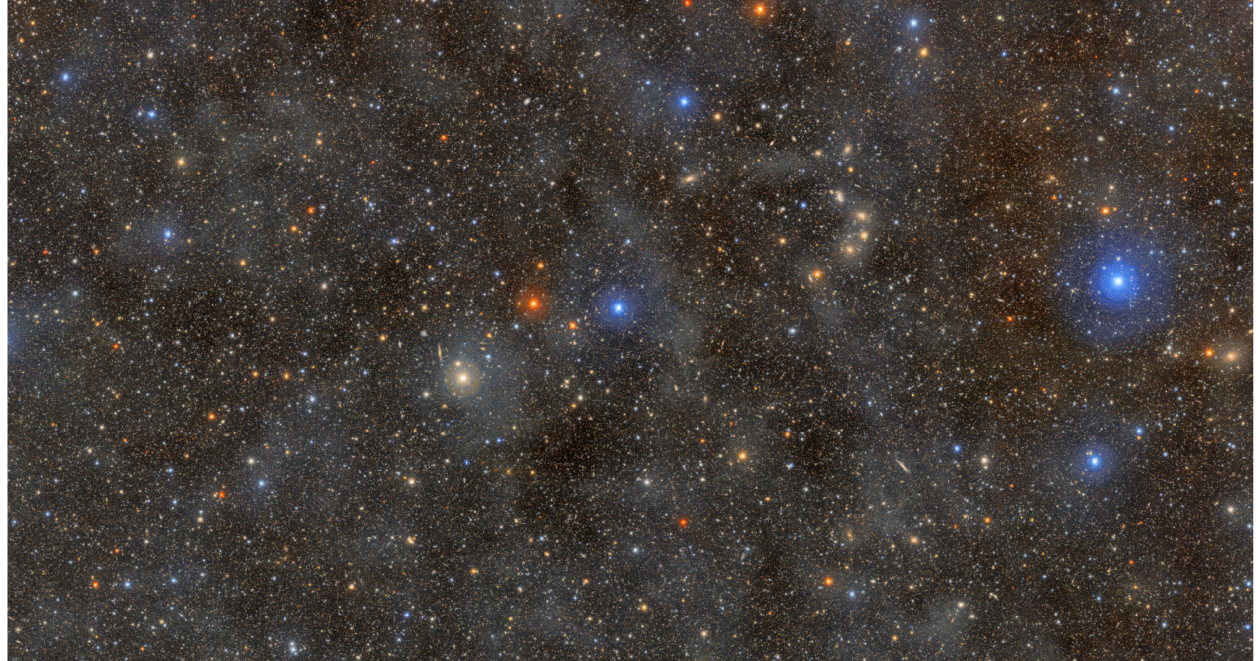
At the heart of this astronomical revolution lies a technological masterpiece: the world’s largest and most powerful digital camera. Boasting an astonishing 3,200-megapixel capability, this colossal instrument, which is roughly the size of a small passenger car, is designed to capture a brand-new, ultra-high-definition picture of the night sky every forty seconds. Under the crystal-clear, high-altitude skies of Chile, the Rubin Observatory possesses the unparalleled capability to photograph the entire visible southern sky in the span of just a few nights, repeating this cycle continuously to detect even the most minute changes over time. To commemorate the momentous launch of the LSST, the project team unveiled an awe-inspiring, 1.7-gigapixel masterpiece of the constellation Lupus. This jaw-dropping image reveals an absolute ocean of distant stars, framed by delicate, glowing wisps of galactic cirrus—ethereal, high-altitude clouds of interstellar gas and dust floating within our own Milky Way galaxy that show up as faint, beautiful veils against the blackness. Yet, the true genius of the observatory lies not just in its ability to take beautiful portraits, but in its dynamic capacity to act as a cosmic motion detector. In February 2026, the team activated the observatory’s groundbreaking Alert Production Pipeline, a highly automated software engine designed to identify sudden, fleeting cosmic shifts. On any given night, this pipeline is projected to generate and broadcast millions of real-time alerts to the global scientific community. Whether it is a sudden stellar explosion, a passing space rock, or a mysterious fluctuation in light, the system will instantly notify astronomers around the world, turning the sky into a live, interactive theater. It is this combination of massive scale and real-time responsiveness that elevates the Rubin Observatory from a traditional telescope into a global early-warning system and a cinematic chronicler of the universe’s constant, restless evolution.
The road to this historic moment was paved by the perseverance of scientific pioneers and the generous foresight of visionary philanthropists who recognized that understanding our universe requires both daring imagination and immense resources. The concept of a wide-field survey telescope began floating through the academic halls of the astrophysics community in the 1990s, but it remained a beautiful, distant dream until it received a vital spark in 2007. That year, Seattle-area technology trailblazer Charles Simonyi and legendary Microsoft co-founder Bill Gates stepped forward with a combined $30 million financial contribution, breathing crucial life and momentum into the project during its critical early development phases. Decades later, this incredible effort culminated in a deeply meaningful recognition. In 2020, the facility was named the Vera C. Rubin Observatory, honoring the legendary American astronomer whose groundbreaking hand-drawn charts and observational work on galaxy rotation rates provided some of the first robust, undeniable evidence for the existence of dark matter. It was a fitting tribute to a woman who spent her life looking at what others could not see, fighting tirelessly for her place in a male-dominated field, and permanently rewriting the laws of cosmology. Additionally, the observatory’s massive, 8.4-meter (27.5-foot) telescope was officially christened the Simonyi Survey Telescope, a tribute to Simonyi’s family and their early, pivotal investment. By weaving together the legacy of a scientific pioneer like Rubin with the modern philanthropy of tech innovators like Gates and Simonyi, the observatory stands as a testament to what humanity can accomplish when public institutions, private benefactors, and brilliant scientific minds collaborate toward a singular, transcendent goal: to look deeper into the darkness and finally understand the light.
While the physical hardware sits atop a mountain in South America, the intellectual engine driving its data analysis is deeply rooted in the Pacific Northwest, particularly at the University of Washington. Handling the deluge of data generated by a 3.2-gigapixel camera taking photos every forty seconds is a monumentally complex computational challenge; every single night, the observatory will harvest terabytes of raw visual information. To prevent this flood of data from becoming an overwhelming, unreadable tsunami, the brilliant minds at UW’s Institute for Data Intensive Research in Astrophysics and Cosmology—fondly known as the DiRAC Institute—have spent years developing revolutionary software tools. These sophisticated algorithms are designed to sort, analyze, and decipher the torrent of information, translating raw light signals into structured, readable scientific insights. Leading this massive computational campaign is UW astronomer Zeljko Ivezić, who served as a critical decision-maker in determining when the observatory was truly prepared to begin its ten-year mission. Ivezić explained that the green light to officially launch the LSST was only given after a grueling period of rigorous system optimization, followed by a comprehensive operational review of technical readiness, data system performance, and scientific validation. The decision was not made lightly; every aspect of the observatory’s performance, from image quality and effective survey speed to system reliability and calibration accuracy, had to be refined to absolute perfection. This painstaking preparation ensures that the data delivered to the global scientific community is not only vast but incredibly precise. The tireless efforts of the software engineers and astronomers at UW highlight a crucial truth of modern discovery: in the digital age, a telescope is only as powerful as the code that interprets its gaze, making these software architects the true cartographers of our modern cosmic maps.
The sheer scope of what the LSST is poised to discover spans the entirety of our known universe, beginning with our very own cosmic backyard. Before the survey had even officially launched, the Rubin team utilized the preparatory test phases to discover more than 11,000 previously undetected asteroids drifting quietly through our solar system. This remarkable feat is merely a tiny preview of what is to come. Advanced computer simulations suggest that over the course of its ten-year run, the survey will chart more than five million asteroids and comet-like bodies, creating the most comprehensive, high-definition map of our solar system in human history. This endeavor is far more than an academic exercise in cosmic bookkeeping; it is a vital safety project for our home planet. By identifying and tracking millions of near-Earth objects, scientists can safeguard our world by predicting potential asteroid impacts generations in advance. Yet, as the gaze of the Simonyi Survey Telescope punches through the local neighborhood, it will also venture into the profound, quiet depths of the far universe. One of the project’s most tantalizing promises is its potential to illuminate the darkest, most elusive corners of cosmology. By observing billions of distant galaxies, the LSST will study the subtle gravitational warping of light across cosmic time, offering unprecedented clues about the nature of dark matter and dark energy. These twin enigmas, though completely invisible to traditional telescopes, together make up more than ninety-five percent of the universe’s total mass-energy content. In searching for these elusive forces, the Rubin Observatory is not simply photographing stars; it is attempting to map the invisible skeletal structure of our universe, seeking to understand the hidden scaffolding that dictates how galaxies form, drift, and ultimately die.
At its core, the decade-long odyssey of the Vera C. Rubin Observatory represents a profound shift in how humanity relates to the night sky. In the past, astronomy was a discipline of snapshots—capturing static moments in time and hoping to piece together the slow, grinding processes of the cosmos. Through the LSST, we are transitioning into an era of dynamic, real-time chronicling, where the universe is observed as the living, changing entity that it truly is. As Dario Gil, the undersecretary for science at the U.S. Department of Energy, beautifully observed, this world-class instrument will capture the restless nature of our cosmos, unlocking secrets from the smallest asteroids in our backyard to the very grand structure of space-time itself. By trying to grasp the fundamental laws that govern our existence, we are embarking on a deeply human quest to understand our origin story. This monumental endeavor is made possible by a seamless partnership between the National Science Foundation and the U.S. Department of Energy’s Office of Science, operated jointly by NSF’s NOIRLab and the SLAC National Accelerator Laboratory. It stands as a shining beacon of what can be accomplished when human curiosity is backed by sustained public support and cross-disciplinary collaboration. For the next ten years, as the Rubin Observatory silently sweeps across the Chilean sky night after night, it will bring the mysteries of the cosmos into our classrooms, laboratories, and homes. In doing so, it reminds us that despite our smallness on this fragile blue planet, our minds possess the extraordinary capacity to span the light-years, decoding the ancient whispers of the stars and writing our own chapter in the great cosmic story.