



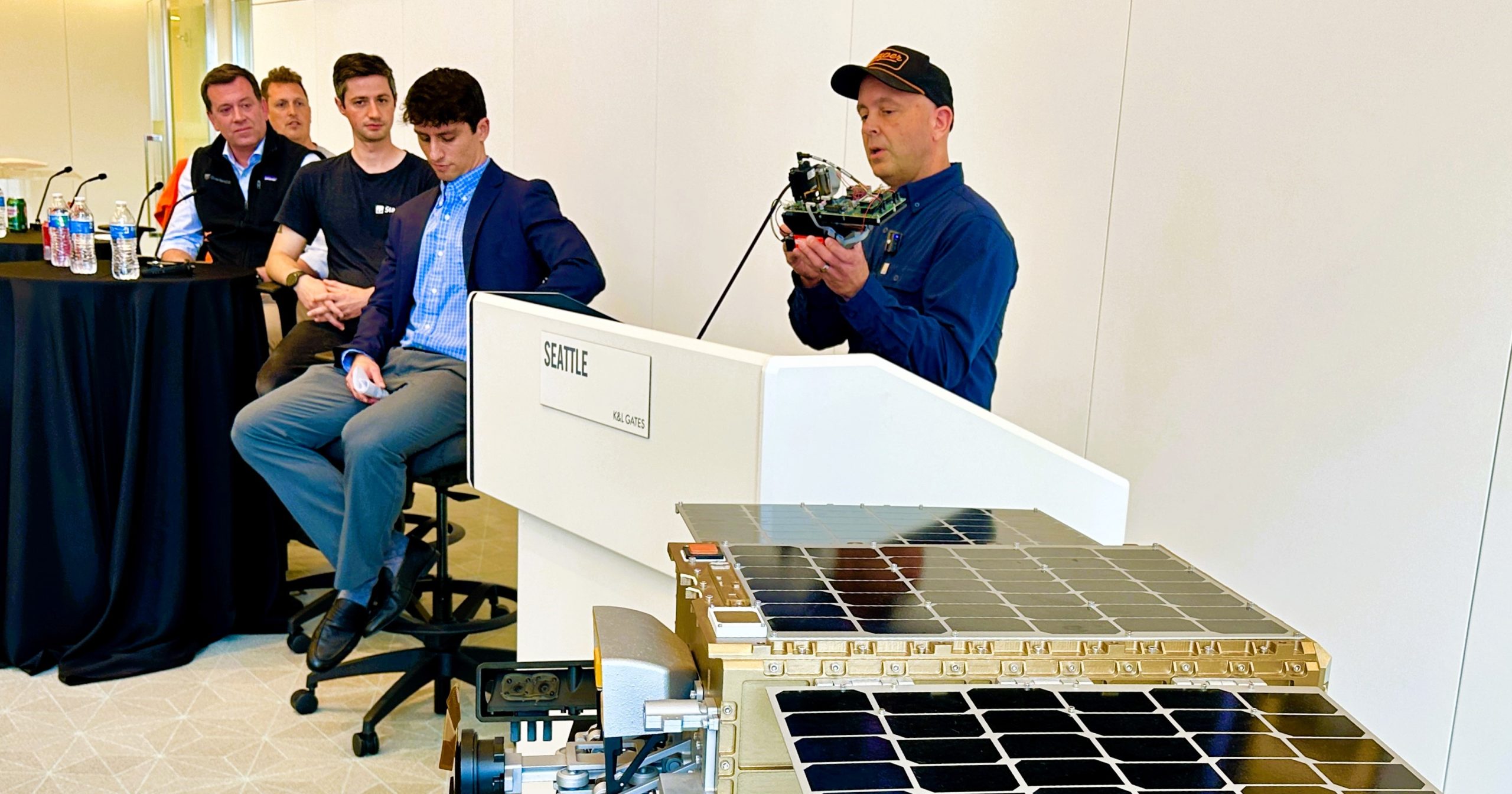
The atmosphere inside the downtown Seattle office of K&L Gates was charged with a distinct, kinetic energy that only arises when the abstract world of computer science collides head-on with raw, tactile engineering. While the modern tech industry has spent decades obsessed with the clean, weightless realms of software applications and cloud databases, a quiet counter-revolution has been brewing on the physical frontier. This week, during Seattle’s Deep Tech Week, four pioneering founders gathered for a visceral, hands-on show-and-tell that felt less like a dry corporate slide presentation and more like a window into a rugged, fully realized future. Arrayed across the tables in front of them were not just laptops and charts, but heavy steel components, delicate spacecraft models, rugged military-grade sensor pods, and glowing silicon processing units designed to withstand the cold void of orbit. These objects served as physical testaments to a shared human journey: the realization that solving the world’s most critical challenges—from environmental sustainability and food security to national defense and the infrastructure of artificial intelligence—requires getting our hands dirty in the real world. By grounding their lofty computational ideas in tangible metal, glass, and silicon, these entrepreneurs are redefining what it means to build a tech startup, reminding us that the ultimate purpose of human ingenuity is not to escape our physical reality, but to master, protect, and elevate it.
Nowhere is this gritty intersection of advanced science and human labor more evident than in the agricultural fields of America, where Paul Mikesell and his team at Seattle-based Carbon Robotics are waging a high-tech war against weeds. At the conference table, Mikesell proudly held up a heavy optical scanner, a key component of his company’s revolutionary LaserWeeder system, which is towed behind tractors to target and shoot weeds with pinpoint laser accuracy. In a captivating moment of transparency, Mikesell pointed to the device’s internal sensors, explaining the intense human struggle and engineering “pain” required to make sure that what the camera sees matches exactly where the co-aligned laser fires, especially when translating dynamic coordinates through a distorted lens angle in real-time. This isn’t a tidy laboratory experiment; this machine operates in the dust, vibration, and blistering heat of active farmland, demanding a level of mechanical resilience that software engineers rarely have to contemplate. This respect for the practical realities of farming also drives Mikesell’s deeply human business strategy: rather than hiding behind a distant network of third-party dealerships, Carbon Robotics employs a dedicated global staff to sell and service the LaserWeeders directly. This direct-to-farm model fosters rich, empathetic relationships, allowing the engineers to listen to the farmers’ feedback, share in their daily anxieties, and continuously adapt their systems—which has even included experimenting with Anthropic’s Claude AI connected to physical oscilloscopes to auto-generate functional firmware on the fly.
While Mikesell works to perfect the relationship between machine and soil, Austin Link is looking upward, tackling a delicate, high-stakes ballet in the silence of outer space. Sitting beside him on the panel was a detailed engineering model of Starfish Space’s Otter Pup spacecraft, a diminutive but incredibly ambitious satellite designed to prove that we can autonomously dock with, inspect, and maneuver other objects in Earth’s orbit. Currently, one of these pioneering craft is executing a high-stakes, real-world orbital docking test, a milestone Link hinted at with quiet, excited anticipation. For decades, satellite servicing was the exclusive domain of massive, billion-dollar state enterprises or incredibly expensive aerospace giants; Northrop Grumman, for example, successfully extended a satellite’s lifespan and made $65 million in the process, but the operational mission cost a staggering $400 million to pull off. Starfish Space is bringing a humanized, lean-startup philosophy to this daunting cosmic challenge, relying on innovative computer vision, smart robotics, and a single orbital thruster that exerts a force equivalent to a housefly sitting on your hand. To navigate the cold mechanics of orbital physics with such an incredibly delicate amount of thrust requires a profound level of mathematical patience and algorithmic foresight, proving that humanity’s future in the stars doesn’t have to be defined by brute-force, high-cost rocketry, but can instead be guided by elegance, precision, and accessible design.
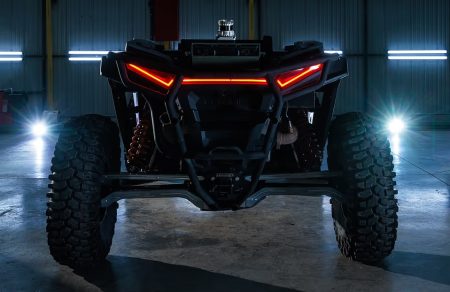
Back down on Earth, Byron Boots, the co-founder and CEO of Overland AI—and a professor of machine learning and robotics at the University of Washington—is translating this same need for intelligent physical navigation to some of the most unforgiving, unmapped terrains on our planet. Boots brought his technology directly to the audience by dragging in a heavy, ruggedized sensor pod ripped straight from one of his company’s 3,000-pound autonomous off-road tactical vehicles. Designed for military and search-and-rescue applications to haul critical supplies, drones, or anti-drone defenses through thick forests, muddy ravines, and rocky deserts, these vehicles cannot rely on the neat lane lines, predictable traffic signs, or smooth asphalt of a city street. This harsh, unpredictable reality forced Overland AI to quickly expand its horizons beyond merely writing elegant autonomous software; they realized that to move fast and protect lives, they had to embrace vertical integration, designing and building the rugged sensor pods and mounting kits themselves. By packing stereo cameras, sophisticated lidar systems, and powerful onboard computers into a single, highly durable “SPARK Kit” that can be bolted onto almost any standard vehicle, Boots and his team have created a plug-and-play autonomous brain. This means a soldier or emergency responder in a stressful, life-or-death environment doesn’t have to worry about complex system integration; they can simply turn the system on, hand over the physical keys to the AI, and focus entirely on their mission.
This theme of ruggedizing fragile, Earth-bound technology for extreme environments reached its absolute peak when Ezra Feilden, co-founder and CTO of Redmond-based Starcloud, held up a gleaming Nvidia H100 GPU—the very chip that has become the highly coveted gold standard of the terrestrial AI revolution. However, as Feilden pointed out to the fascinated audience, these ultra-powerful processors were originally built to enjoy a comfortable, air-conditioned life within sterile, earth-based data centers, completely sheltered from the violent vibrations of a rocket launch or the sweeping thermal extremes and intense radiation of outer space. Starcloud’s pioneering mission is to take these massive, power-hungry computational workhorses, ruggedize them to survive without a single drop of maintenance for over five years in orbit, and deploy them as space-based data centers—a feat they famously proved possible last year by training a large language model directly in Earth’s orbit. This bold endeavor is driven by a deeply human and ecological concern: the explosive, insatiable growth of artificial intelligence is placing a crushing strain on Earth’s land, water, and electrical grids, making the transition to solar-powered, space-based supercomputing an increasingly attractive alternative. To turn this vision into a viable reality, Feilden and his team are scaling up operations at their new facility in Woodinville, preparing to manufacture and launch thousands of custom, ruggedized satellites equipped with SpaceX-partnered laser terminals to process the world’s most complex data high above the atmosphere.
The fascinating convergence of these four distinct deep tech ventures highlights a profound, ongoing debate regarding the business strategies and underlying assumptions that will shape the next decade of human industry. A brilliant moment of contrast emerged during the panel when Link, whose Starfish Space designs products based strictly on today’s steep launch economics, expressed fascination with Feilden’s business model, which boldly gambles on the imminent arrival of massive, low-cost heavy-lift vehicles like SpaceX’s Starship to dramatically drive down orbit-access costs. This intellectual healthy tension illustrates a vibrant ecosystem where different strategic philosophies can thrive side-by-side, united by a singular, breathtaking goal: to expand humanity’s operational capabilities across the earth, the wilderness, and the heavens. Whether they are protecting rural crops from weeds, guiding delicate spacecraft with the gentle force of a fly, navigating rugged war zones, or building solar-powered supercomputers in the stars, these four founders are proof that the most exciting tech frontier is no longer confined to our phone screens. By combining the incredible cognitive power of modern artificial intelligence with hard, uncompromising physical engineering, they are showing us that our physical world is still wide open for exploration, transformation, and a beautiful, tangibly constructed future.