

Finding Hope in Collaboration: Inside Climate Week NYC’s Push for Scalable Solutions
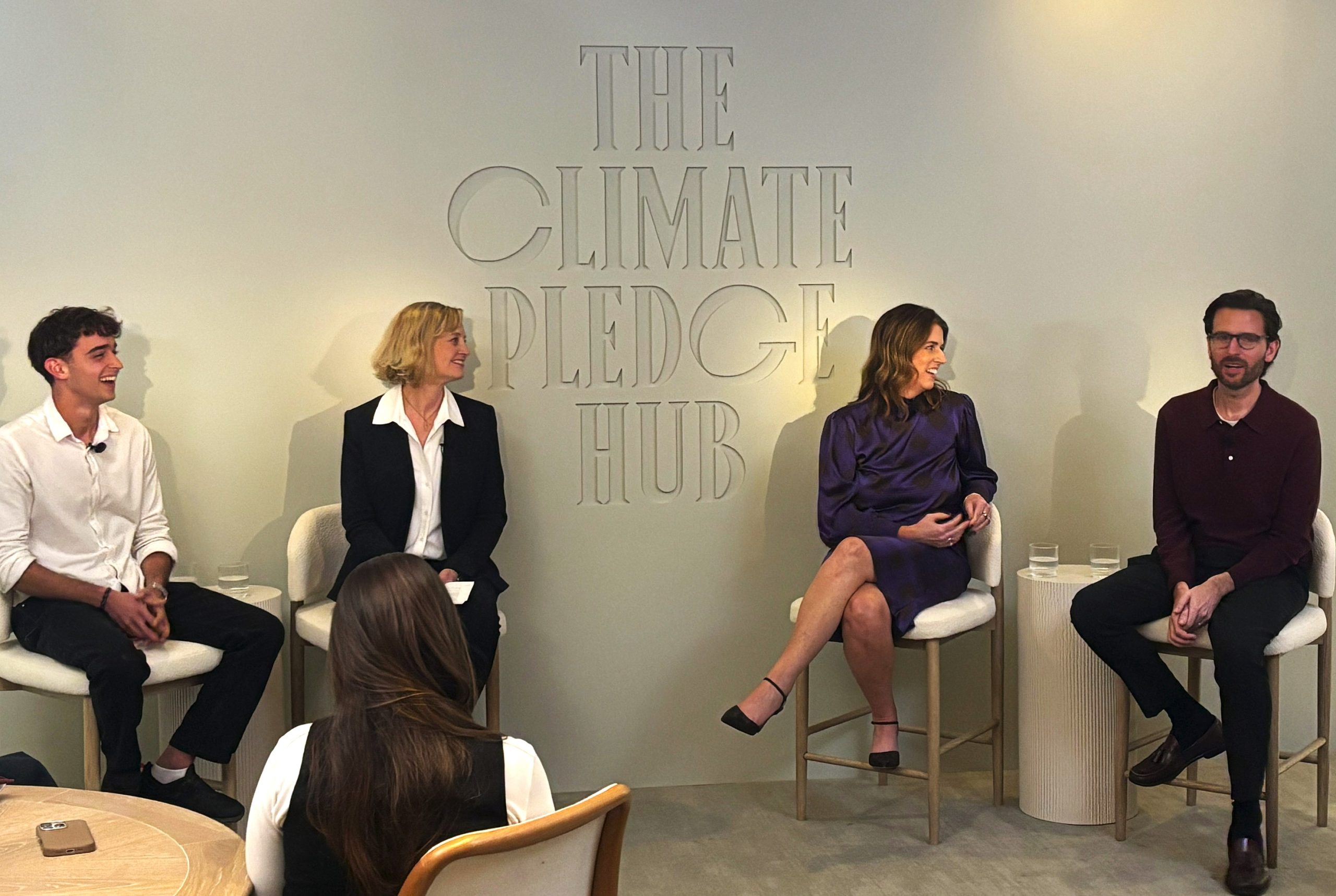
The shadow of artificial intelligence’s growing environmental footprint and global political tensions hung heavy over Climate Week NYC, yet the mood among the thousands of attendees who flooded Manhattan’s event spaces was decidedly more hopeful than despairing. Business leaders, nonprofit executives, and government officials gathered across hundreds of sessions to confront the uncomfortable paradox of our time: how do we pursue technological progress without sacrificing the planet? At The Climate Pledge Hub in Midtown Manhattan, a notable convergence took place as executives from organizations that have publicly committed to achieving net-zero carbon emissions by 2040 came together for a candid conversation about what realistic, scalable climate action actually looks like in practice. The gathering represented a microcosm of the larger Climate Week spirit—acknowledging the immense challenges ahead while refusing to surrender to cynicism or inaction.
Kara Hurst, Amazon’s chief sustainability officer, opened the discussion with a reflection on how dramatically the climate solutions landscape has transformed in recent years. “There was a period of time where it was like, ‘Well, we don’t know how to do some of this,'” she admitted, acknowledging the genuine uncertainty that once plagued sustainability efforts. But that hesitation has given way to something far more dynamic. “The innovation has skyrocketed,” Hurst continued, her tone carrying a mix of pride and urgency. “The number of people working on these industries is phenomenal, and so the solutions are available.” Joining her on the panel was Jason Knauf, CEO of The Earthshot Prize, a decade-long initiative launched in 2020 by Prince William that identifies and supports innovative environmental solutions from around the globe. Each year, the program recognizes fifteen finalists and selects five winners, each receiving a substantial award of approximately $1.4 million to accelerate their work. Also present was Franco Rodríguez Viau, the young CEO and co-founder of Satellites on Fire, an Earthshot finalist whose wildfire detection technology has already made significant international impact. The conversation, moderated by GeekWire’s Lisa Stiffler, touched on topics ranging from the AI boom’s environmental costs to the power of youth-driven innovation, offering a comprehensive look at both the obstacles and opportunities facing climate action today.
Perhaps the most pressing concern discussed at Climate Week was the environmental toll of the AI data center explosion. Across the city, attendees grappled with troubling statistics: new gas power plants being constructed to meet surging electricity demands, carbon-intensive concrete and steel flowing into massive construction projects, and emissions trajectories heading in the wrong direction. Amazon alone committed an astounding $200 billion to data center expansion this year, yet the company’s carbon emissions rose by 16 percent last year—a stark reminder that technological advancement often comes with environmental consequences. The question on many minds was whether net-zero goals for 2040 remain realistic in this context. Hurst acknowledged the challenge without flinching, describing it as “a real challenge” while emphasizing her organization’s determination to meet the moment. “I’m not saying that it’s going to be easy, and I’m not saying it’s going to be linear,” she said, her words carefully measured. “But we’re going to put everything we have behind that.” To counterbalance the environmental impact of its data infrastructure, Amazon has invested in an impressive portfolio of 700 renewable energy projects worldwide, capable of generating 42 gigawatts of power, with more facilities continuously being added. The company is also exploring lower-carbon building materials, including mass timber, demonstrating a multi-pronged approach to reducing its footprint. “We are absolutely committed to our goal of 2040,” Hurst affirmed, though she readily conceded, “it is challenging.”
The panelists emphasized repeatedly that the path forward lies not in isolated efforts but in strategic partnerships that aggregate purchasing power and accelerate the adoption of clean technologies. Hurst highlighted The Climate Pledge, which Amazon co-launched and which has grown to include more than 700 signatories, as a prime example of collaborative action. Another initiative she cited was the Zero Emission Maritime Buyers Alliance, a coalition supporting low-carbon shipping options. The conversation also showcased the Velocity program, a partnership between Amazon Web Services, Earthshot, and investment firm Plug and Play that helps late-stage climate technology companies find customers. The program focuses on two critical areas: materials innovation (addressing issues like fashion waste and sustainable construction) and energy independence (spanning batteries, grid technology, and other infrastructure). Four selected winners each receive up to $100,000 in AWS credits, with their solutions promoted to Climate Pledge signatories. This approach recognizes that individual companies, no matter how large, cannot solve climate change alone—but coordinated efforts across industries can create the market signals needed to drive widespread change. Earthshot itself goes beyond simply writing checks, mobilizing a global network to connect its portfolio of sustainable solutions with investors, corporate customers, and policy support for wider adoption. This ecosystem approach, the panelists argued, is essential for moving promising innovations from pilot projects to mainstream implementation.
Despite the undeniable political divisiveness surrounding climate issues, Knauf offered a refreshingly optimistic perspective, arguing that climate change could serve as a unifying force rather than a source of further polarization. “The biggest story in the world right now is that this set of issues is the unifying mission in human history,” he asserted, challenging the narrative that environmental action is inherently contentious. While the impacts of climate change manifest differently at the local level—whether in Bangladesh’s Sundarbans mangrove region facing rising sea levels or along Miami’s vulnerable beaches—the shared nature of the threat creates opportunities for common ground. Knauf encouraged a more inclusive approach: “Be open-minded. Talk to people who disagree with you. Don’t shut them down. Find common ground. Invite people in.” Both he and Hurst emphasized the importance of leading with values that transcend political affiliations. Regardless of where one falls on the political spectrum, most people want what Hurst described as “a healthy, livable planet for your children with clean air and clean water.” This shared aspiration, the panelists argued, provides a foundation for collaboration even when specific policy approaches may differ. The message was clear: climate action doesn’t require universal agreement on every detail, but it does require a willingness to engage constructively across differences.
The conversation took an inspiring turn when Rodríguez Viau shared his personal journey as a young innovator. At just 16 years old, he and two friends co-founded Satellites on Fire in Argentina after witnessing the devastating impact of wildfires on family friends who lost their homes. Through interviews with firefighters and forest rangers, they identified a critical gap: slow detection in remote areas was allowing small blazes to escalate into catastrophic infernos. Their solution was both elegant and practical—an AI-powered system that analyzes data from 13 satellites every five minutes, immediately sending location alerts to first responders via WhatsApp or text message. “AI that we developed is nowadays detecting fires hours faster than NASA, which is the most used system globally for wildfires,” Rodríguez Viau said, his pride evident. Since its launch in 2020, the startup has expanded to operate in 21 countries across five continents, with continued growth on the horizon. His story served as a powerful reminder that age need not be a barrier to meaningful climate action, and that innovative solutions often emerge from direct engagement with affected communities. It also underscored the importance of accessible technology and the potential for relatively simple approaches—like leveraging existing satellite infrastructure and widely-used messaging platforms—to create significant impact.
The panel concluded with a discussion of “positive tipping points,” a concept that offers a more optimistic framework for understanding climate progress. Historically, climate discourse has focused on negative tipping points—like the Amazon rainforest degrading until lush jungle transforms into dry savanna, or ice sheets collapsing once certain thresholds are crossed. But new research from Earthshot and the University of Exeter in England highlights the potential for favorable tipping points that could accelerate climate action. The study identifies 51 sustainability objectives—including restoring wetlands, preventing and composting food waste, and shifting to electric vehicles—that could trigger rapid, beneficial changes when enough momentum accumulates. “There’s some positive systems that if we actually put all of our efforts together and focus over the next few years, we know we can tip them into irreversible positivity,” Knauf said, his optimism grounded in research. This framing shifts the narrative from doom-and-gloom warnings to a more empowering vision: that collective action, concentrated at the right moments and in the right ways, can produce transformative results.
The session closed with each panelist offering a final thought for listeners to carry forward. Knauf’s advice was simple yet profound: “Invite people in. Let’s grow this movement. Let’s stop pushing people away. And use it to support each other and feel like we’re part of something bigger.” Hurst offered practical wisdom about the importance of transparency and shared learning: “When you find something that works, publish a case study. And when you find something that doesn’t work, talk about it also. Because we can move really fast when we know what the solutions are, but we can move really, really fast when we know what doesn’t work and we can avoid it.” Rodríguez Viau, the youngest voice on the panel, offered perhaps the most personally resonant reflection: “I was listening when you were speaking about the 2040 goal, and I was thinking, ‘I don’t know if we will reach the goals that we want to reach or not, but at least I want to feel that I did everything I could.'” His words captured the essence of the entire discussion—a recognition that the outcome remains uncertain, but the commitment to action, to collaboration, and to giving everything we have in pursuit of a better future is what ultimately matters. Climate Week NYC 2026 demonstrated that while the challenges ahead are daunting, the collective determination to address them has never been stronger.