





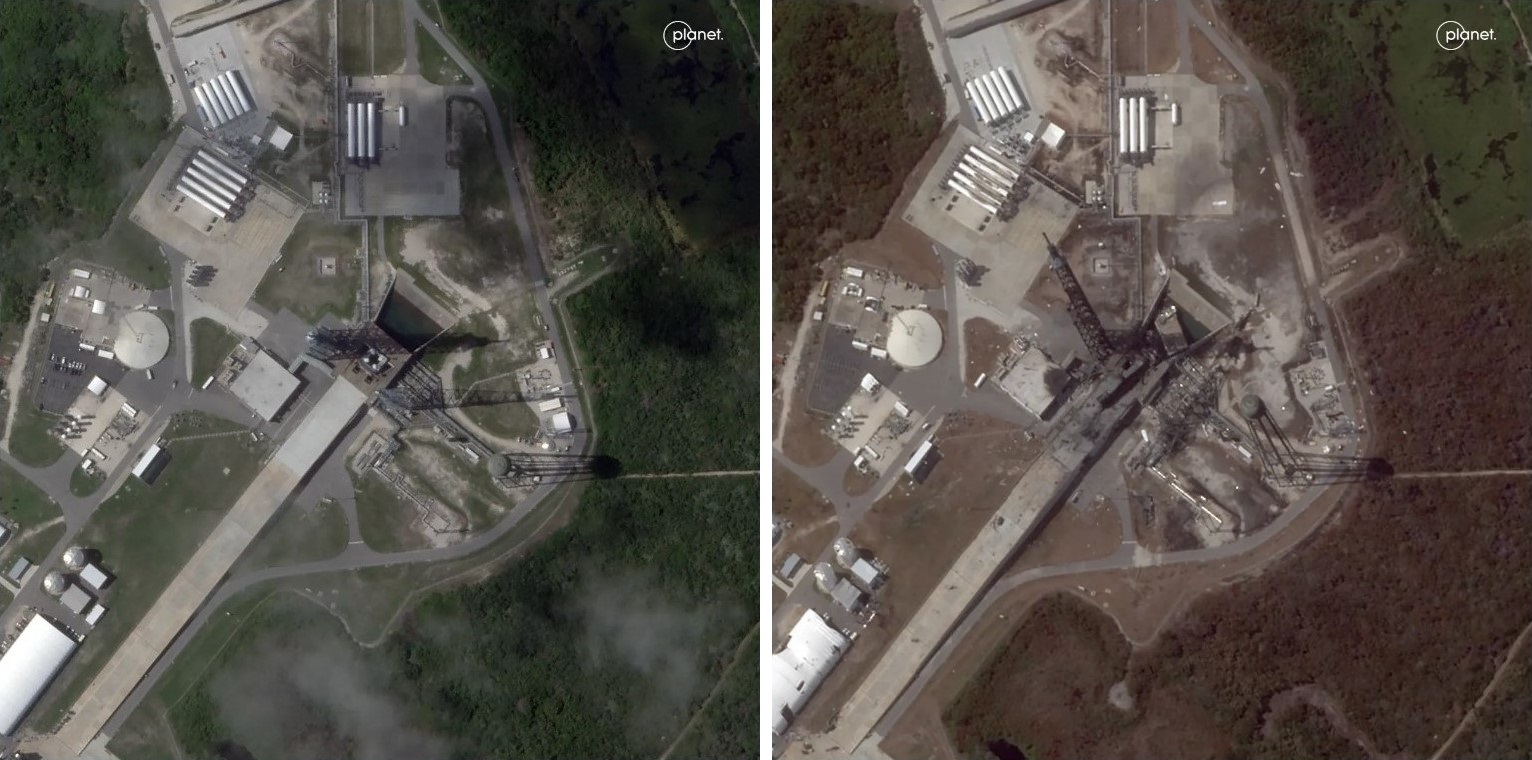
On a quiet morning along Florida’s Space Coast, Cape Canaveral Space Force Station stood as a shining monument to human ambition, with Launch Complex 36 acting as the stage for Blue Origin’s grandest dreams. Yet, the brutal volatility of rocket science was laid bare on May 28, 2026, when a New Glenn heavy-lift rocket experienced a catastrophic explosion during a routine static-fire test. The aftermath of this disaster was dramatically captured from orbit by Planet Labs’ SkySat satellites, offering a stark look at the fragility of our machines against the immense energies required to escape Earth’s gravity. In a haunting visual comparison, the satellite imagery from May 20 shows the pristine launchpad cradling the massive, white rocket, a beacon of imminent success standing tall against the Atlantic horizon. Just eleven days later, on May 31, the corresponding image reveals a deeply altered, somber landscape—a charred, darkened scar on the Earth, surrounded by the skeletal, smoke-stained remnants of support structures and scorched earth. This sudden, violent event sent massive shockwaves through the global aerospace community, bringing a screeching halt to a mission that was poised to make history and throwing the future of private spaceflight into temporary disarray. Observers and industry experts immediately braced for a devastating, long-term delay, with high-profile figures like NASA Administrator Jared Isaacman somberly warning on CNBC that restoring the ruined launchpad to operational status would undoubtedly take “some serious time.” This realistic and sobering assessment cast a heavy shadow of doubt over Blue Origin’s immediate future, raising quiet, anxious questions about whether the company could recover from such a severe, visible setback before losing crucial momentum in the competitive, fast-paced modern space race. The physical destruction of the rocket, nicknamed “No, It’s Necessary,” was not just a loss of steel, valves, and sophisticated electronics; it represented years of intense labor, sleepless nights, and the profound emotional investment of thousands of dedicated engineers.
In the immediate wake of such a public disaster, a company’s leadership is put to the ultimate test, and Blue Origin’s newly appointed CEO, Dave Limp, chose to meet the crisis with a mixture of transparent communication and relentless optimism. Taking to the public forum of X, Limp defied the bleak outcomes projected by outside analysts by sharing a surprisingly encouraging firsthand assessment after personally walking the integration facilities and inspecting the scarred remains of Launch Complex 36. He delivered what he warmly described as “a bit of good news,” revealing that despite the terrifying spectacle of the blast, the most critical, complex, and extraordinarily long-lead-time infrastructure had miraculously survived intact. The extensive propellant farm, storing the highly volatile liquid oxygen, liquid hydrogen, and liquefied natural gas (LNG) tanks that feed the engines, was found to be in remarkably good shape. Additionally, the massive water suppression tower, crucial for dampening the acoustic fury of liftoff, remained completely standing and functional. While the towering support structure suffered heavy, visible structural damage, Limp’s engineering teams concluded that it could be repaired directly in place, bypassing the nightmare scenario of a complete demolition and rebuild. Even more encouragingly, the neighboring integration facility stood safe and untouched, harboring the pristine booster nicknamed “Never Tell Me The Odds” along with three advanced GS-2 upper stages, ensuring that the physical core of their fleet was ready to fight another day. Limp explained that instead of allowing this setback to prompt a retreat, the company would double down on its current manufacturing pipelines. The rate of production for the current 7×2 New Glenn rocket configuration—which boasts a robust seven-meter-wide payload fairing powered by two highly efficient BE-3U engines—was progressing smoothly. Rather than pausing to shift prematurely to a larger nine-meter configuration, Blue Origin would continue building and storing these workhorse stages at a steady pace to reclaim the skies.
To understand the resilient heartbeat of Blue Origin during this crisis, one must look closely at its core organizational philosophy, famously summarized by founder Jeff Bezos in the Latin phrase Gradatim Ferociter—meaning “Step by Step, Ferociously.” This motto became more than just words on a wall; it served as a rallying cry for a devastated workforce that had to sweep up the physical and emotional debris of their fallen rocket. Limp channeled this exact spirit by audaciously declaring that the company would return to flight before the end of the calendar year. In an extraordinary engineering pivot born directly from the ashes of the explosion, Limp revealed that Blue Origin would permanently bypass a major piece of damaged ground equipment: the heavy transporter-erector system that had historically raised the rocket to its vertical launch posture. The engineering team had already spent months developing an alternative “vertical conops” (concept of operations), designed to roll out and integrate the rocket vertically. Seizing the chaos of the recovery as an unexpected opportunity for innovation, Limp announced that they would transition directly to this advanced vertical method immediately, completely eliminating the need to design, build, and certify a brand-new transporter-erector. This bold decision not only shaves months off their recovery timeline but highlights the profound human ability to convert a catastrophic failure into a catalyst for technological leapfrogging, demonstrating that progress in the space sector is rarely a straight line, but a series of hard-fought, chaotic lunges forward. The psychological impact of this pivot cannot be overstated; it transformed the collective grief of the engineering team into localized, focused adrenaline. By framing the disaster not as a defeat, but as an accelerated transition to a superior technological future, leadership successfully preserved the fiery pride of the workforce, ensuring that the steps taken forward would indeed be ferocious.
The urgency to restore New Glenn to service is not merely a matter of company pride; it is a critical necessity for a host of major partners, chief among them being NASA. The American space agency has woven Blue Origin deeply into the fabric of its ambitious scientific and human exploration roadmaps, making the rapid recovery of Launch Complex 36 a matter of national strategic importance. Under the current schedule, NASA had entrusted New Glenn and the robotic Blue Moon Mark 1 lunar lander to deliver a sophisticated suite of scientific payloads to the lunar surface. Looking slightly further ahead, the agency’s highly anticipated VIPER rover—designed to crawl through the permanently shadowed craters of the lunar south pole in search of life-sustaining water ice—is slated to rely on Blue Origin’s launch capabilities in 2027. Furthermore, the high-stakes testing of a crew-capable iteration of the Blue Moon lander, which must undergo critical trials as early as next year to support the historic Artemis 3 mission, hinges entirely on a functional New Glenn rocket. This dependency on Blue Origin’s success was only reinforced recently when NASA awarded the company a massive, high-profile contract worth up to $468 million to design and construct two advanced Lunar Terrain Vehicles (LTVs) to transport astronauts across the rugged lunar wilderness by 2028. Each of these monumental endeavors is a delicate domino, and the fiery blast at Cape Canaveral threatened to spark a cascading delay across the entire Artemis lunar architecture, putting immense pressure on Blue Origin to deliver on its end-of-year flight promise. The modern space ecosystem is a highly integrated web, and when one major pillar stumbles, the vibrations are felt through the entire scientific community. Astrobiologists, planetary geologists, and aerospace engineers have spent years designing instruments for these missions, and their professional lives are tethered to the reliability of New Glenn.
Beyond the federally funded scientific endeavors of NASA, the explosion on the pad directly impacted the commercial interests of another giant entity in the Jeff Bezos cosmos: Amazon’s ambitious broadband internet project, known as Amazon Leo. The ill-fated rocket that met its fiery end, “No, It’s Necessary,” had been specifically designated to carry a crucial batch of 48 satellites into low Earth orbit, representing a vital step in Amazon’s race to deploy its global satellite constellation and challenge established rivals like SpaceX’s Starlink. Following the disaster, Rajeev Badyal, the seasoned vice president of Amazon Leo, addressed his team in an internal memo that perfectly captured the stoic, battle-hardened perspective of veteran space engineers. Badyal urged his employees to refrain from premature speculation regarding the cause of the explosion, grounding his team with the timeless perspective that “spaceflight is hard, and setbacks happen.” Rather than allowing the loss of the New Glenn booster to paralyze their operations, Badyal reminded his technicians that Amazon’s broader deployment strategy was thoughtfully diversified. The tech giant had already secured numerous launch contracts with a variety of alternative providers, including United Launch Alliance (ULA) and Arianespace, ensuring that their satellite deployment pipeline was not entirely reliant on a single rocket. To underscore this operational resilience, ULA flawlessly launched 29 Amazon Leo satellites into orbit aboard an Atlas 5 rocket just a single day after the Cape Canaveral explosion, steadily pushing the active constellation count to 331 and proving that the march to connect the globe has not faltered. In the cutthroat world of satellite telecommunications, where commercial windows of opportunity can slam shut in an instant, maintaining a steady head and a diversified launch strategy is the difference between survival and obscurity, reminding the world that while individual rockets may rise and fall, the relentless pursuit of global connectivity marches forward.
Ultimately, the dramatic events at Launch Complex 36 serve as a humbling, powerful reminder of the relentless line walked by humanity in its quest to conquer the heavens. The interactive, sliding satellite imagery made available by Planet Labs offers the world an intimate, visceral look at this delicate boundary—a digital window where a simple swipe of a finger reveals the sudden, total transition from complex order to absolute chaos. Yet, history has shown time and again that the path to the stars is paved with the ashes of failed tests, and every successful launch is born from the hard-learned lessons of past explosions. As Blue Origin fastidiously sweeps away the charred debris, replaces damaged steel, and transitions to a bolder, vertical concept of operations, the recovery effort stands as a profound testament to human resilience and the unyielding drive of the engineers who refuse to look down. The closing months of 2026 will undoubtedly be a pressure cooker of long hours, intense scrutiny, and high-stakes testing as the team races against the ticking winter clock to fulfill their promise of a return to flight. When the next New Glenn booster finally ignites its engines and ascends from the rebuilt pad at Launch Complex 36, it will carry more than just commercial satellites or NASA cargo; it will carry the vindicated hopes of a workforce that refused to let a trial by fire dictate their destiny, proving once and for all that the path forward must always be trodden Gradatim Ferociter. The story of a rocket explosion is never merely a tale of mechanical failure; it is a human narrative of grit, adaptability, and the refusal to surrender to gravity. As the world watches Launch Complex 36 undergo its rapid rebirth, we are reminded that our greatest achievements as a spacefaring species do not come when everything goes perfectly, but in the triumphant, defiant moments when we rebuild from the ground up.