





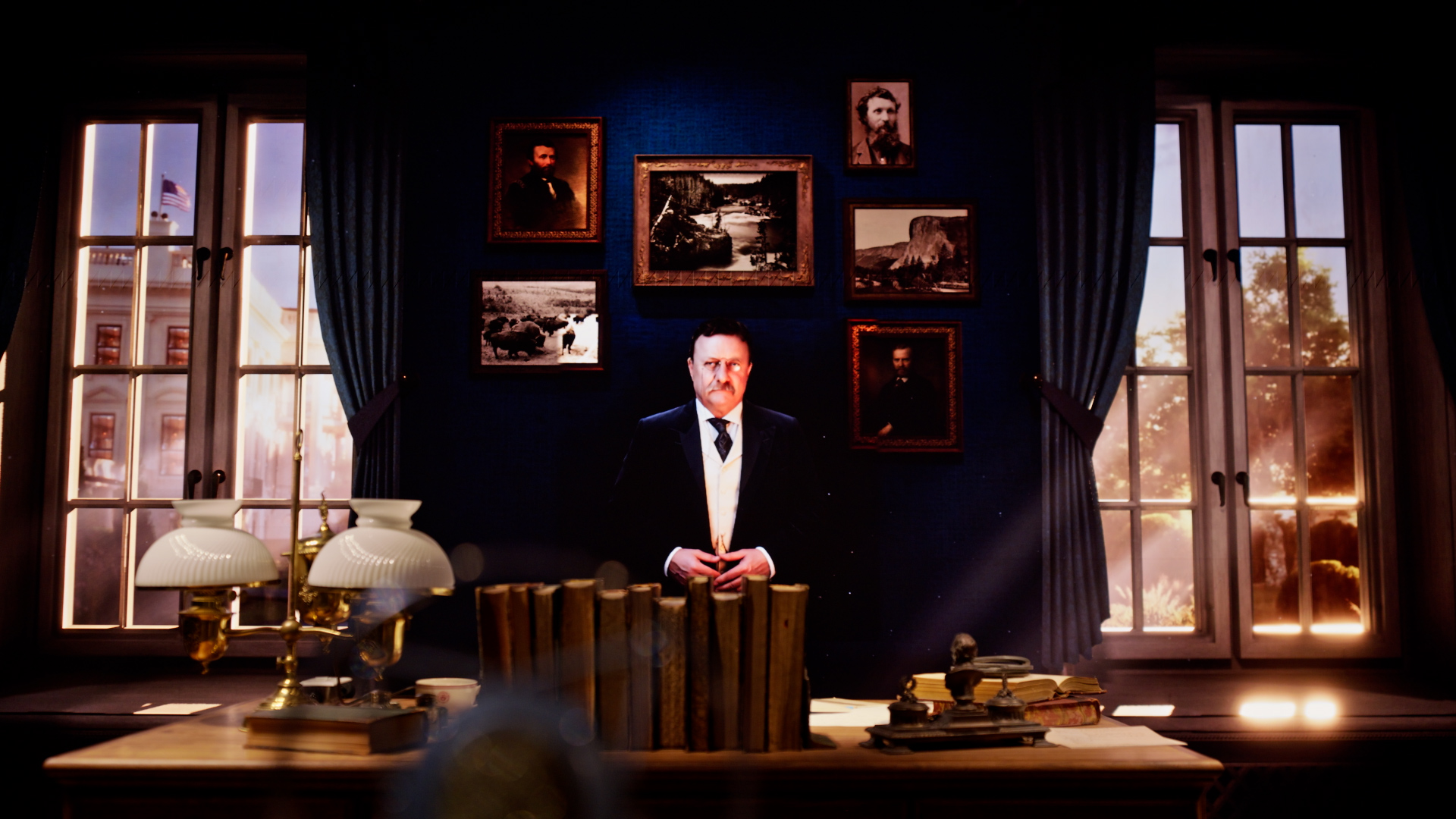
Imagine stepping into a rustic North Dakota library and striking up a casual conversation with the 26th president of the United States. Thanks to a groundbreaking collaboration between the Theodore Roosevelt Presidential Library in Medora and tech giant Microsoft, this surreal scenario has become a reality. Visitors can now interact with a lifelike, artificial-intelligence-powered avatar of Theodore Roosevelt that answers questions about his life, leadership, and legacy in real time. Beyond being a technical marvel, this digital resurrection serves as an emotional bridge across time, transforming passive historical education into a dynamic, two-way conversation that brings the past vividly into the present.
The power of this technology was recently put to the ultimate test when Pulitzer Prize-winning presidential historian Doris Kearns Goodwin visited the library. Goodwin, who spent a decade researching and writing about Roosevelt, was visibly moved to finally stand face-to-face with the man who occupied her thoughts for so many years. In a heartfelt moment, she confessed to the digital president, “I feel like I’ve lived with you for ten years of my life.” The avatar’s witty, spirited responses—delivered with Roosevelt’s trademark “rough rider” charm—perfectly captured the essence of a leader who vowed to go down fighting, leaving the seasoned biographer genuinely amazed by the depth of the interaction.
At the heart of this virtual reincarnation is a sophisticated knowledge engine called “Box 1,” built with the help of Microsoft’s AI for Good Lab. Rather than relying on simple scripts, the AI is fed hundreds of thousands of historical letters, archives, and personal documents. It organizes and reconstructs these fragmented materials into a unified, searchable database that allows the avatar to respond to complex inquiries with historically accurate context. Additionally, this technology powers “The Campfire Reading Room,” an open-access digital tool that allows curious minds and researchers worldwide to explore Roosevelt’s original writings from the comfort of their homes.
What makes this project truly revolutionary is its design as a “living library” that grows and learns over time. As more archival materials are unearthed and digitalized, they are uploaded directly into Box 1, automatically expanding the avatar’s vocabulary, memory, and depth of knowledge. Museum experts emphasize that keeping cultural institutions relevant to younger generations is an ongoing challenge, but this self-updating AI model ensures that the exhibit will never feel stagnant or outdated. It represents a new era of storytelling where history is not just preserved under glass, but constantly evolving to engage future generations.