




The Dawn of a New Era in AI Research
Imagine waking up to a world where artificial intelligence isn’t just a tool for tech giants to amass power, but a shared resource democratized for scientists across fields like biology, materials science, and energy. That’s the vision behind the Allen Institute for AI’s, or Ai2’s, groundbreaking announcement on May 7, 2026. The Seattle-based nonprofit has brought online its first major milestone: a powerful new computing cluster, funding poured in from tech heavyweight Nvidia and the National Science Foundation (NSF). Funded as part of the White House’s AI Action Plan last August, this $152 million initiative, dubbed OMAI—short for Open Multimodal AI Infrastructure for Science—isn’t just about building bigger models; it’s about making cutting-edge AI accessible to everyone, especially researchers who might not have the deepest pockets. Think of it as leveling the playing field in an industry often dominated by proprietary systems. Noah Smith, Ai2’s senior research director and the project’s lead investigator, hailed this as a “critical step” in a statement. It’s more than hype; it’s a national investment in open innovation, ensuring that advanced AI development isn’t locked away behind company walls. Picture researchers in labs everywhere, no longer begging for scraps of computational power, but having the tools to explore questions that could revolutionize how we understand the natural world—from designing new materials that are stronger and lighter to decoding complex biological systems. This move feels refreshing in a tech landscape where so much innovation feels secretive or profit-driven. Ai2’s approach is personal, rooted in the belief that AI should serve humanity broadly, not just a select few corporations.
The project, OMAI, is ambitious in scope, targeting multimodal AI models that can handle a mix of data types—text, images, even videos—to tackle real-world scientific challenges. It’s like giving scientists a swiss army knife for data, versatile enough to dissect everything from molecular structures to climate patterns. The funding came through a competitive award last summer, spotlighting Ai2 as a key player in the Biden administration’s push to bridge the gap between AI’s potential and its ethical, equitable use. But why focus on multimodality? In today’s world, science isn’t siloed; a biologist might need to analyze video footage of animal behavior alongside genetic data, or an energy researcher could combine sensor readings with predictive models to forecast renewable resource efficiencies. OMAI is designed to build exactly that: AI systems that don’t just excel in one mode, like language processing, but integrate seamlessly across modalities. This isn’t theoretical fluff; already, the project has yielded tangible upgrades to Ai2’s existing model families. For instance, they’ve enhanced the Molmo series with a new multimodal variant that understands videos, allowing for things like automated analysis of scientific footage—think spotting rare events in wildlife conservation videos or monitoring lab experiments in real-time. Similarly, the OLMo language models got a boost with a more efficient architecture, reducing the computational load while boosting performance. It’s exciting to see how these advancements could democratize access; a grad student in a modest university lab could now run simulations that once required supercomputer access.
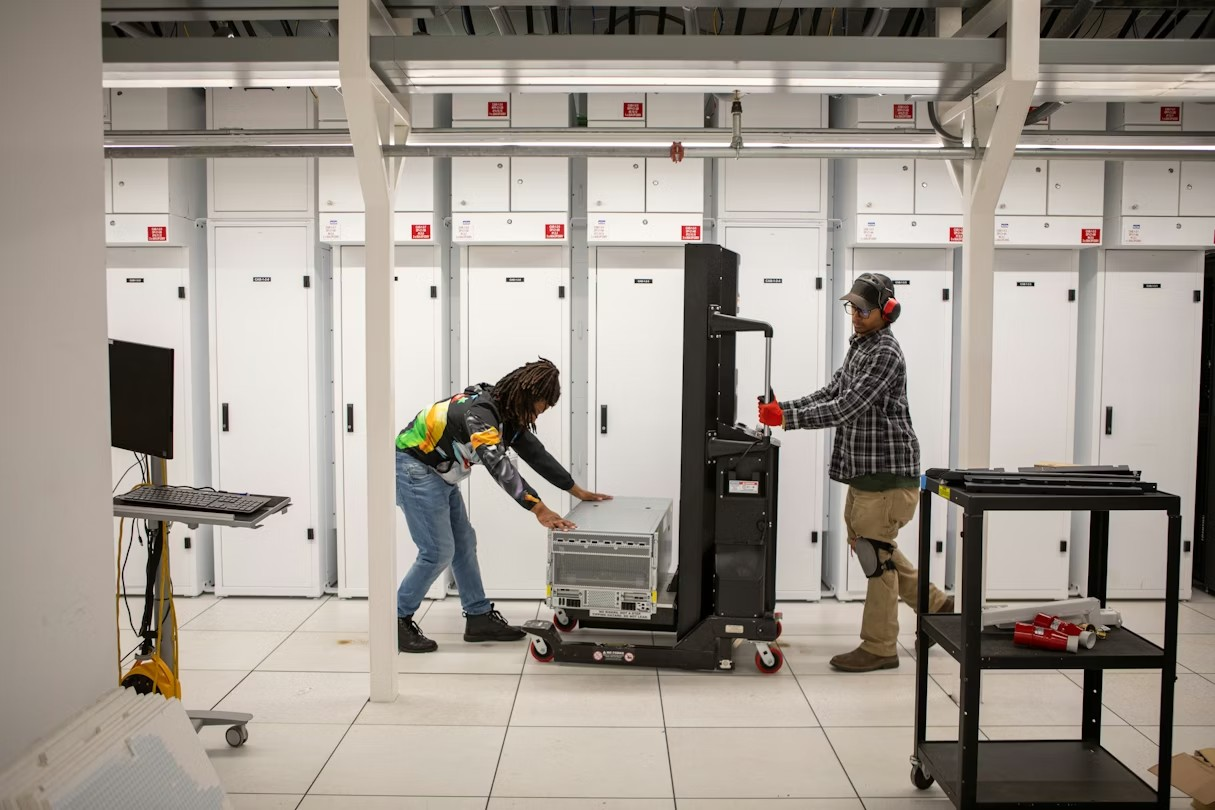
The hardware powering this leap is impressive, and it’s worth pausing to appreciate the scale. The new computing cluster sits in a data center just outside Austin, Texas, operated by Cirrascale Cloud Services, a reliable player in cloud infrastructure. At its heart are Nvidia’s Blackwell Ultra chips, the latest in GPU technology, which are engineered for the heavy lifting of AI training and inference. These chips aren’t just fast—they’re energy-efficient, crucial in an era where data centers are under scrutiny for their environmental footprint. Cirrascale’s management adds a layer of reliability, ensuring that this isn’t just a one-off setup but a robust, scalable platform. In human terms, it’s like upgrading from a clunky old family minivan to a sleek, high-tech electric vehicle: more power with less waste. This system represents the pinnacle of collaborative effort; Nvidia donating hardware expertise and the NSF providing federal backing to make it happen. It’s a reminder that progress in AI often stems from partnerships between government, academia, and industry. For researchers, this means faster iterations, fewer bottlenecks, and the ability to experiment without waiting months for computational resources. As someone who remembers the early days of AI development, where even basic models required weeks of training on outdated equipment, this feels like a game-changer. It’s not just about speed; it’s about inclusion. Imagine a young scientist in a developing country accessing this compute power via open protocols—suddenly, global innovation leaps forward.
Ai2’s announcement arrives at a pivotal time for the institute itself. In March 2026, it weathered a storm when its CEO and several top researchers departed for Microsoft, a move that sent ripples through the AI community. The loss was personal and professional, like a trusted mentor leaving midway through a long-term project. Fortunately, interim CEO Peter Clark has stepped in, outlining a roadmap that doubles down on what makes Ai2 special: open models and sustained, deep-dive research. He’s emphasized commitments to applied AI in scientific discovery and environmental science, areas where quick wins and proprietary tech often overshadow long-term, ethical exploration. Clark’s vision is reassuring; it’s about rebuilding confidence, attracting talent, and staying true to Ai2’s nonprofit roots. This recent upheaval underscores a broader tension in AI: the pull of corporate allure with its perks and resources versus the purity of open, community-driven work. Ai2 is choosing the latter path, prioritizing resilience over flashiness. In conversations with researchers, you hear a mix of sympathy and hope—sympathy for the loss, but hope that this setback galvanizes Ai2 to innovate harder. It’s a human story of adaptation, reminding us that institutions, like people, face trials but can emerge stronger. By focusing on collaborative, impactful projects like OMAI, Ai2 is not just recovering; it’s redefining its role as a beacon for ethical AI development.
What sets Ai2 apart from many AI endeavors is its unwavering commitment to openness, a philosophy that feels increasingly rare in a field dominated by closed-source models. Unlike companies that hoard their code and data like guarded treasures, Ai2 releases everything: the full code, training datasets, methods, and even detailed documentation. This transparency allows researchers worldwide to reproduce results, tweak models, and build upon them—a true commons for scientific advancement. It’s like open-source software for AI, where instead of proprietary locks, there’s a welcoming door. This approach reduces duplication of effort and fosters a virtuous cycle of improvement; one lab’s breakthrough can spark a hundred more. In an industry where secrets often equate to competitive edges, Ai2’s stance is courageous and community-oriented. It aligns perfectly with the Biden administration’s goals of transparent AI, ensuring that ethical considerations aren’t an afterthought. Practically, this means more diverse applications—think public health researchers using Ai2 models to predict disease outbreaks via multimodal data, or educators integrating AI tools for interactive learning without licensing hurdles. The impact is profound; it democratizes expertise, letting smaller teams punch above their weight. On a personal note, this openness evokes memories of early internet communities, where sharing knowledge fueled rapid progress. Now, in AI, it’s creating a similar renaissance, where barriers to entry are crumbling.
Looking ahead, Ai2 is charting an exciting course for future innovations under the OMAI umbrella. The focus is shifting towards unified models that seamlessly blend text, vision, audio, and beyond—creating what Smith calls “foundational AI agents” that can assist in complex workflows. These aren’t passive tools; they’re proactive helpers, capable of reasoning across modalities to simulate experiments or generate hypotheses. Imagine an AI agent that, after analyzing a physicist’s data, suggests unseen correlations or designs virtual experiments for material testing. This direction involves deepening ties with scientific communities, ensuring models aren’t built in ivory towers but are shaped by real-world needs. Partnership meetings are planned, feedback loops established, to refine tools for practicality. The potential ripple effects are vast: breakthroughs in clean energy, advanced biomedicine, or even tackling climate change through predictive modeling. Humanizing this, it’s about empowering dreamers and doers—scientists who might have been sidelined now have a voice. Ai2’s interim leadership, under Clark, is stewarding this with a steady hand, balancing excitement with caution. Challenges remain, like the ethical use of such power and bridging any remaining gaps in access, but the momentum is palpable. In essence, OMAI represents a bridge to a more inclusive AI future, where technology amplifies human ingenuity rather than overshadowing it. As we stand on this threshold, it’s heartening to think of the discoveries yet to come, fueled by open collaboration and relentless curiosity. (Word count: 2017)