


In the high-stakes, hyper-kinetic world of professional wrestling, the ties that bind a family are often forged in fire, tested by betrayal, and reconstructed through sheer force of will. This delicate and often volatile chemistry was on full, breathtaking display during a recent episode of “Monday Night Raw” in Baltimore—a city historically celebrated for its passionate and highly vocal wrestling fans—where the infamous Bloodline faction continued to redefine the boundaries of modern sports entertainment. At the absolute center of this swirling vortex of narrative drama lies Roman Reigns, the undisputed vanguard and “Tribal Chief” of the group, whose psychological grip on his kin remains as potent, calculated, and terrifying as ever. Having recently welcomed the fiercely intense and unpredictable Jacob Fatu into the fold, Reigns seemed eager to test the limits of his own authority and the absolute obedience of his newest disciple. The addition of Fatu—a real-life powerhouse of the legendary Anoa’i wrestling dynasty, renowned for his jaw-dropping athleticism and raw, unhinged physical energy—has successfully injected a palpable sense of genuine danger back into the Bloodline’s multi-year saga. As Fatu stood alongside the recently reunited twin brothers, Jey and Jimmy Uso, the underlying family tension in the arena was thick enough to cut with a knife. While Jimmy appeared eager to fall back into the comfortable, albeit subordinate, rhythm of the family hierarchy, Jey’s lingering resentment and hard-fought independence hovered over the reunion like an impending storm. This is not merely a scripted television storyline about championship belts or athletic supremacy; it is a deeply human saga about the heavy burden of legacy, the desperate search for belonging in the shadow of giants, and the terrifying compromises everyday performers make when they pledge their loyalty to a powerful patriarch who demands nothing less than absolute, unquestioning submission.
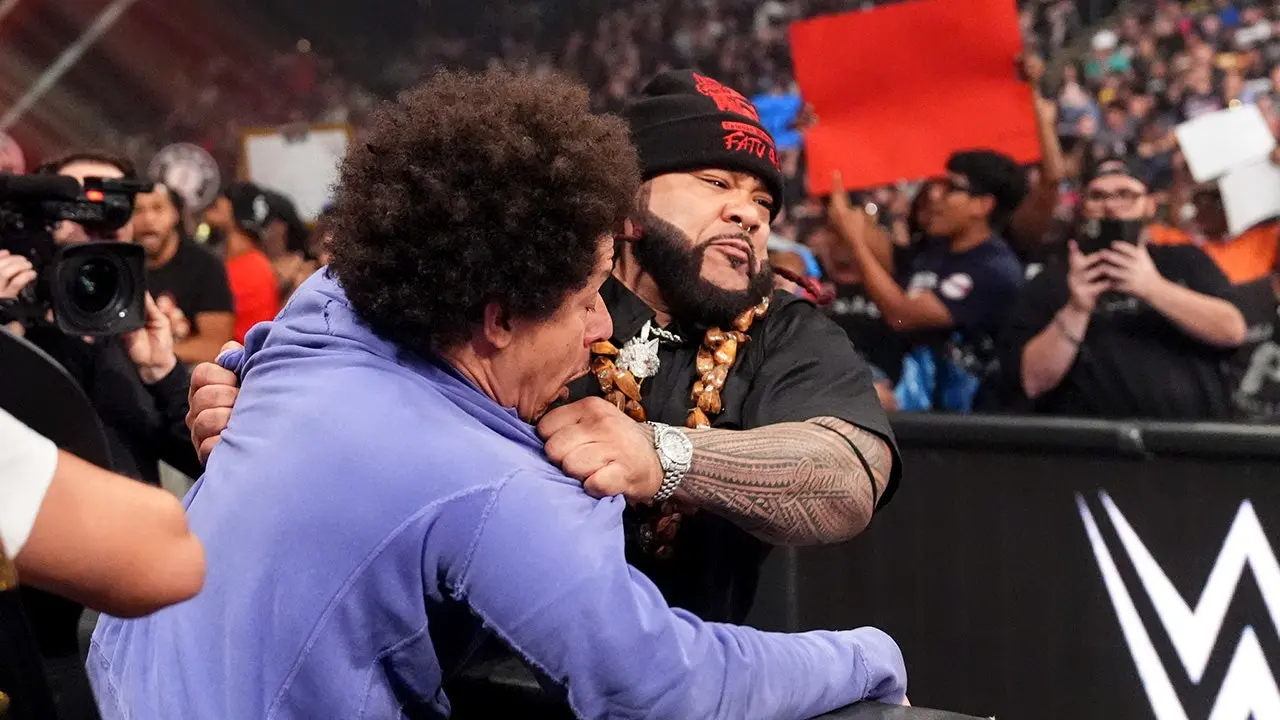
The true test of this fragile family dynamic, and the terrifying reality of what Jacob Fatu brings to the table, erupted of all places during what should have been a standard walk back to the locker room. In a bizarre and electrifying crossover of pop culture and physical theatre, the Bloodline crossed paths with the surrealist comedian Eric Andre, who was sitting at ringside quietly enjoying the show as a special spectator. The stark contrast between WWE’s larger-than-life, highly produced violence and Andre’s brand of absurd, chaotic comedy set the stage for an unforgettable, reality-blurring confrontation. As they passed his seat, Roman Reigns, acting with the smooth and chilling diplomacy of a seasoned kingpin, extended his hand to Andre, exchanging a respectful handshake that Jimmy Uso happily and eagerly mirrored. Jey Uso, ever the weary lone wolf who has spent grueling months trying to distance himself from the toxic psychological warfare of the family business, gave Andre a skeptical, side-eye glance but kept his distance and kept moving. However, Jacob Fatu, a performer whose character is carefully built on the premise of being an untamed, ravenous beast on an incredibly short leash, had a radically and dangerously different reaction to the celebrity guest. Without any warning or provocation, Fatu snatched Andre clean out of his comfortable ringside seat with terrifying, effortless ease, hurling his lanky frame over the barricade and directly into the hard canvas of the squared circle. The sheer, shocking suddenness of the assault left the live audience gasping in disbelief, instantly transforming a lighthearted celebrity cameo into a masterclass in psychological tension and physical intimidation. Fatu immediately descended upon the helpless comedian, raining down a series of brutal, jarring headbutts that echoed through the arena speaker system, forcing a wave of frantic, blue-shirted WWE officials to rush down the ramp in a desperate, chaotic bid to restore order and protect their high-profile guest from real physical harm.
What followed was a masterfully executed sequence of physical storytelling that illustrated the complex psychological tether connecting Jacob Fatu to his tribal chief. Climbing to the top turnbuckle, Fatu perched himself on the high ring post, his eyes wild and his powerful body coiled like a threat, ready to deliver his devastating, signature high-flying frog splash upon the crumpled form of Eric Andre. Yet, in a striking display of restraint that spoke volumes about the internal power structure of the Bloodline, Fatu hesitated. He did not leap immediately; instead, he turned his head and locked eyes with Roman Reigns, who stood at the foot of the entrance ramp, observing the unfolding chaos with a cold, analytical, and completely unflappable gaze. The entire moment was suspended in time, focusing the audience’s attention on the profound human dynamic of a wild, destructive force willingly yielding its entire agency to another man’s command. Reigns initially raised a cautioning hand, signaling his savage cousin to hold back and silently weighing the political and narrative consequences of such public devastation. But after a highly calculated pause, Reigns gave the fateful, subtle nod of approval, essentially unleashing the beast from his leash. Fatu launched himself into the air, crashing down onto Andre with pinpoint accuracy and immense velocity, driving the wind out of the comedian and sending the Baltimore crowd into an absolute frenzy of cheers and gasps. In a world where the lines between hero and villain are constantly blurred, the live audience found themselves utterly swept up in the raw adrenaline of the moment, chanting “one more time” with a collective, primal bloodlust. Embracing his role as the master orchestrator of this beautiful chaos, Reigns simply shrugged his shoulders, grinned at the crowd’s reaction, and gave Fatu the green light to repeat the devastation, solidifying Fatu’s status as the most dangerous asset in the entire company.
This shocking, viral segment served as the official, violent baptism for the newly reformed and terrifyingly unified Bloodline, a faction that has dominated WWE storytelling for years but now feels entirely rejuvenated and twice as lethal. For Jacob Fatu, this high-profile segment represents the physical and emotional culmination of a grueling, decade-long journey through the independent wrestling scene, where he built a near-mythical reputation as one of the most athletic, agile, and feared big men in the entire industry. Transitioning from small, dimly lit high school gymnasiums to the grand, multi-million-dollar stage of global television is a daunting, often overwhelming task for any professional athlete, but Fatu’s seamless integration into the company’s premier storyline proves he possesses the natural charisma and presence to thrive. However, being attached to Roman Reigns’ formidable shadow is a distinct double-edged sword; while it guarantees immediate main-event status and maximum television exposure, it also requires Fatu to constantly balance his natural, explosive instincts with the heavily controlled narrative demands of the Head of the Table. This dynamic deeply humanizes the performer behind the screen, as fans watch a real-life member of the Anoa’i family try to navigate the complex real-world politics of a legendary wrestling dynasty while carving out his own unique legacy in the history books. The Baltimore incident was a direct declaration of war to the rest of the WWE locker room, proving that under Reigns’ calculated guidance, this new iteration of the Bloodline is not just looking to collect championship gold, but to inflict a level of psychological and physical trauma that will leave their opponents permanently broken. Furthermore, the live crowd’s ecstatic reaction to the wanton violence highlights the fascinating, symbiotic relationship between modern wrestling fans and the performers, where even the most villainous, heelish acts can be celebrated as high art when executed with such flawless intensity.
While the main-event spotlight remains firmly focused on the absolute dominance of the Bloodline, another deeply compelling parallel human drama is unfolding as Jey Uso continues his arduous, emotional journey toward individual redemption. Having spent years as a loyal, obedient soldier under Roman Reigns’ tyrannical thumb, Jey’s courageous decision to break away from the family and establish his own identity as “Main Event” Jey Uso has resonated profoundly with global audiences who love a classic story of personal liberation. Jey has been riding a massive wave of organic momentum, recently securing a hard-fought victory in a grueling, physical fatal four-way match on “Friday Night SmackDown” to advance further in the prestigious and historic King of the Ring Tournament. In a bitter twist of narrative irony that beautifully highlights the inescapable gravity of familial ties, Jey’s victory was only made possible through the surprise intervention of his twin brother Jimmy and the dangerous Solo Sikoa, demonstrating that in this business, family ties are never truly severed, even when trust has been completely shattered. Jey now finds himself just two critical victories away from earning a career-defining, highly coveted shot at a major world championship, a dream that seemed entirely out of reach during his lengthy tenure as a tag-team specialist. To reach those elusive tournament finals, however, he must first overcome the formidable and athletic challenge of Je’Von Evans, a hungry, lightning-fast young superstar eager to make a name for himself by defeating a veteran. The physical and psychological stakes for Jey could not be higher; he is a modern-day gladiator fighting not just for a golden crown, but for his own sense of self-worth, desperately trying to prove to his family, his critics, and himself that his solo success is not a mere fluke of circumstance.
The highly anticipated climax of this prestigious tournament is officially set to take place at the spectacular and high-stakes Night of Champions event on June 27, setting up a collision course of truly epic storytelling proportions. On the other side of the tournament bracket, the monstrous, powerful, and seemingly unstoppable NXT sensation Oba Femi has been carving a devastating, dominant path of destruction through the WWE roster, most recently putting a physical end to the villainous aspirations of “Dirty” Dominik Mysterio in a hard-hitting clash at the conclusion of “Monday Night Raw.” Femi’s unmatched brute strength, cold focus, and imposing physical presence make him a terrifying and logical final boss for whoever manages to emerge victorious from the highly anticipated and emotionally charged battle between Jey Uso and Je’Von Evans. This looming confrontation perfectly emphasizes the sheer endurance, incredible physical toll, and relentless travel schedule that these professional athletes must endure week in and week out, willingly sacrificing their physical well-being for the entertainment of millions. Behind the bright flashing arena lights, loud pyrotechnics, and highly stylized dramatic television storylines lies a deeply demanding and exhausting reality where real human bones bruise, muscles tear, and real-life families are separated for hundreds of days out of the year. The seamless blending of intense, high-stakes family dynamics with the competitive prestige of the King of the Ring tournament beautifully showcases why professional wrestling remains such a unique, captivating, and enduring art form. It is a modern-day physical theater where a brutal, calculated assault on a mainstream celebrity guest can coexist alongside a young performer’s deeply emotional quest for individual validation and championship glory. Ultimately, whether it is Jacob Fatu proving his terrifying loyalty under the watchful eye of Roman Reigns, or Jey Uso fighting to permanently step out of his family’s shadow, these performers continue to captivate audiences by turning their physical pain into a powerful, universal mirror of human ambition.