


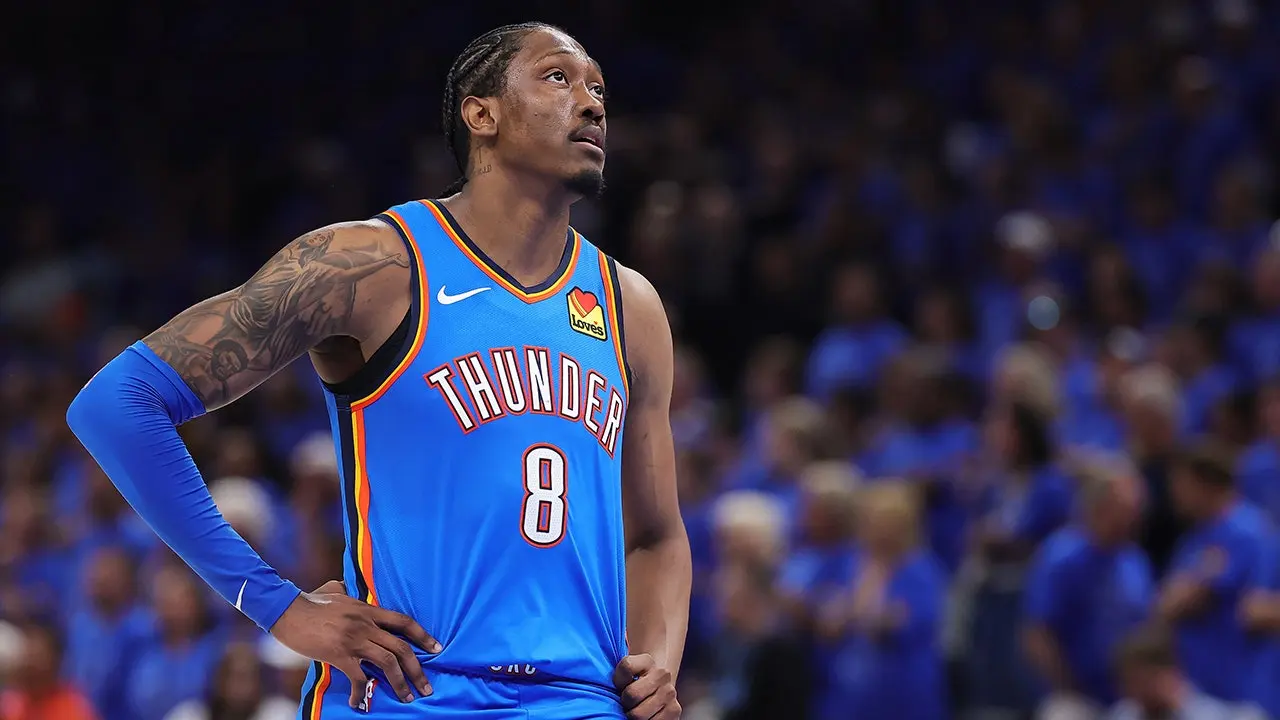
There is no phrase in the lexicon of professional sports that carries the same weight, the same goosebump-inducing gravity, as “Game 7.” It is the ultimate crucible, a basketball purgatory where seasons are either immortalized in glory or abruptly extinguished in heartbreak. Yet, as the Oklahoma City Thunder prepare to step onto the hardwood for this definitive showdown, the electric anticipation echoing through the arena is tinged with a profound sense of melancholy. The devastating announcement that star guard Jalen Williams has been officially ruled out for Saturday’s winner-take-all clash due to a persistent hamstring injury has sent shockwaves through the fan base and the locker room alike. For Williams, this is not merely a medical update on an injury report; it is a deeply personal tragedy. To work an entire lifetime for a moment of this magnitude, to endure the grinding monotony of rehabilitation, and to finally stand on the precipice of the NBA Finals, only to have one’s own body rebel at the absolute worst moment, is a psychological torture unique to elite athletes. The Thunder must now adjust their sails in the midst of a perfect storm, facing the daunting task of overcoming a relentless San Antonio Spurs squad without one of their primary offensive catalysts and emotional anchors. This is the cruel, unyielding reality of professional basketball: the show must go on, even when one of its brightest stars is forced to watch from the sidelines in street clothes, harboring the silent agony of what might have been, while his teammates carry the heavy burden of his absence onto the court. Williams’ absence shifts the entire tactical geometry of the series, forcing coach Mark Daigneault to reimagine his rotations on the fly, while demanding that the remaining roster tap into a reservoir of resilience they haven’t yet had to access.
The trajectory of this injury reads like a Shakespearean tragedy of athletic ambition, marked by brief glimmers of hope quickly snuffed out by the unforgiving physics of the human body. It all began during the high-stakes crucible of Game 2, a night when the Thunder secured a commanding 122-113 victory but paid a prospective price that would only become clear in the days to follow. Williams, explosive and dynamic, appeared to aggravate his left hamstring mid-stride, a sudden restriction of motion that immediately set off alarm bells for the medical staff. What followed was an agonizing waiting game; the guard was sidelined for the next three contests, pacing the sidelines in a state of restless energy, desperately trying to wish his muscles back into cohesion. When Game 6 arrived, with the series hanging in a delicate balance, Williams made the heroic, albeit high-risk, decision to test his limits, stepping onto the floor for a brief, ten-minute cameo off the bench. Yet, those ten minutes were a stark, painful reminder of the limitations of sheer willpower. He was visibly compromised, unable to find his signature burst of speed or lateral quickness, as the Spurs capitalized on the Thunder’s vulnerability to secure the win and force this decisive seventh game. The image of Williams limping back to the bench, his head bowed, spoke volumes about the internal war waged between an athlete’s competitive spirit and the biological limits of flesh and bone. The hamstring is a notoriously fickle muscle, requiring patience and progressive loading—two luxuries that the accelerated timeline of the NBA playoffs simply does not afford. By bypassing the traditional, step-by-step return-to-play protocols that would normally govern a player’s recovery during the low-stakes environment of the regular season, Williams put his long-term health on the line for a fleeting chance to help his brothers in arms. That his body ultimately forced a shutdown ahead of Game 7 is not a failure of resolve, but rather a somber assertion of physical reality over human desire.
In the wake of this devastating diagnosis, Thunder head coach Mark Daigneault emerged not just as a strategist, but as a protective guardian of his player’s spirit and reputation. Addressing the media with a mixture of solemnity and immense pride, Daigneault laid bare the emotional reality of Williams’ desperate attempt to play through the pain. “He’s obviously not 100%,” Daigneault remarked, his voice carrying the weight of a coach who hates to see his players suffer. The coach went on to applaud the young guard’s extraordinary bravery, highlighting the mutual uncertainty that clouded his return in Game 6, noting that neither he nor Williams truly knew what to expect when they decided to give it a try. Daigneault’s words painted a vivid picture of a team culture built on sacrifice and deep mutual trust, explaining that they sought to place Williams in an “insulated role” just to see if his mere presence and basketball IQ could provide a spark. To Daigneault, Williams is not just a statistical contributor but an “All-Star player, an All-NBA player,” whose value transcends the box score. The coach pointedly reminded reporters that Williams had bypassed the rigorous, weeks-long rehabilitation protocols of the regular season out of a pure, unadulterated desire to help Oklahoma City cross the finish line. By asserting that Williams was “certainly not the reason we lost” Game 6, Daigneault shielded his wounded star from the inevitably harsh spotlight of public criticism, cultivating an environment where Williams’ sacrifice was honored rather than questioned. This public display of solidarity underscores the profound human bond that exists within this Thunder squad, where players are valued as human beings first and assets second. It is a testament to Daigneault’s leadership that in the face of immense pressure, his primary instinct was to validate his player’s character. In a sports culture that often views athletes as commodities to be consumed and discarded, Daigneault’s heartfelt defense of Williams reminds us that behind the multi-million dollar contracts and the bright arena lights, these are young men fighting through immense physical and emotional hurdles for the love of the game.
To truly understand the depth of Williams’ current frustration, one must look back at the arduous journey he traveled just to reach this point in his career. Last offseason, while many of his peers were enjoying the fruits of their labor, Williams was recovering from major surgery to repair a severely damaged wrist—an injury that threatened to derail his momentum after a sensational run to the NBA Finals the year prior. That magical Finals run had elevated Williams to national prominence, establishing him as a cornerstone of Oklahoma City’s bright future. Yet, the physical toll of that deep postseason run, followed by the immediate necessity of surgical intervention, set the stage for a tumultuous and fragmented regular season. Williams was limited to appearing in just 33 regular-season games this year, a frustratingly stop-and-start campaign that tested his mental fortitude as much as his physical endurance. Every time he seemed to find his rhythm, another setback pushed him back to the training room, turning this season into a grueling marathon of rehabilitation. Despite these persistent hurdles, his impact when healthy was undeniable, serving as the engine that drove the Thunder’s offense and the versatile defender who anchored their perimeter. To have his body falter once again, on the brink of another potential trip to the sport’s grandest stage, feels like a cruel twist of fate for a player who has spent the last twelve months doing nothing but fighting his way back to full health. The mental exhaustion of constant injury rehab cannot be overstated; it is a lonely, agonizing process of performing repetitive exercises in quiet gymnasiums while watching your teammates bond on the court. Williams had fought through all of that, pushing past the pain of his recovering wrist, only to be betrayed by a completely different muscle group just as the stakes reached their absolute peak. It is a stark reminder of the fragile nature of athletic careers, where a split-second movement can erase months of hard work and leave a player stranded on the bench at the exact moment they are needed most.
The battle lines for Saturday’s game are drawn in the dust of a fierce and unrelenting rivalry with the San Antonio Spurs, a franchise that has historically stood as a gatekeeper in the Western Conference. Without Jalen Williams in the lineup, the Thunder find themselves in a tactically compromised position, forcing them to confront a Spurs team that is smelling blood in the water. San Antonio’s coaching staff will undoubtedly look to exploit the void left by Williams’ absence, restructuring their defensive schemes to put immense pressure on Oklahoma City’s remaining playmakers, most notably Shai Gilgeous-Alexander. The challenge for Coach Daigneault will be to find a combination of bench players who can replicate even a fraction of Williams’ multi-faceted production, whether through hot perimeter shooting or gritty, lock-down defense. Game 7s are rarely pretty; they are defensive rock fights characterized by high anxiety, physical exhaustion, and the heavy atmosphere of elimination. For Oklahoma City, the psychological hurdle of playing without their emotional focal point is just as daunting as the physical challenge on the court. The Thunder will need to summon a collective effort, a “next man up” mentality that is easy to preach but incredibly difficult to execute under the blinding lights of a national broadcast. It is in these moments of extreme adversity that unexpected heroes are born, and the Thunder’s young roster must now dig deep into their collective soul to write a triumphant chapter to a story that has suddenly become incredibly complicated. The Thunder’s home-court advantage will play a critical role, as the rowdy Oklahoma City faithful will need to act as a sixth man, injecting energy into a tired roster that is missing one of its vital organs. Every possession will be contested, every loose ball will be a battleground, and the absence of Williams means that there is absolutely no margin for error. If the Thunder are to survive this onslaught, they must play with a level of cohesion and desperation that honors the sacrifice of their fallen brother.
Hovering over this intensely dramatic Western Conference finale is the giant, waiting shadow of the ultimate prize: a trip to the NBA Finals to face the formidable New York Knicks. The Knicks, representing the historic basketball capital of the world, have experienced a historic resurgence of their own, snapping an agonizingly painful, nearly three-decade-long Finals drought in spectacular fashion by sweeping the Cleveland Cavaliers in the Eastern Conference finals. This dominant, sweeping display has allowed New York to rest, heal, and meticulously dissect tape of whoever manages to crawl out of the grueling, blood-soaked battle in the West. It is a classic contrast of postseason conditions; while the Knicks await their next opponent with fresh legs, aligned strategies, and a clear head, either the Thunder or the Spurs will emerge from Saturday’s Game 7 bruised, battered, and emotionally spent. Yet, for Oklahoma City, any thoughts of Madison Square Garden, championship rings, or facing the hot-shooting Knicks on the sport’s grandest stage must be forcefully put on hold for forty-eight minutes of pure athletic survival. Professional sports, at their absolute core, are beautiful because they are entirely unscripted, and they are painful because they are deeply, undeniably human. Jalen Williams’ devastating absence is a sobering, quiet reminder that behind the clinical statistics, the jaw-dropping highlights, and the multi-billion dollar business machine of the NBA, there are real human spirits navigating the delicate, sometimes tragic dance between physical greatness and biological vulnerability. Whether the Thunder manage to triumphantly overcome his absence to punch their ticket to the Finals, or fall just short of the mountaintop in front of their home crowd, Saturday’s Game 7 will stand as a timeless monument to the unpredictable, agonizing, and utterly captivating nature of the game we love, played by men who give everything they have until there is simply nothing left to give.