



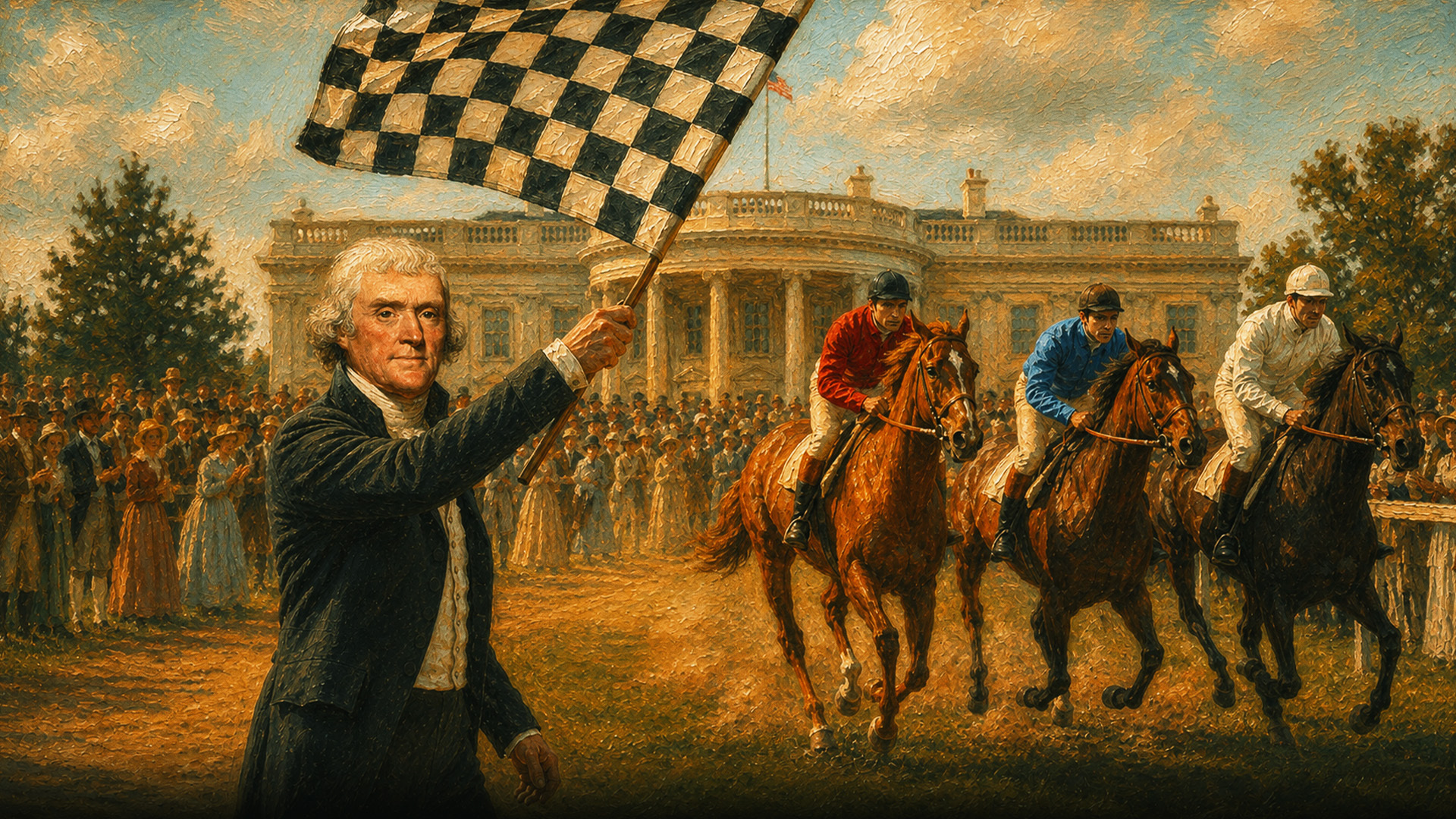
For over two centuries, the heart of American democracy has pulsed with more than just political debate and legislative maneuvering; it has also thundered with the hooves of horses and, in the modern era, the deafening roar of internal combustion engines. The upcoming Freedom 250 Grand Prix in Washington, D.C., is not a novel concept born of the 21st century’s obsession with spectacle, but rather a grand reprise of a tradition that is as old as the nation itself. On July 4th, 1801, a full 225 years before the modern race is set to hit the streets, President Thomas Jefferson helped orchestrate a celebration of America’s 25th birthday that was wild, raucous, and deeply rooted in the equestrian world. While the modern era is treated to the high-tech, carbon-fiber speed of IndyCar machines reaching over 200 miles per hour, the early republic celebrated with the primal speed of thoroughbreds. According to historical accounts, the Washington Jockey Club established a racecourse just a few blocks from the executive mansion, with a portion of the track actually running directly across Pennsylvania Avenue and winding through what is now the serene Lafayette Square, a place usually associated with protests and presidential photo opportunities rather than flying dirt and frenzied betting.
Jefferson’s 1801 festival was a far cry from the polished, multi-million dollar production that will grace the nation’s capital this summer. It began at daybreak, with the northern grounds of the President’s Park awakening to the clatter of workers raising tents and wooden booths. Within hours, crowds swelled, transforming the landscape into a bustling, chaotic carnival. The air was thick with the smell of roasting meats, the sweetness of cider, and the exhaust of a populace eager to celebrate their fledgling independence. Vendors peddled food, drink, and a dizzying array of “cottage goods,” while the thunder of hooves on the dirt track competed with the fife-and-drum cadence of the Washington Militia parading through the throngs. It was a spectacle of the people, for the people—a raw, unfiltered demonstration of early American joy. What is perhaps most human and endearing about this historical anecdote is that after the dust had settled and the races concluded, Jefferson, the architect of the Declaration of Independence, opened the doors of the White House to any and all attendees. He didn’t retreat to a private box or isolate himself with the elite; instead, he invited the sweaty, cheering masses inside for a reception, establishing an annual tradition of White House hospitality that would persist throughout the nineteenth century. This was not just a presidential appearance; it was a societal glue, a moment where the leader of the nation sat amongst the citizens, sharing in the collective pride of a self-governing experiment.
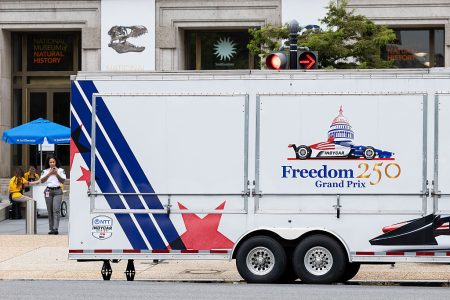
This historical context reveals that Donald J. Trump’s announcement of the Freedom 250 is not merely a publicity stunt or a fleeting political gesture, but rather a conscious or subconscious revival of a presidential legacy that celebrates kinetic energy and national pride. As the 47th President of the United States, Trump is bringing a 250-mile, 147-lap spectacle to Washington, D.C., specifically to commemorate the nation’s 250th birthday. Standing at a showcase on July 13th, flanked by “extraordinary figures in the history of motorsports,” Trump declared that this event would be “like no other race, ever,” exuding the bombast and confidence that has come to define his political and public persona. The audacity of the claim is matched by the ambition of the project. The Freedom 250 Grand Prix of Washington, D.C., is historic because it marks the very first time the NTT IndyCar Series—the pinnacle of American open-wheel racing—has ever held a race in the nation’s capital. The logistics are staggering; transforming the hallowed, marble-laden streets of the National Mall into a temporary race circuit is an engineering feat that requires closing major arteries, erecting massive safety barriers, and coordinating with federal security agencies in a post-9/11 world. Yet, the organizers have succeeded, and the course, while not crossing the actual White House lawn, will snake its way along the iconic Pennsylvania Avenue, sweep past the Constitution Avenue corridor, and race directly in the shadow of the towering Washington Monument.
The juxtaposition of these two presidential events—Jefferson’s dusty horse track and Trump’s high-tech asphalt circuit—highlights the evolution of American entertainment, yet the underlying ethos remains identical: a celebration of skill, endurance, and the unyielding American spirit. This summer, the Freedom 250 is not an isolated event; it is paired with the UFC Freedom 250, creating a combat and motor sports weekend that essentially turns the national capital into a massive sporting arena. This move signals a shift in how the highest office perceives its role in cultural stewardship. In the early republic, Jefferson viewed the White House as a literal extension of the public square, a place to host the masses. In the modern context, the White House and its surrounding federal district are being leveraged as a global stage to broadcast American strength and technological prowess. The construction of the course itself is a marvel of modern engineering. Unlike the permanent infrastructure of a facility like Indianapolis Motor Speedway, the Washington D.C. circuit is a temporary ribbon of asphalt laid down weeks beforehand, requiring meticulous planning to ensure the surface is smooth enough for the razor-sharp underbodies of the cars. Crews must navigate the complex choreography of installing pit garages, media centers, and grandstands all while respecting the architectural sanctity of the National Mall—a delicate dance between speed and history.
When the green flag waves at 1:13 p.m. ET on Sunday, August 23rd, (with the FOX pre-race show kicking off at 11:30 a.m. ET), the drivers themselves enter a high-stakes crucible fraught with uncertainty. Because this is the inaugural race on this specific circuit, no one holds the distinct advantage of previous experience or data logs from years past. It is a level playing field, a leap of faith into the unknown that will rely purely on raw instincts, quick adaptation, and the drivers’ ability to memorize a course that is unforgiving, lined by concrete walls just inches from their tires. This unpredictability adds immense pressure to a championship fight that is currently reaching its boiling point. The reigning points leader and current master of the discipline, Alex Palou, enters the race with a formidable 542 points, a commanding lead that allows him a slight cushion of confidence. However, his margin for error is shrinking as the season winds down. While Palou appears to be cruising, the battle behind him is a white-knuckle war of attrition. The fight for second place is agonizingly close, with Kyle Kirkwood (409 points), David Malukas (405), and Christian Lundgaard (403) separated by a mere six points. For these three, the Freedom 250 represents a potential seismic shift in the championship standings. A single mistake, a mechanical failure, or a collision on the tight, walled street circuit could be the difference between a podium finish and a catastrophic points loss, completely altering the trajectory of their seasons.
In many ways, this race is the perfect metaphor for the American journey itself—a chaotic, exhilarating, and dangerous path toward a goal, marked by striking victories and devastating defeats. The human element is the beating heart of this event. The crews that will spend sleepless nights adjusting suspension settings on the cold asphalt; the drivers who will spend hours walking the 1.7-mile grid, studying every bump and every curve; and the fans who will press their faces against the barriers, absorbing the heat and the smell of burning rubber—all of these people are reenacting the enthusiasm of those who crowded into Jefferson’s tent city back in 1801. The craftsmanship of the racecars, the psychological endurance required to maintain focus for 147 laps of heavy braking and high G-forces, and the sheer physical toll it takes on the human body, speaks to a universal pursuit of excellence. As the sun sets over the Washington Monument on August 23rd, the echoes of the roaring engines will fade, but the legacy will endure. Just as Jefferson’s 1801 races became a touchstone for early 19th-century celebrations, the Freedom 250 is poised to become a permanent fixture, a modern-day tradition where the craziest, fastest spectacles of the 21st century are held within sight of the Capitol dome. It is a reminder that democracy, at its core, is not just about laws and constitutions; it is about gathering together, feeling the collective excitement, and celebrating the freedom to push boundaries, speed forward, and chase glory—whether on a dusty dirt path or a gleaming, high-tech asphalt ribbon cutting through the historic center of the free world.