


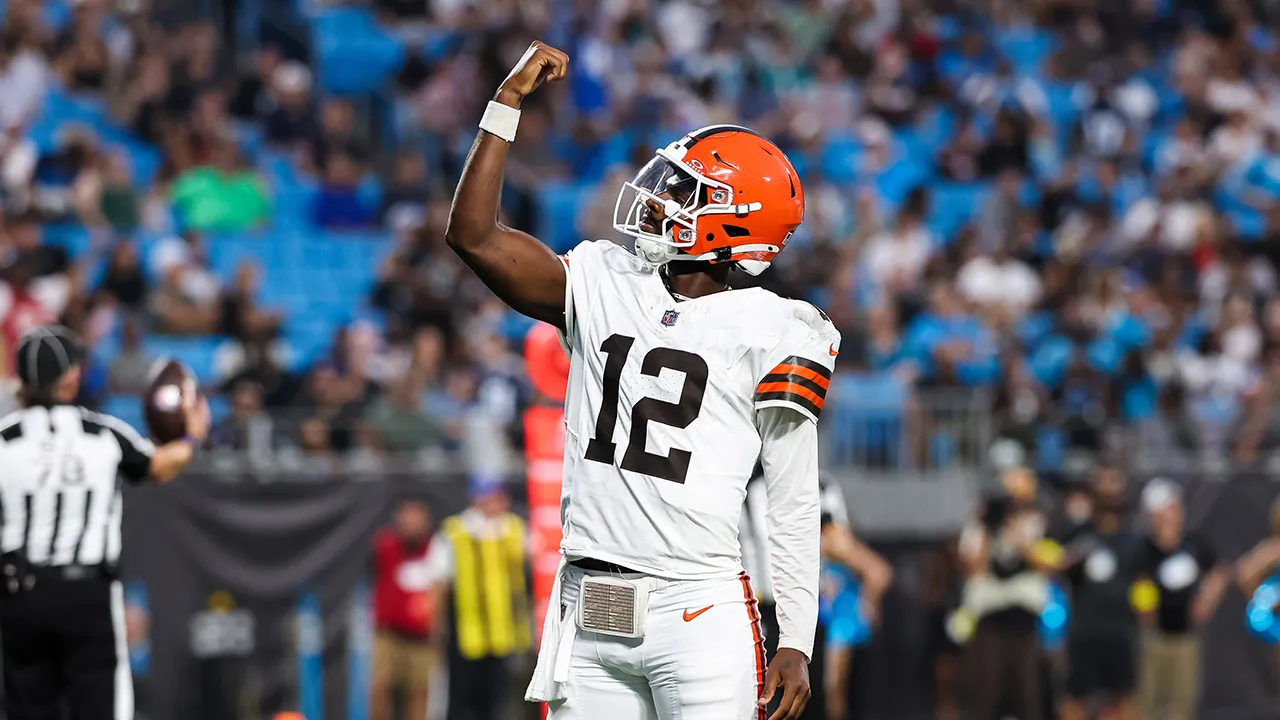
Shedeur Sanders entered the April 2025 NFL Draft surrounded by an almost mythical aura of promise, charisma, and sky-high expectations. For months, scouts, analysts, and fans debated where the star quarterback would land, with many predicting a guaranteed first-round selection and the corresponding massive rookie contract. Instead, draft weekend delivered a sobering reality check. Sanders experienced a dramatic and highly publicized slide down the draft boards, watching helplessly as other quarterbacks—including fellow Heisman Trophy finalist Dillon Gabriel, who was selected by the Cleveland Browns in the third round—were taken ahead of him. It was not until Day 3 that the phone finally rang, with the Browns calling his name to secure him with a modest four-year, $4.647 million contract. Yet, while his draft stock plummeted and his initial on-field salary was capped at just over $1.1 million per year, Sanders instantly proved that his commercial appeal was entirely independent of his draft position. In an unprecedented financial twist, the rookie quarterback ended up cashing in on a scale never before seen in league history. Through the NFL Players Association’s group licensing agreements, Sanders generated a staggering $17.7 million during the 2025 season alone. This astronomical sum, fueled by fanatical merchandise demand, completely shattered the previous licensing record of $9.5 million held by seven-time Super Bowl champion Tom Brady, proving that while NFL front offices may have doubted Sanders, the public was fully invested in his brand.
To understand how a Day 3 draft pick could out-earn the arguably greatest quarterback of all time in merchandise sales, one must look at the unique cultural phenomenon that surrounds Shedeur Sanders. His financial windfall was not a product of corporate charity but a direct reflection of an incredibly loyal and passionate fanbase that flooded retail markets to buy his jersey, collect his trading cards, and snap up any memorabilia bearing his name. The transition from college star to professional athlete often cools a player’s marketability if they are not an immediate starter, but Sanders bypassed this traditional trajectory entirely. When combined with his personal corporate endorsements, his off-field earnings for his rookie campaign easily soared past the $20 million mark, making him one of the highest-paid rookies in sports history before he even took a meaningful snap under center. This commercial juggernaut highlighted a shifting paradigm in the modern sports landscape, where personal brand power and digital connectivity can completely eclipse traditional draft-slot valuations. For the Browns, a franchise historically plagued by quarterback instability and searching for a spark, Sanders’ arrival brought an immediate jolt of energy and economic vitality, turning Cleveland into an unexpected epicenter of national sporting merchandise sales.
However, the glitz and glamour of multi-million-dollar endorsement deals and record-breaking jersey sales did little to ease the cold, hard realities of the NFL gridiron. When Sanders arrived in Cleveland, he found himself entering a complex and high-pressure quarterback room that was not ready to hand him the keys to the kingdom just yet. Head coach Kevin Stefanski initially chose to rely on the seasoned composure of veteran signal-caller Joe Flacco to guide the team at the start of the 2025 season, leaving Sanders to watch, learn, and adjust from the sidelines. For a player accustomed to the spotlight and the absolute authority he wielded during his college career under his father, Deion Sanders, this period of waiting was a true test of mental fortitude. The media scrutinized his every move on the sidelines, questioning whether he possessed the actual work ethic and adaptability required to succeed at the game’s highest level, or if he was simply a creation of hype and family pedigree. Sanders quietly embraced the backup role, using the time to absorb the playbook, adjust to the blinding speed of NFL defenses, and build chemistry with his new teammates, proving to coaches and skeptics alike that he was willing to earn his place rather than rely on his famous name.
That opportunity finally arrived in Week 12, when the Browns, eliminated from logical playoff contention and eager to evaluate their future, handed Sanders his first professional start on the road against the Las Vegas Raiders. Stepping onto the field under immense pressure, Sanders validated the coaching staff’s decision by guiding Cleveland to a gritty 24-10 victory, completing 11 of 20 passes for 209 yards, one touchdown, and one interception. Following the successful debut, Coach Stefanski officially named the rookie the starter for the remainder of the season, kickstarting a developmental trial by fire that would define the final months of the Browns’ campaign. Over his seven starts, Sanders experienced the volatile highs and lows typical of a rookie quarterback playing behind a struggling offensive line, finishing the year with 1,400 passing yards, seven touchdowns, and ten interceptions while compiling a 3-4 starting record. While the statistics were far from flawless, they showcased a young quarterback possessing undeniable raw talent, remarkable pocket presence, and a resilient willingness to stand in the pocket and deliver throws under heavy duress.
As the dust settled on his rookie campaign, Sanders quickly learned that survival in the NFL requires constant adaptation, as the offseason brought sweeping changes to Cleveland’s organization. General Manager Andrew Berry notably refused to commit to Sanders as the definitive starting quarterback for the 2026 season, keeping the franchise’s options open as they navigated a transition period. Central to this uncertainty is the return of veteran quarterback Deshaun Watson, who is finally healthy and eager to reclaim the starting job he was originally signed to secure. Furthermore, the Browns overhauled their coaching staff, parting ways with Stefanski and bringing in former Baltimore Ravens offensive coordinator Todd Monken as the new head coach to revitalize the stagnant offense. At voluntary spring practices, Monken initiated a true quarterback competition, dividing first-team repetitions between the seasoned Watson and the developing Sanders. This fluid situation has created a fascinating dynamic in Cleveland, where the coaching staff must balance Watson’s massive financial contract and veteran experience against Sanders’ undeniable progress, raw potential, and incomparable commercial appeal.
Ultimately, the upcoming season represents a critical crossroads for Shedeur Sanders as he attempts to translate his historic off-field popularity into sustained on-field success. The narrative of his career has always been defined by proof; he has constantly had to prove that his success was earned rather than inherited, and that his talent is worthy of the massive platform he commands. Under Todd Monken’s new offensive scheme, Sanders will have to master a complex playbook, improve his decision-making to limit turnovers, and outperform a highly motivated Deshaun Watson in the heat of training camp. The safety net of merchandising success and financial comfort will do little to help him when the pass rush closes in, meaning the young quarterback must elevate his game to a championship caliber to secure his long-term future in Cleveland. Yet, if his journey thus far is any indication, Sanders possesses the unique blend of self-belief, resilience, and adaptability required to thrive under intense pressure, preparing him to turn this latest competitive hurdle into the defining chapter of his NFL career.