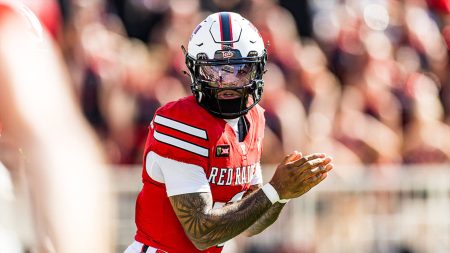


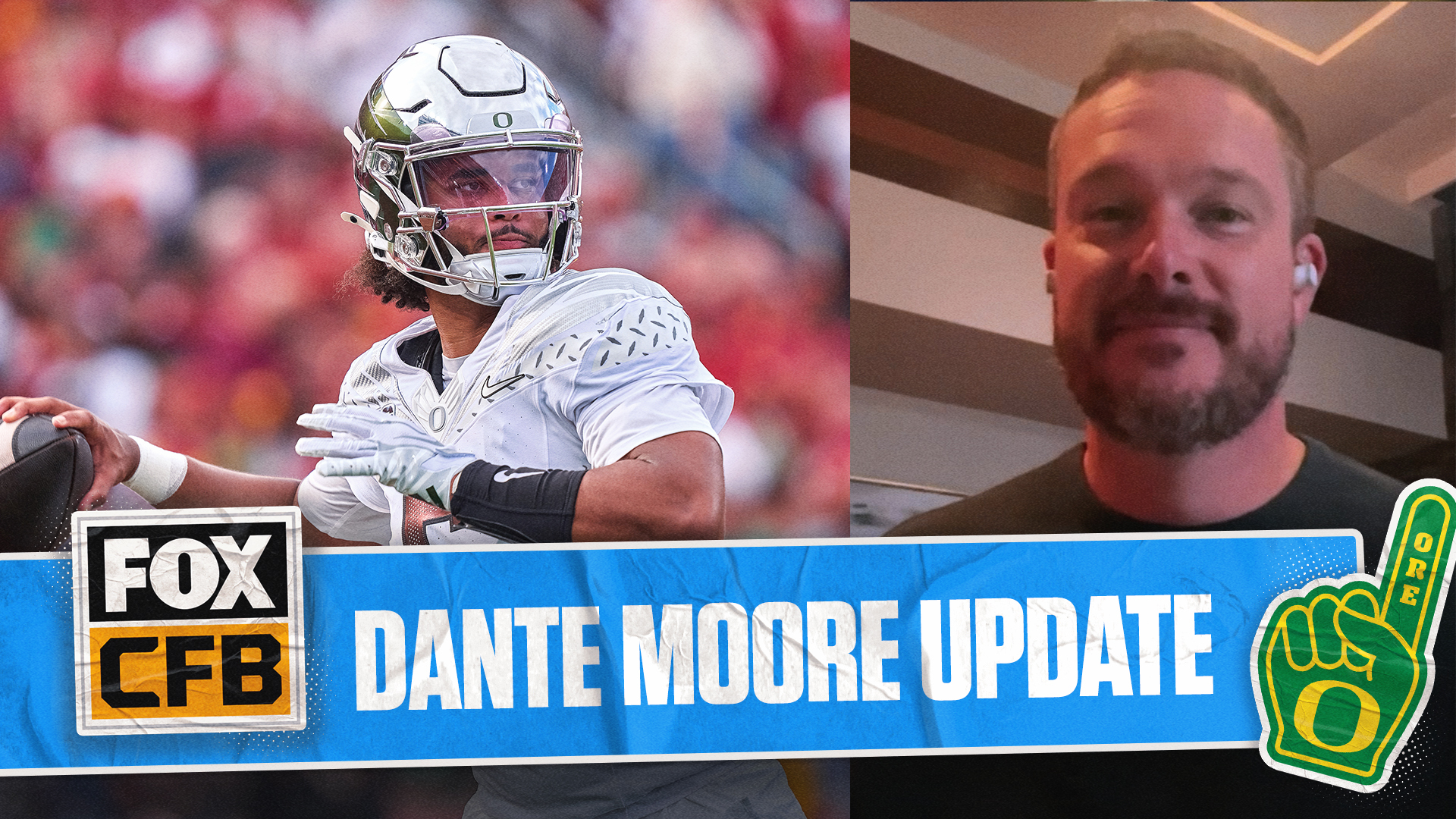
In the high-stakes, emotionally charged world of college football, few moments are as sobering as watching a star quarterback go down. That was the scene at Autzen Stadium last Saturday when Oregon’s Dante Moore took a violent hit to the head while attempting to slide during the Ducks’ 41–27 victory over USC. The stadium fell momentarily silent, players from both sides tensed, and Oregon head coach Dan Lanning stormed across the field, visibly livid. In the days since, the collective question has been about Moore’s health. On Saturday, Lanning offered a cautiously hopeful update on “Big Noon Kickoff,” telling viewers that Moore is recovering and trending in the right direction. The coach’s voice carried both gratitude and restraint as he talked about his senior quarterback, someone who has become the heart of Oregon’s offense. “It’s looking like he’s going to be OK,” Lanning said, adding, “I’m grateful that God has his hand over him and in recovery mode right now. We’ll just continue to proceed with an abundance of caution to make sure that he’s ready to go whenever he’s able to step back out there for us.” Those words were more than just medical jargon — they were the careful, hopeful words of a coach who cares deeply about his player as a person beyond the jersey and the stat sheet.
To fully understand the weight of that moment, one has to rewind to the second quarter, with 10:05 remaining, when Moore, trying to evade pressure and gain yardage, decided to slide. It was the kind of calculated decision quarterbacks make a thousand times in practice, a routine act meant to avoid contact and protect the football. But the slide wasn’t enough. Desman Stephens II, a USC linebacker, delivered a punishing helmet-to-head blow that sent Moore to the turf and immediately triggered a sideline eruption. Lanning, known for his intensity but usually composed on the sideline, was incandescent. Players from both teams had to be physically separated as the officials reviewed the play. The aftermath was swift: Stephens was suspended by USC for the Trojans’ Week 5 home game against Washington, a consequence that did little to quell the sense of injustice felt by the Oregon sideline. For Moore, lying on the grass with the air thick and quiet, the game stopped being about rankings or rivalries. It became about the fragility of a young man’s future, the terrifying reality that one hit can change everything. In college football, players have brothers beside them, but on a field where speed and violence meet, the most important family is the one that comes to the sideline and wraps an arm around their wounded teammate, whispering that he’s going to be all right.
When Moore was unable to continue, Oregon turned to Dylan Raiola, a name Nebraska fans will recognize well. Raiola, who started at quarterback for Nebraska from 2024 to 2025, transferred to Oregon and found himself in the backup role, patiently waiting for a moment exactly like this. His performance was not just good; it was sensational. In the game against USC, Raiola completed 19 of 25 passes for 289 yards and two touchdowns, with no interceptions, posting a staggering 199.5 passer rating. It was a display of poise and precision that kept the Ducks rolling and eased the tension in the stadium. The week before, against Portland State, he had been perfect — completing all 11 of his passes for 124 yards and three touchdowns. But what impressed Lanning most wasn’t just the stat line; it was the readiness, the maturity, the quiet professionalism of a young man who never let his backup role become an excuse to coast. Lanning spoke about it with genuine pride, saying, “I’m just so proud of him. You talk about owning a role and not waiting for your opportunity but preparing for your opportunity, and Dylan’s a guy that prepared for his opportunity.” In an era of transfer portals and entitlement, Raiola’s attitude is a refreshing reminder that sometimes playing time is earned not by complaining, but by being ready when the door swings open.
Oregon’s season has been anything but smooth, even before this latest injury scare. The Ducks opened the year as the No. 2 team in the country, a ranking that came with glowing expectations and a bullseye on their backs. A narrow, squeaked-out home win over Boise State caused them to fall to No. 6, and then a stunning upset loss at Oklahoma State sent them spiraling all the way to No. 21. For a program with national championship ambitions, that fall was jarring. But football is often about response, not just talent. After the Oklahoma State disappointment, the Ducks regrouped, and the win over USC — gritty, physical, and punctuated by adversity — felt like a turning point. They improved to 3-1, and in the latest AP Top 25 Poll, they climbed to No. 15. That ranking might not satisfy fans who dreamed of a top-five run, but it’s a sign that this team is learning to handle pressure, to win ugly, and to find heroes in unexpected places. The season, like Moore’s recovery, is a work in progress, and the Ducks’ true character will be defined in the weeks ahead.
With a bye in Week 5, Oregon now has a precious opportunity to breathe, heal, and prepare. The next challenge is a ranked matchup at home against No. 23 UCLA on Oct. 10, a Pac-12 rivalry game that suddenly carries major weight for both programs. The bye week couldn’t come at a better time, especially for Moore, who will have extra days to clear the fog, undergo medical evaluations, and rest his body and mind. Football’s concussion protocols exist for a reason, and Lanning’s commitment to an “abundance of caution” suggests that the team will not rush Moore back for the sake of a win. His health, as Lanning emphasized, is the priority. The Ducks have a capable arm in Raiola, and the coaching staff has shown they won’t hesitate to trust him. But Moore is not just another player — he’s the leader of this offense, a senior who has weathered the highs and lows of a demanding season. His return, whenever it comes, will be a moment of celebration, but it must be a careful return, guided by doctors and patience, not by the roar of the crowd.
Beyond the tactics, the rankings, and the schedule, this story is deeply human. It’s about a young man who woke up one morning in a hospital or a quiet training room, remembering a hit but perhaps not the final score. It’s about a coach who, for all his fiery competitiveness, understands that football is ultimately a game played by human beings with families, dreams, and futures. It’s about a backup quarterback who stepped into the bright lights and steady hands, proving that preparation is its own form of faith. And it’s about a team rallying around an injured brother, putting aside rivalries and histrionics, at least for a moment, to remember what matters. Lanning’s words — “I’m grateful that God has his hand over him” — reflect a perspective that can feel rare in the ruthless spotlight of college athletics. In a sport defined by violence, it’s the vulnerability of the players that often gets forgotten. As Oregon enjoys its bye week and prepares for UCLA, one hope binds everyone together: that Dante Moore walks off the field someday soon, not just a quarterback returning to his team, but a young man returning to his life. In the end, that’s the only score that truly counts.