



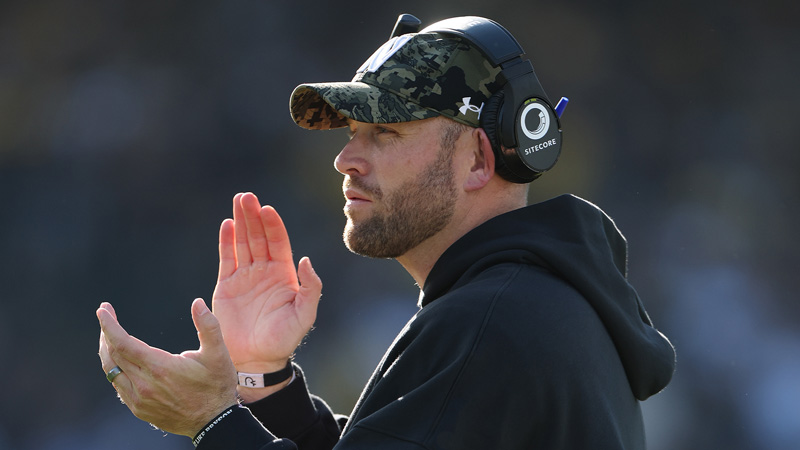
It was the kind of announcement that, a few years ago, would have felt almost impossible to imagine. Northwestern University took to the airwaves on Thursday morning to deliver news that carries both practical weight and emotional resonance for anyone who has followed the program through its recent storms: head coach David Braun has been extended through the 2031 college football season. For a fan base that has weathered scandal, instability, and the uneasy feeling of watching a proud institution lose its footing, the move is more than a contractual formality. It is a declaration that the Wildcats have found a steady hand, a man who took over in the most difficult of circumstances and somehow turned chaos into calm, losing into learning, and skepticism into belief. Mark Jackson, Northwestern’s Combe Family Vice President for Athletics and Recreation, made the university’s sentiment unmistakably clear in a statement accompanying the announcement. “David Braun is the right leader today for Northwestern Football and for the years to come,” Jackson said, and then he went further, describing Braun in terms that cut through the usual athletic-department platitudes: he recruits young men of high character who embrace an elite academic environment, he develops student-athletes in an era when talent retention is brutally difficult, and he does so with “a rare combination of relentless competitiveness and integrity.” Jackson did not stop there. He called Braun “everything that we need in a head coach,” and pointed to the opening of the new Ryan Field in just a few weeks as evidence that the future is bright with Braun at the helm. “We look forward to having David, Kristin and their family in Evanston for the seasons ahead,” Jackson added, a personal note that underscored just how much this extension is about family as much as football.
To fully appreciate what this moment means, you have to rewind to the summer of 2023, when Braun arrived at Northwestern not as a savior but as a defensive coordinator. He had been hired for that role in the ordinary course of a coaching staff rebuild, and nobody could have predicted the chain of events that would soon thrust him into the national spotlight. In July of that year, the university dismissed head coach Pat Fitzgerald in the wake of a hazing investigation that rattled the program to its core, leaving Northwestern in a state of public embarrassment and internal turmoil. The Wildcats had gone just 1-11 the previous season, a record that was already a source of deep disappointment, and now they faced the added weight of a scandal that invited harsh scrutiny from every corner of the sports world. Braun, the relatively new defensive coordinator, was named interim head coach, a title that sounded provisional but demanded something far more substantial from him than simply holding the fort. He had to be a counselor, a disciplinary presence, a unifier, and a coach all at once. What happened next was remarkable. Rather than folding under the pressure, Braun coaxed an inexplicably resilient season out of a group that might reasonably have crumbled. The Wildcats finished 8-5 overall and 5-4 in Big Ten play, a turnaround so stark and so emotionally stirring that Braun was named the 2023 Big Ten Coach of the Year. Along the way, Northwestern snapped a miserable 14-game road losing streak, a feat that felt like shedding a decade of accumulated doubts. The season ended with a Las Vegas Bowl victory over Utah, a triumphant conclusion that felt almost cinematic given where the program had stood just months earlier. Braun’s brilliant debut did not go unnoticed, and during that same season, the university removed the interim tag, making him the permanent head coach and signaling that Northwestern was willing to trust an outsider who had become an insider through sheer force of will.
Since taking over in that fateful 2023 season, Braun has compiled a record of 20-19 overall and 11-16 in Big Ten play, with two bowl appearances to his name in 2023 and 2025. Those numbers, at first glance, may not leap off the page the way an undefeated season or a national championship run might, but they have to be understood in context. This is a program that went 1-11 just before Braun arrived, and it is a program that operates within the hyper-competitive atmosphere of the Big Ten, where every Saturday brings a battle against schools with greater historical resources, larger stadiums, and decades of established recruiting pipelines. Braun has managed to keep Northwestern competitive while also navigating the realities of modern college football, where the transfer portal and Name, Image, and Likeness deals have reshaped rosters overnight and made loyalty feel like a luxury item. Jackson’s praise for Braun’s ability to retain talent is not incidental; it is central. In an era when players are constantly looking for greener pastures, the fact that young men are choosing to remain Wildcats, even when other options appear, speaks volumes about the environment Braun has created. He has built a culture that values academics as much as athletics, no small thing at a university where the academic bar is genuinely elite. That combination of competitiveness and integrity, the phrase Jackson used, is not just a nice slogan. It is the foundation of everything Braun has done in Evanston. He has made Northwestern a place where players can be ambitious without being consumed by the darker sides of the sport, where character is not negotiable, and where the idea of family extends beyond the stadium walls to include spouses, children, and the community that surrounds the university.
Braun himself, in the statement released with the extension, offered a message that managed to be both gracious and forward-looking. “I am so honored to have the opportunity to lead a storied football program at an institution that demands and expects excellence, instills character, and provides a transformative experience for its student-athletes on and off the field,” he said, before thanking President Chiang and Mark Jackson for their continued investment and support. He spoke of sharing in the belief in what Northwestern Football can become, a phrase that captures the aspirational nature of this partnership. And then he added something that felt deeply personal: “Northwestern is a special place. Kristin and I are proud to call it home for many years to come.” That last line, with its mention of his wife, is a reminder that coaching decisions are never just professional calculations. They are also decisions about where to raise a family, where to put down roots, and where to invest one’s heart. For Braun, the choice to commit to Northwestern through 2031 is not merely a career move. It is an embrace of a particular kind of institution, one that demands excellence in the classroom as well as on the field, and one that offers a transformative experience for young people who will go on to do far more than play football. Braun’s journey to this point has been shaped by a series of coaching positions that prepared him well for this challenge. Before arriving in Evanston in 2023, he served as the defensive coordinator and safeties coach for the North Dakota State Bison from 2019 to 2022, a program known for winning championships at the FCS level and producing coaches with a certain no-nonsense toughness. Prior to that, he spent two years as a defensive assistant with the Northern Iowa Panthers from 2017 to 2018, and he held other coaching positions that gave him a broad understanding of the game at multiple levels. That pedigree is visible in the way his teams play: disciplined, prepared, and resilient.
As for the present, the 2026 season has already offered a taste of what the Braun era extends to mean. Northwestern opened the season on September 5 with a convincing 34-18 home win over the South Dakota State Jackrabbits, a result that immediately signaled that this team was not content to rest on past accomplishments. Next up is a Saturday night home matchup against the Colorado Buffaloes, who come into the game with a 2-0 record and a considerable amount of national attention of their own. That game is scheduled for 7:30 p.m. ET and will be broadcast on FOX, giving Braun’s Wildcats a prime-time stage to prove that their progress under his leadership is sustainable. The excitement around this game is only heightened by the looming opening of the new Ryan Field, a state-of-the-art facility that represents the university’s commitment to elevating the football program to match the ambitions of its head coach. The combination of a new stadium, a steady coach, and a roster of players who have chosen to stay and build something together creates an atmosphere of genuine possibility. There is a sense, perhaps for the first time since the scandal, that Northwestern Football is not just surviving but thriving. Braun’s extension through 2031 aligns his future with that optimism, ensuring that the face of the program will remain a constant while everything around it evolves Ki. In a college football landscape that has become increasingly unstable, where coaches are fired after two seasons and players transfer at the first sign of adversity, this commitment to continuity is refreshing. It suggests that Northwestern is willing to invest not just in winning games, but in building a program that honors the institution’s values.
Ultimately, this extension is about more than wins and losses, though those matter. It is about what the program stands for and who is entrusted to carry that forward. David Braun arrived as a relatively anonymous defensive coordinator and was thrust into a role that would have broken lesser men. He responded with grace, grit, and an unwavering belief in the young people under his charge. He took a team that had known only defeat and scandal and turned it into a group that believes in itself again. He has done so while maintaining an academic standard that most coaches would find burdensome, while navigating the turbulent waters of modern college athletics, and while raising a family in a community that has embraced him and Kristin as its own. The extension through 2031 is Northwestern’s way of saying thank you and please stay. It is a commitment that says the university sees in Braun what his players have seen all along: a coach who cares deeply, who competes fiercely, and who leads with an integrity that is increasingly rare. The new Ryan Field will open its gates in a few weeks, and the Colorado game on Saturday night will provide another opportunity for the Wildcats to show the country what they are becoming. But no matter the score, the most important victory may have already been secured on Thursday morning, when Northwestern chose its leader and its leader chose to stay. In a sport defined by motion and contingency, that kind of mutual devotion is something to cherish. The story of David Braun is not yet a story of championships won, but it is a story of hope restored. And sometimes, in the long arc of a program’s journey, that is worth even more than a trophy.